
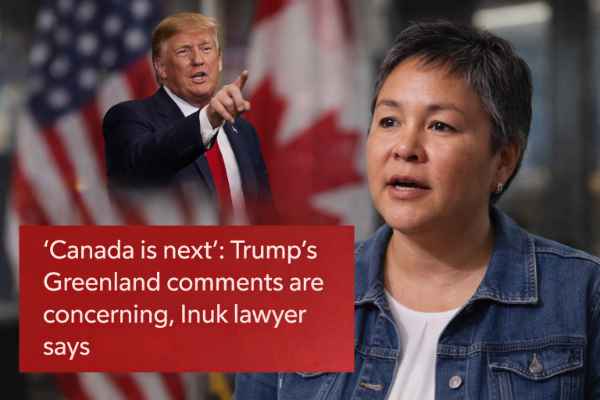
Comments by former U.S. President Donald Trump about Greenland have triggered unease north of the border, with an Inuk lawyer warning that Canada could be the next target of such rhetoric. The remarks have reignited concerns about sovereignty, Indigenous rights, and the casual framing of Arctic territories as strategic assets rather than homelands.
Trump’s renewed comments referencing U.S. interest in Greenland — a territory of Denmark with a predominantly Inuit population — were described by critics as dismissive of international law and Indigenous self-determination. While the idea of acquiring Greenland was first floated during Trump’s presidency and widely rejected at the time, its re-emergence has struck a nerve among Arctic communities and policy experts.
An Inuk lawyer speaking on the issue said the language used around Greenland reflects a troubling mindset that could extend to Canada’s Arctic, where Inuit communities have long fought to assert sovereignty through treaties, land claims, and self-governance. “When powerful leaders talk about territories as if they are commodities, it sends a dangerous message,” the lawyer said, adding that such rhetoric ignores the people who live there and their inherent rights.
Canada’s North holds growing strategic importance due to climate change, melting sea ice, and expanding shipping routes, making it increasingly central to global security and economic calculations. Experts warn that this has led to renewed geopolitical interest from major powers, raising fears that Indigenous voices could be sidelined in high-level strategic discussions.
Ottawa has not directly responded to Trump’s latest remarks, but Canadian officials have repeatedly emphasized that Arctic sovereignty is non-negotiable and rooted in international law, treaties, and Indigenous partnership. Legal scholars note that Canada’s claims are strengthened by the active presence and governance of Inuit communities across the North.
Indigenous leaders argue that the episode underscores the need for Canada to more clearly center Inuit leadership in Arctic policy and foreign affairs. “The best defence of sovereignty is respecting the people who have always been here,” the lawyer said.
The comments have also prompted debate among diplomats and analysts, who say even rhetorical suggestions of territorial acquisition can strain alliances and destabilize norms. For many in Canada’s North, the concern is not just about Greenland — but about ensuring that the Arctic is never treated as an empty space open to negotiation.
As geopolitical competition intensifies in the polar regions, Indigenous leaders are calling for vigilance, clarity, and a firm rejection of any narratives that undermine sovereignty or self-determination.