
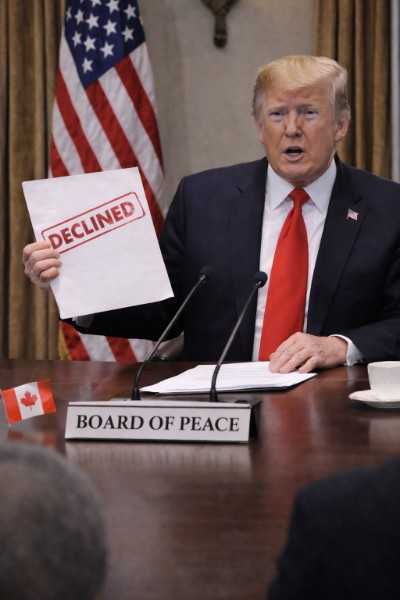
U.S. President Donald Trump has revoked Canada’s invitation to join his proposed “Board of Peace,” marking a sharp turn in relations between Washington and Ottawa and signaling growing friction over foreign policy and geopolitical alignment.
The decision comes after Canada raised concerns about the structure, membership, and political implications of the board, which Trump has promoted as a high-level forum to shape peace initiatives in global conflicts, including Gaza and Ukraine. Sources say Ottawa had sought clarity on the board’s mandate and how it would align with international law and multilateral frameworks.
Trump’s move is being seen as a public snub to Canada, particularly at a time when the two countries are already navigating tensions over trade, tariffs, Arctic policy, and foreign engagement with China and the Middle East. In a statement, Trump suggested that participation would be limited to countries fully aligned with U.S. strategic priorities, without directly naming Canada’s objections.
Canadian officials have not issued a detailed response but emphasized that Canada remains committed to multilateral diplomacy and established international institutions rather than ad hoc political platforms. Analysts say the revocation underscores a shift toward a more transactional U.S. foreign policy approach that rewards alignment and punishes dissent.
Experts warn the move could further strain bilateral cooperation on global security, peacekeeping, and diplomatic initiatives, areas where Canada and the U.S. have traditionally worked closely. Some observers also see the episode as symbolic of broader uncertainty in U.S.–Canada relations under Trump’s leadership.
While the practical impact of exclusion from the board remains unclear, the diplomatic optics are significant, reinforcing perceptions of widening gaps between the two allies on global peace and security frameworks.