

Opening Summary
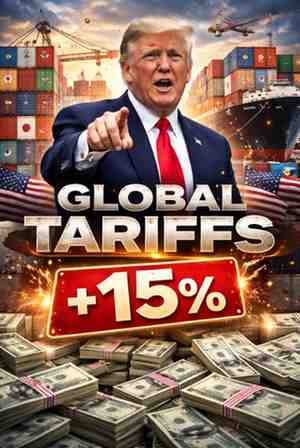
Former U.S. President Donald Trump announced a new 15% global tariff on imports just one day after the U.S. Supreme Court struck down his previous sweeping tariff regime. The announcement was made in the United States and has immediate implications for global trade, financial markets, and key trading partners including Canada. The move matters internationally as it raises fresh questions about executive authority, trade stability, and economic uncertainty.
Background and Context
During his presidency, Trump relied heavily on tariffs as a central tool of economic and foreign policy. His administration imposed duties on a wide range of imports, arguing they were necessary to protect U.S. industries and address trade imbalances.
Those measures sparked trade disputes with allies and rivals alike, including Canada, China, and the European Union. Canada was particularly affected in sectors such as steel, aluminum, and manufacturing, leading to retaliatory tariffs and prolonged negotiations.
The Supreme Court’s recent ruling limited the scope of presidential authority to impose broad global tariffs without explicit congressional approval. The decision was widely viewed as a setback for unilateral trade actions and a reaffirmation of Congress’s constitutional role in trade policy.
Against that backdrop, Trump’s announcement of a new 15% tariff has drawn attention for both its timing and its scale.https://newsbee.ca/2026/02/10/trumps-immigration-chiefs-to-testify-in-congress-following-protester-deaths/
Latest Developments
Trump said the new 15% tariff would apply broadly to imported goods, framing the move as necessary to protect American workers and industries. He did not provide detailed explanations on the legal mechanism that would be used to implement the tariffs following the Supreme Court ruling.
The announcement came just one day after the court invalidated the earlier tariff framework, raising questions about how the new measures would comply with the ruling. Trump did not address whether congressional approval would be sought or whether alternative legal authorities would be used.
U.S. trade officials have not released formal documentation outlining which products or countries would be affected, nor have they clarified when the tariffs would take effect.
Markets reacted cautiously, with analysts warning that renewed tariff threats could disrupt supply chains and increase costs for consumers and businesses.
Why This Matters
The decision to raise global tariffs so soon after a Supreme Court ruling has significant implications for trade certainty. Businesses rely on predictable rules to plan investment, pricing, and supply chains, and sudden policy shifts can create volatility.
For Canada, the announcement is particularly important due to the deeply integrated nature of the Canada–U.S. economy. Tariffs on manufactured goods or raw materials can quickly affect Canadian exporters, employment, and cross-border production.
The move also raises constitutional and legal questions within the United States. If the new tariffs face legal challenges, it could lead to further court battles over the limits of executive power.
Internationally, the announcement risks reigniting trade tensions at a time when many economies are already facing inflationary pressures and slowing growth. Higher tariffs could contribute to higher consumer prices and retaliatory measures from trading partners.
Politically, the move reinforces Trump’s protectionist stance and signals that trade policy would remain a central feature of his economic agenda.
What Happens Next
U.S. agencies are expected to clarify how the new tariffs would be implemented and under what legal authority. Legal experts anticipate that the measures could be challenged if they are seen as conflicting with the Supreme Court’s ruling.
Trading partners, including Canada, are likely to assess potential impacts and consider responses if tariffs are applied to their exports. Diplomatic engagement and possible dispute settlement processes may follow.
Congress may also come under pressure to assert a stronger role in trade policy, particularly if tariff actions continue without legislative approval.
Markets and businesses will closely watch for further details, including timelines, exemptions, and enforcement mechanisms.
Conclusion
Trump’s announcement of a 15% global tariff one day after a Supreme Court ruling against his previous trade measures has injected fresh uncertainty into global trade. The move underscores ongoing tensions between executive action and judicial limits in U.S. trade policy.
For Canada and other trading partners, the development raises concerns about economic stability and the future direction of U.S. trade relations. Whether the tariffs take effect or face further legal hurdles will shape the next phase of global trade dynamics.