

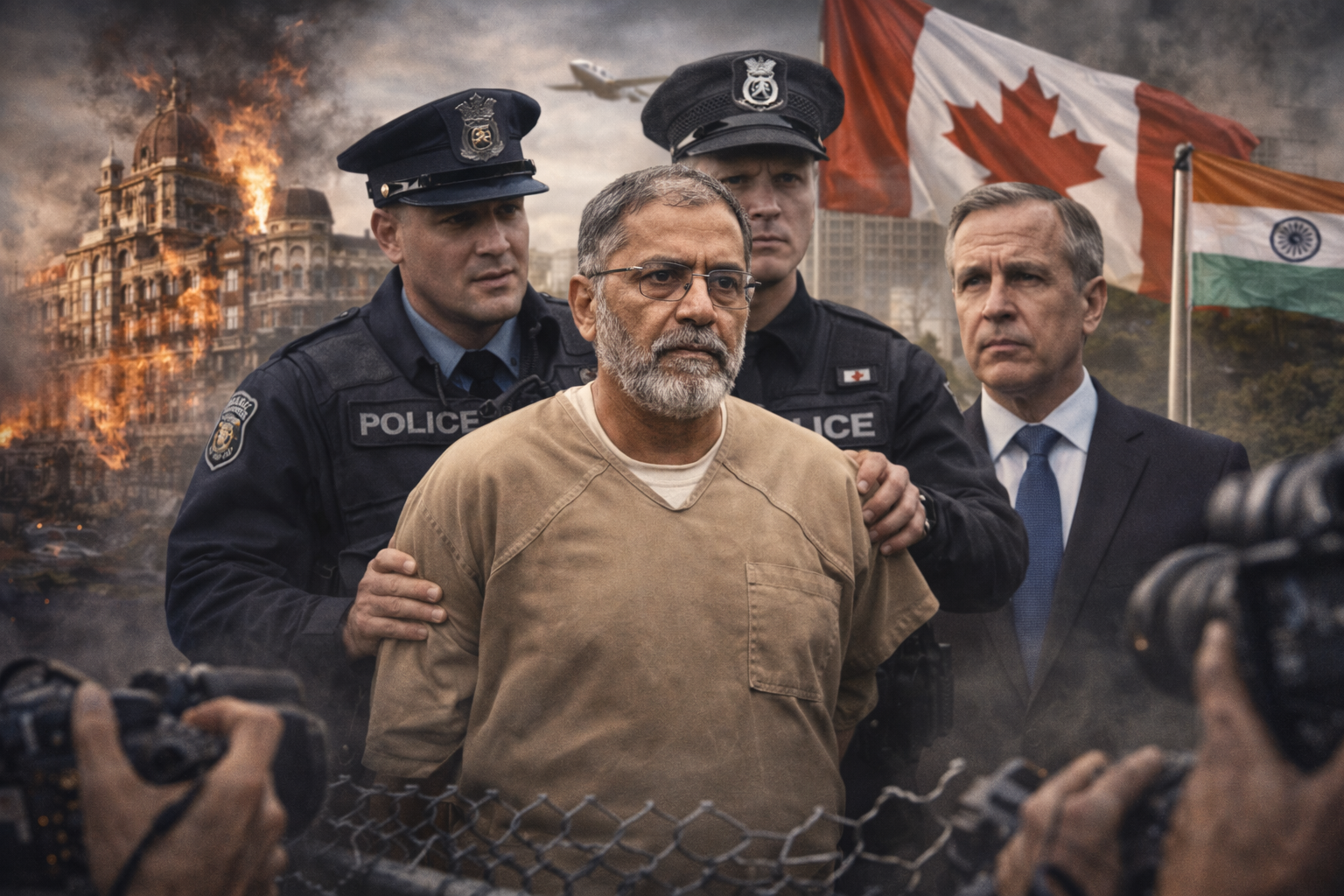
Opening Summary
Canada has moved to revoke the citizenship of Tahawwur Rana, a key accused in the 2008 Mumbai terror attacks, just days ahead of Prime Minister Mark Carney’s planned visit to India. The decision was taken in Canada and comes amid heightened diplomatic engagement between Ottawa and New Delhi. The development matters internationally as it touches on counterterrorism cooperation, extradition, and Canada–India relations.
Background and Context
Tahawwur Rana, a Canadian citizen of Pakistani origin, has long been accused by Indian authorities of playing a central role in the planning and facilitation of the November 26, 2008 Mumbai attacks, which killed 166 people and injured hundreds.
Rana was convicted in the United States for providing material support to the Pakistan-based militant group Lashkar-e-Taiba and for his role in a separate terror plot. India has repeatedly sought his extradition, describing him as one of the key conspirators behind the Mumbai attacks.
Canada’s Citizenship Act allows the government to revoke citizenship obtained through misrepresentation, fraud, or concealment of material facts. Revocation proceedings are considered a serious step and are typically linked to national security concerns.
The move comes at a sensitive diplomatic moment, as Canada seeks to stabilize and rebuild ties with India after a period of strained relations.
Latest Developments
Canadian authorities have initiated the process to revoke Rana’s citizenship, citing national security considerations and the seriousness of the terrorism allegations against him. Officials have not publicly detailed the legal grounds, but the process indicates that Ottawa believes the threshold for revocation has been met.
The timing of the decision has drawn attention, as it comes shortly before Prime Minister Mark Carney’s scheduled visit to India. The visit is expected to focus on resetting bilateral ties, economic cooperation, and security collaboration.
Indian officials have long argued that Rana should face trial in India for his alleged role in the Mumbai attacks. The citizenship revocation could remove a legal barrier that has complicated extradition efforts in the past.
Canadian government representatives have said the decision is based on domestic law and security assessments, not diplomatic pressure, though they acknowledged the broader international implications.
Why This Matters
The move has significant implications for Canada–India relations. Counterterrorism cooperation has been a sensitive and sometimes contentious issue between the two countries, particularly regarding individuals accused of extremist or terrorist activities.
For India, the revocation is likely to be seen as a positive signal of Canada’s willingness to address long-standing concerns related to the Mumbai attacks. It may help build trust ahead of high-level diplomatic engagements.
From Canada’s perspective, the decision underscores a tougher stance on national security and the use of citizenship revocation in exceptional cases involving terrorism.
The case also highlights the complex intersection of immigration law, citizenship rights, and international justice. Revoking citizenship does not automatically lead to extradition, but it can simplify legal pathways.
Internationally, the move reinforces the principle that citizenship does not shield individuals from accountability in cases involving serious crimes such as terrorism.
What Happens Next
Rana is expected to have the opportunity to challenge the citizenship revocation through legal channels in Canada. Such cases can take months or longer to resolve, depending on court proceedings.
If the revocation is finalized, Canadian authorities may consider next steps related to extradition requests or cooperation with foreign jurisdictions, including India and the United States.
Prime Minister Carney’s visit to India is expected to include discussions on security cooperation, and the Rana case may form part of broader talks behind closed doors.
Legal experts say the outcome will depend on judicial review and adherence to due process requirements under Canadian law.
Conclusion
Canada’s move to revoke the citizenship of Tahawwur Rana ahead of Prime Minister Mark Carney’s India visit marks a significant development in a case tied to one of the deadliest terror attacks in recent history. The decision signals a shift toward addressing long-standing security concerns with international partners.
As legal proceedings unfold, the case is likely to remain a focal point in Canada–India relations and a test of how national security, citizenship law, and international justice intersect.