

Opening Summary
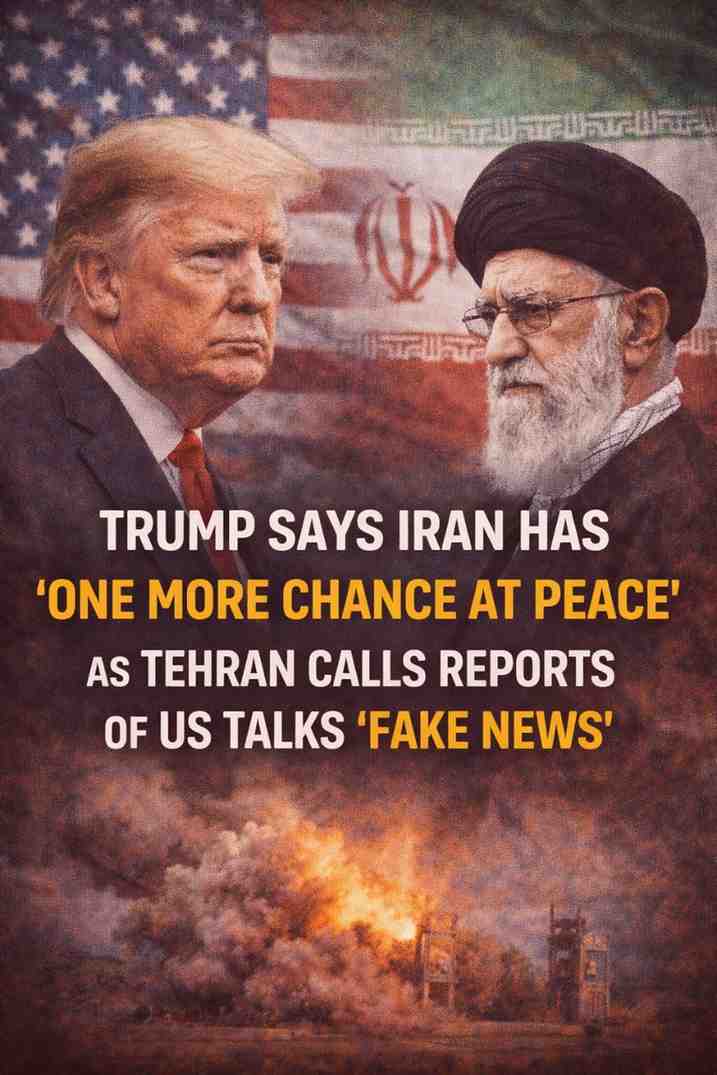
U.S. President Donald Trump said Iran has “one more chance at peace” as tensions continue in the ongoing war involving the United States, Israel, and Iran. However, Iranian officials rejected claims of any negotiations, calling reports of talks with Washington “fake news.” The conflicting statements highlight deep divisions and uncertainty around possible diplomatic efforts.
Background and Context
The conflict escalated after coordinated U.S. and Israeli strikes targeted Iranian military and nuclear-related facilities earlier in 2026. Iran responded with missile and drone attacks on U.S. bases, Israeli targets, and allied infrastructure across the Middle East.
Since then, tensions have remained high, with repeated military exchanges and growing concerns about wider regional escalation. The situation has also affected global oil markets and shipping routes, particularly around the Strait of Hormuz.
Diplomatic efforts have been discussed by multiple international actors, including regional mediators, but no formal agreement or ceasefire has been reached.
Latest Developments
President Donald Trump said Iran has “one more opportunity” to end its threats and move toward peace, warning that failure to do so could lead to further consequences.
At the same time, Trump suggested that discussions with Iran were ongoing and indicated there could still be a path toward a deal.
Iranian officials strongly denied these claims. Senior leaders said no direct or indirect negotiations with the United States are taking place and described reports of talks as “fake news.”
Iran also accused Washington of spreading misinformation and attempting to influence global markets and public perception through claims of diplomacy.
The contrasting statements from both sides have created uncertainty about whether any real diplomatic channel exists.
Why This Matters
The disagreement over whether talks are taking place highlights the difficulty of resolving the conflict through diplomacy.
If negotiations are not occurring, the likelihood of continued military escalation increases. Statements from both sides suggest that trust remains low and positions remain firm.
For the international community, the lack of clear communication raises concerns about miscalculation, especially in a conflict involving multiple countries and strategic infrastructure.
The situation also continues to affect global markets, particularly energy prices, as uncertainty around the conflict persists.
What Happens Next
Diplomatic efforts may continue through third-party mediators, even if direct talks between the United States and Iran are not currently taking place.
Military operations are expected to continue unless a ceasefire or agreement is reached.
International pressure for de-escalation is likely to grow as governments seek to prevent further expansion of the conflict.
Observers will be watching closely for any signs of confirmed negotiations or changes in tone from either side.
Conclusion
President Trump’s statement that Iran has “one more chance at peace” contrasts sharply with Tehran’s denial of any talks, underscoring the uncertainty surrounding diplomatic efforts.
As the conflict continues, the gap between public messaging and actual negotiations will play a key role in determining whether tensions escalate further or move toward resolution.