
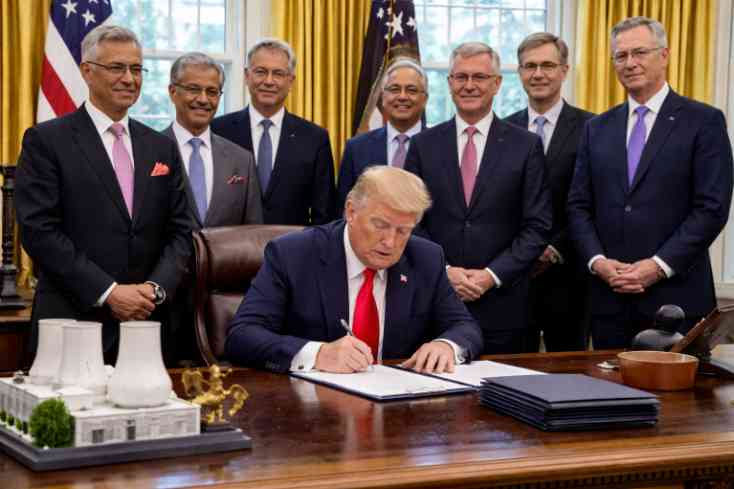
U.S. President Donald Trump has signed a new law aimed at strengthening America’s civil nuclear engagement abroad, while simultaneously signalling that India’s nuclear liability framework must be aligned with global norms for deeper cooperation to move forward. The development has brought renewed focus on a long-standing friction point in India–U.S. nuclear ties.
Speaking after signing the legislation, Trump underscored Washington’s interest in expanding nuclear energy partnerships as part of its broader energy and strategic agenda. However, he made it clear that liability protections for suppliers remain a key concern, particularly in countries where American firms are expected to invest heavily. India’s current liability law, which allows operators to seek recourse against suppliers in the event of an accident, has long been viewed by U.S. companies as a deterrent to large-scale participation.
The issue dates back to India’s Civil Liability for Nuclear Damage Act, passed in 2010 in the wake of the Bhopal gas tragedy, which shaped strong domestic sentiment in favour of accountability. While India maintains that its framework reflects public safety priorities and sovereign legislative choices, successive U.S. administrations have argued that it diverges from international conventions followed by most nuclear nations.
Officials in Washington say aligning India’s liability regime with global practices would unlock stalled projects, enable U.S. reactor manufacturers to re-enter the Indian market, and strengthen energy cooperation at a time when both countries are seeking alternatives to fossil fuels. The newly signed law, according to U.S. officials, is designed to give American firms greater confidence as they pursue overseas nuclear contracts.
In New Delhi, the development is being closely watched. Indian officials have previously indicated that any changes to the liability framework would require careful political consensus, given domestic sensitivities and legal complexities. India has instead pointed to insurance pools and administrative measures introduced to address supplier concerns without amending the law itself.
Analysts say Trump’s remarks reflect a broader push to translate strategic alignment between India and the U.S. into tangible commercial outcomes. Whether this renewed pressure leads to movement on the liability issue remains uncertain, but it has once again placed nuclear cooperation at the centre of bilateral economic and strategic discussions.
As talks continue, both sides are expected to balance commercial interests, public accountability, and long-term energy goals, with the nuclear liability question likely to remain a decisive test of how far the partnership can evolve.