

Opening Summary
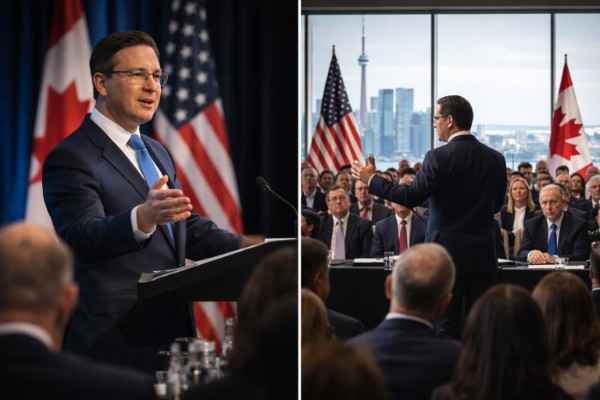
Canada’s Conservative leader delivered a speech in Toronto, Ontario, outlining a renewed vision for Canada–U.S. relations amid shifting trade, security, and economic dynamics. The address focused on strengthening economic ties, protecting Canadian interests, and ensuring stability in cross-border cooperation. The speech matters nationally as Canada recalibrates its approach to its most important trading partner.
Background and Context
The Canada–United States relationship is central to Canada’s economy and foreign policy. The two countries share the world’s longest undefended border and maintain deeply integrated supply chains across sectors including automotive manufacturing, energy, agriculture, and technology.
Trade between the two countries is governed primarily by the Canada–United States–Mexico Agreement (CUSMA). While the agreement has provided a framework for stability, disputes over tariffs, industrial policy, and procurement rules have periodically strained ties.
In recent years, U.S. trade policies, including tariffs and Buy American provisions, have affected Canadian exporters. At the same time, security cooperation through NATO and NORAD has remained a cornerstone of bilateral defence.
Canadian political leaders often use major speeches to signal how they would manage this critical relationship, particularly when economic uncertainty or political changes in Washington create unpredictability.
Latest Developments
Speaking in Toronto, the Conservative leader set out what was described as a pragmatic and assertive approach to Canada–U.S. relations. The speech emphasized economic competitiveness, cross-border infrastructure, and reducing barriers to trade.
The leader said Canada must be proactive in defending its industries while maintaining strong diplomatic channels with Washington. He also stressed the importance of energy exports, critical minerals, and supply chain resilience as pillars of the bilateral partnership.
Security cooperation was highlighted as another priority, with references to continental defence modernization and collaboration on emerging threats.
While the speech did not include specific policy proposals or timelines, it framed Canada–U.S. engagement as central to economic growth and national security.
Political opponents have yet to respond in detail, though Canada–U.S. relations remain a key topic in federal political debate.
Why This Matters
The Canada–U.S. relationship affects millions of jobs and a significant share of Canada’s exports. Any shift in approach can influence market confidence, investor decisions, and cross-border mobility.
With ongoing global trade tensions and evolving U.S. domestic politics, Canadian leaders face the challenge of balancing cooperation with the protection of domestic industries.
Energy and critical minerals have become increasingly strategic in North American policy discussions. Canada’s ability to position itself as a reliable partner may shape future trade and security arrangements.
The speech also signals how the Conservative Party intends to differentiate its foreign and economic policy approach from the current government, particularly in dealing with Washington.
What Happens Next
The Conservative leader is expected to continue outlining foreign and economic policy positions ahead of future federal political milestones.
Canadian officials, regardless of party affiliation, are likely to maintain active engagement with U.S. counterparts as trade reviews and policy updates proceed under CUSMA.
Observers will watch whether the speech leads to more detailed proposals or legislative initiatives focused on trade competitiveness and security coordination.
Future Canada–U.S. meetings at the ministerial or leader level may reflect themes raised in the Toronto address.
Conclusion
The Conservative leader’s Toronto speech placed Canada–U.S. relations at the centre of economic and security strategy. By emphasizing competitiveness, energy cooperation, and defence alignment, the address highlighted the enduring importance of the bilateral partnership.
As political debate continues, Canada’s approach to Washington will remain a defining issue shaping trade, security, and economic outcomes.