

Opening Summary
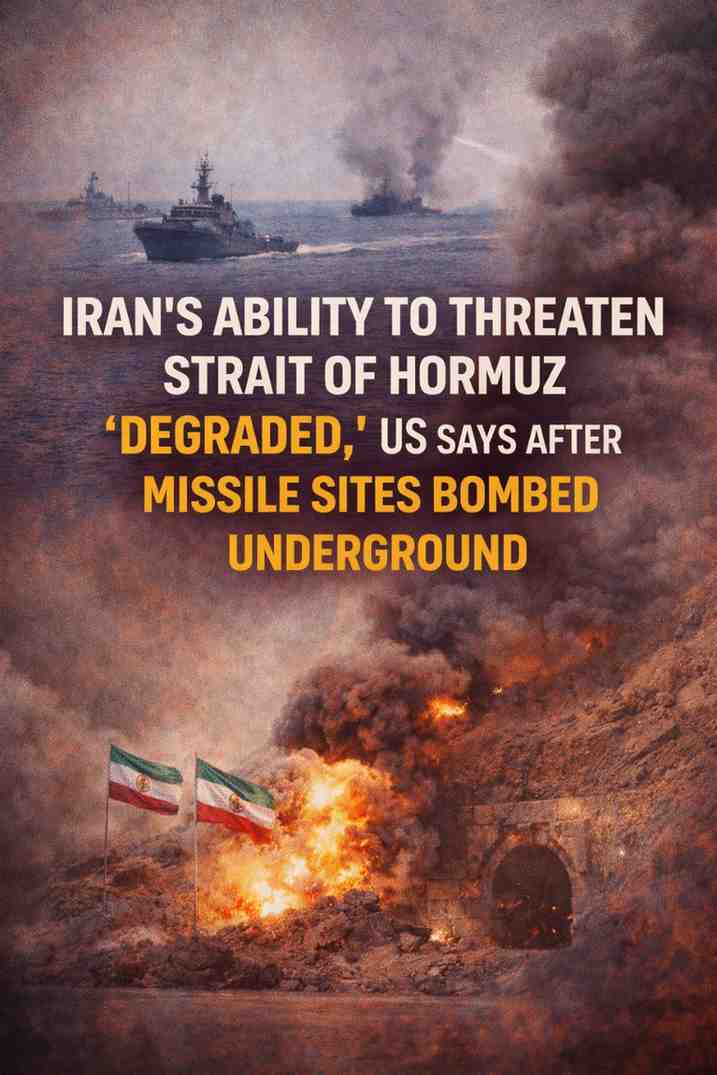
The United States said Iran’s ability to threaten the Strait of Hormuz has been “degraded” following recent airstrikes on underground missile facilities along Iran’s coast. U.S. military officials confirmed the strikes targeted key weapons storage and surveillance infrastructure. The development matters globally as the Strait of Hormuz is a critical route for international oil shipments and energy security.
Background and Context
The Strait of Hormuz is one of the world’s most strategically important waterways, with roughly one-fifth of global oil supply passing through it. Any disruption in the region can have immediate effects on global energy markets.
The ongoing conflict involving Iran, the United States, and Israel has increasingly focused on maritime security in the Gulf. Iran has previously threatened to block or restrict access to the strait in response to military actions against its territory.
In recent weeks, tensions escalated after Iran targeted shipping routes and U.S. military assets, prompting a broader campaign by U.S. and allied forces to secure the waterway.
The U.S. military has been conducting operations aimed at neutralizing Iran’s missile systems, naval assets, and drone capabilities that could threaten commercial shipping.
Latest Developments
U.S. Central Command said recent strikes successfully hit a hardened underground facility used by Iran to store anti-ship cruise missiles, mobile launchers, and related equipment.
Officials said multiple high-capacity bombs were used to penetrate the site and destroy not only the weapons storage areas but also intelligence systems and radar networks used to track maritime activity.
According to U.S. military leadership, these operations have reduced Iran’s ability to target vessels and disrupt navigation in and around the Strait of Hormuz.
However, officials also indicated that operations are ongoing, and further strikes may be carried out to ensure maritime security in the region.
Why This Matters
The Strait of Hormuz is vital to the global economy. Any threat to shipping routes can disrupt oil supply and lead to sharp increases in fuel prices worldwide.
The U.S. claim that Iran’s capabilities have been degraded suggests a shift in the balance of control over the waterway, at least in the short term.
For countries like Canada and other energy-importing nations, stability in the Strait of Hormuz is essential to maintaining predictable fuel prices and economic stability.
At the same time, the situation remains volatile. Even reduced capabilities do not eliminate the risk of further attacks or disruptions.
What Happens Next
U.S. and allied forces are expected to continue operations aimed at securing shipping lanes and preventing further threats from Iranian missile systems and naval assets.
Iran may attempt to rebuild or reposition its capabilities, and retaliatory actions remain possible as the conflict continues.
Diplomatic efforts from international actors may also intensify, particularly to prevent further escalation and ensure the safe flow of global energy supplies.
Conclusion
The United States’ assessment that Iran’s ability to threaten the Strait of Hormuz has been degraded reflects the impact of recent military strikes on key missile infrastructure. While the operations may improve short-term security in the region, the broader conflict continues to pose risks to global stability and energy markets.
The coming days will be critical in determining whether the situation stabilizes or escalates further in one of the world’s most important strategic corridors.