
PM Modi and President Shavkat Mirziyoyev Set $5 Billion Trade Goal and Expand Cooperation in Energy, Defence, Technology and Connectivity
Summary
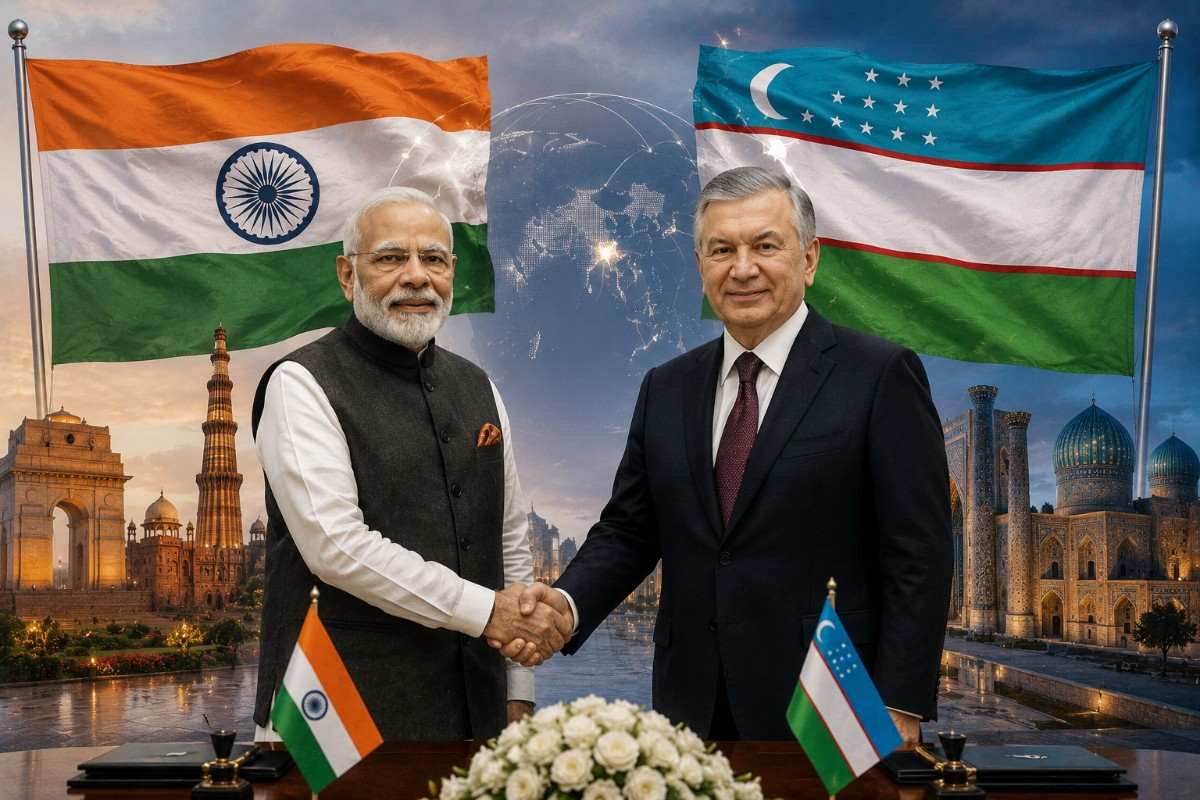
India and Uzbekistan have decided to elevate their bilateral relationship to a Comprehensive Strategic Partnership, marking a major step forward in cooperation between New Delhi and one of Central Asia’s most important countries. The decision was announced following talks between Prime Minister Narendra Modi and Uzbek President Shavkat Mirziyoyev in Tashkent during Modi’s state visit to Uzbekistan.
The two leaders also set an ambitious target of increasing annual bilateral trade to more than $5 billion by 2030 and agreed to deepen cooperation across sectors including defence, energy, critical minerals, technology, digital connectivity, healthcare, education and infrastructure.
Major Upgrade in Bilateral Relations
The decision to move from a Strategic Partnership to a Comprehensive Strategic Partnership signals a broader and deeper level of cooperation between the two countries.
During their talks, Modi and Mirziyoyev reviewed the full range of India-Uzbekistan relations and discussed future priorities. The leaders emphasized the importance of stronger political dialogue and closer cooperation in areas of shared economic and strategic interest.
India sees Uzbekistan as an important partner in Central Asia, a region that is becoming increasingly significant because of its strategic location, energy resources and role in regional connectivity.
$5 Billion Trade Target by 2030
A major outcome of the meeting was the decision to significantly increase bilateral trade.
India and Uzbekistan have set a goal of reaching $5 billion in annual trade by 2030. The target represents a major expansion from current levels and reflects the desire of both governments to increase investment and business links.
The two sides are expected to focus on reducing barriers to trade and encouraging companies from both countries to explore new opportunities.
Long-Term Uranium Supply Discussed
The leaders also discussed establishing a framework for the long-term supply of uranium from Uzbekistan to India.
The proposed cooperation is particularly important for India’s civil nuclear energy programme and could strengthen India’s access to reliable energy resources in the coming years.
Uzbekistan is rich in natural resources, and India is increasingly seeking stronger partnerships with resource-producing countries to support its long-term energy and industrial needs.
Cooperation Across Multiple Sectors
The new partnership will cover a wide range of areas.
Both countries discussed expanding cooperation in trade and investment, infrastructure, critical minerals, mining, defence and security, agriculture, pharmaceuticals, healthcare, information technology and education. Digital public infrastructure, including potential cooperation involving India’s UPI system, was also included in the discussions.
Artificial intelligence, cybersecurity, space cooperation and energy transition are also expected to become increasingly important parts of the bilateral relationship.
New Foreign Ministers Mechanism
India and Uzbekistan have agreed to establish a mechanism led by their foreign ministers to coordinate and monitor the implementation of agreements between the two countries.
The new arrangement is expected to provide high-level oversight and help ensure that important projects and initiatives move forward without unnecessary delays.
This reflects the intention of both governments to turn political agreements into concrete economic and strategic projects.
Agreements Signed During Modi’s Visit
A substantial package of agreements was signed following the high-level talks.
The agreements covered areas including cultural exchanges, traditional medicine, higher education and scientific research, environmental protection, tourism, geology and mineral resources, and archaeological cooperation. A partnership agreement was also established between Uzbekistan’s Samarkand region and the Indian state of Gujarat.
These agreements highlight the fact that the relationship is expanding beyond government and security cooperation into education, culture and people-to-people connections.
Importance for India’s Central Asia Strategy
The strengthened relationship with Uzbekistan is important for India’s broader engagement with Central Asia.
India has been working to increase its diplomatic, economic and strategic presence in the region. Stronger relations with Uzbekistan could help India improve access to Central Asian markets, energy resources and transport networks.
For Uzbekistan, closer ties with India offer opportunities for investment, technology, pharmaceuticals, education and access to one of the world’s fastest-growing major economies.
Conclusion
The decision by India and Uzbekistan to establish a Comprehensive Strategic Partnership marks a significant new chapter in relations between the two countries.
With a $5 billion trade target by 2030, plans for long-term uranium cooperation and expanded collaboration in defence, technology, infrastructure and education, both governments are signaling a long-term commitment to closer ties.
Prime Minister Modi’s visit has therefore strengthened India’s position in Central Asia while opening new opportunities for economic and strategic cooperation with Uzbekistan. The success of the new partnership will now depend on how quickly both countries translate the agreements announced in Tashkent into practical results.