

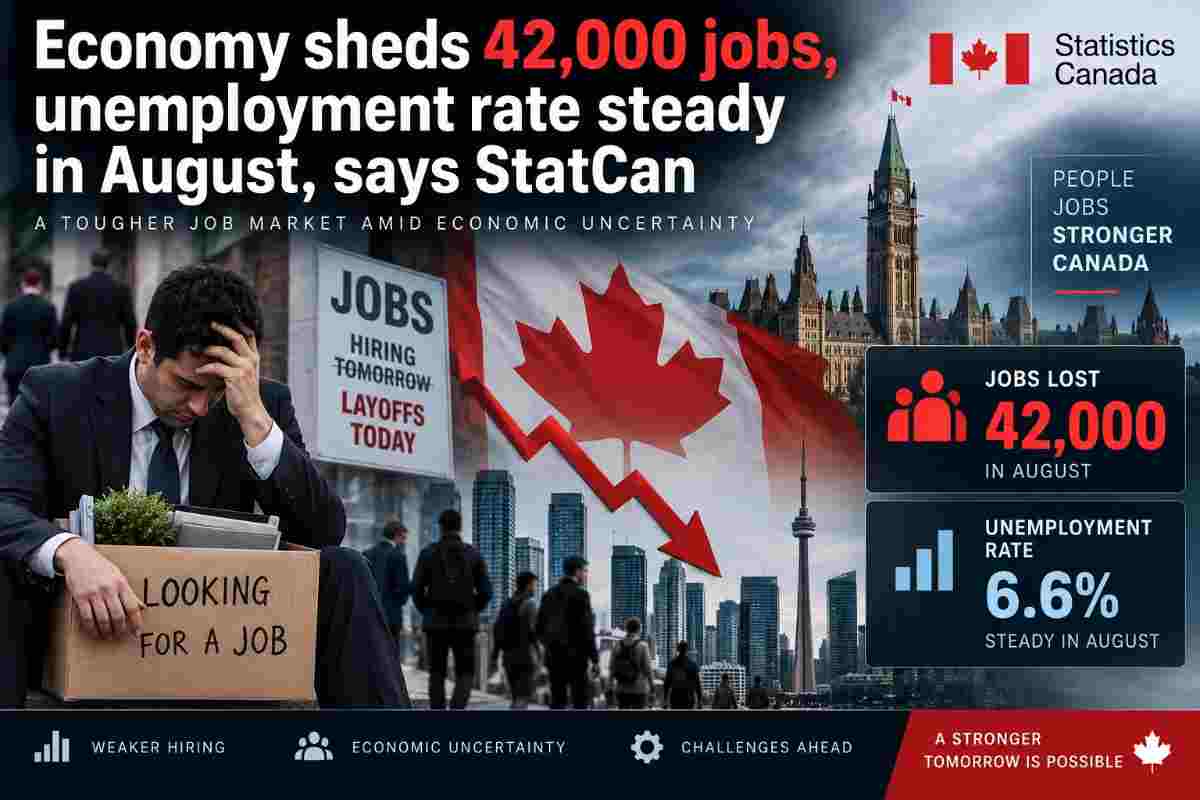
Unemployment Rate Holds at 6.4% Despite Sharp Employment Drop, While Full-Time Work Bears Most of the Losses
Summary
Canada’s labour market weakened significantly in August, with employment falling by 41,700 jobs, according to new data from Statistics Canada. Despite the decline in employment, the national unemployment rate remained unchanged at 6.4%, while the employment rate slipped to 60.8%.
The decline was substantially worse than economists had expected and reversed some of the employment gains recorded earlier in the summer. The latest figures are raising fresh concerns about the strength of Canada’s economy as businesses continue to face uncertainty from trade tensions and changing economic conditions.
Full-Time Employment Takes the Biggest Hit
Most of August’s employment decline came from full-time positions.
Statistics Canada reported that full-time employment fell by approximately 35,900 jobs, while part-time employment declined by about 5,800.
The weakness in full-time employment is particularly significant because it can provide a clearer indication of underlying labour-market conditions than short-term or seasonal hiring.
Unemployment Rate Remains at 6.4%
Despite the employment decline, Canada’s unemployment rate stayed at 6.4%.
The rate remained unchanged partly because the labour force itself contracted during the month. This means the employment decline did not translate into a corresponding increase in the share of people actively looking for work.
The employment rate, which measures the proportion of the working-age population that is employed, fell by 0.1 percentage points to 60.8%.
Several Major Sectors Lose Jobs
The employment decline was spread across several parts of the economy.
Healthcare, education, transportation and retail were among the sectors experiencing notable employment losses. Together, these industries accounted for a large share of the monthly decline.
The figures suggest that the weakness was not limited to a single industry, although some sectors were affected more heavily than others.
Youth Employment Under Pressure
Young Canadians also faced a difficult labour market in August.
The youth unemployment rate rose to approximately 12.9%, highlighting continued challenges for younger workers entering or remaining in the labour market.
Seasonal employment patterns can have a particularly large impact on younger workers, especially during the transition from summer jobs into the fall.
Trade Uncertainty Adds Pressure
The weaker employment figures arrive as Canada continues to deal with significant uncertainty surrounding trade relations with the United States.
The latest U.S. tariffs on Canadian products have increased concerns among businesses about costs, exports and future investment. Industries exposed to cross-border trade could face additional pressure if tariffs remain in place for an extended period.
Economists will be watching upcoming employment and economic data closely to determine whether August represents a temporary setback or the beginning of a broader slowdown.
Wage Growth Also Shows Signs of Easing
The latest figures also showed some moderation in wage growth.
Growth in wages for permanent employees slowed to around 2%, marking one of the weakest readings in years outside the pandemic period.
Slower wage growth could ease some inflationary pressure, but it may also indicate that employers are becoming more cautious about hiring and compensation.
What the Numbers Mean for the Economy
The August employment report presents a mixed picture.
On one hand, the unemployment rate remains relatively low compared with some recent periods. On the other, the sharp decline in employment and falling employment rate suggest that fewer Canadians are currently working.
The combination of weaker hiring, slower wage growth and trade uncertainty could make the Bank of Canada’s assessment of the economy more complicated in coming months.
Conclusion
Canada’s labour market suffered a significant setback in August, losing 41,700 jobs while the unemployment rate remained at 6.4%. Full-time employment accounted for most of the decline, with several major service sectors also reporting substantial losses.
The figures provide a warning sign for the Canadian economy, particularly as businesses navigate ongoing trade tensions and uncertainty. While one month’s data does not establish a long-term trend, policymakers and economists will be watching closely to see whether employment begins to recover or whether the August decline signals a deeper slowdown.