

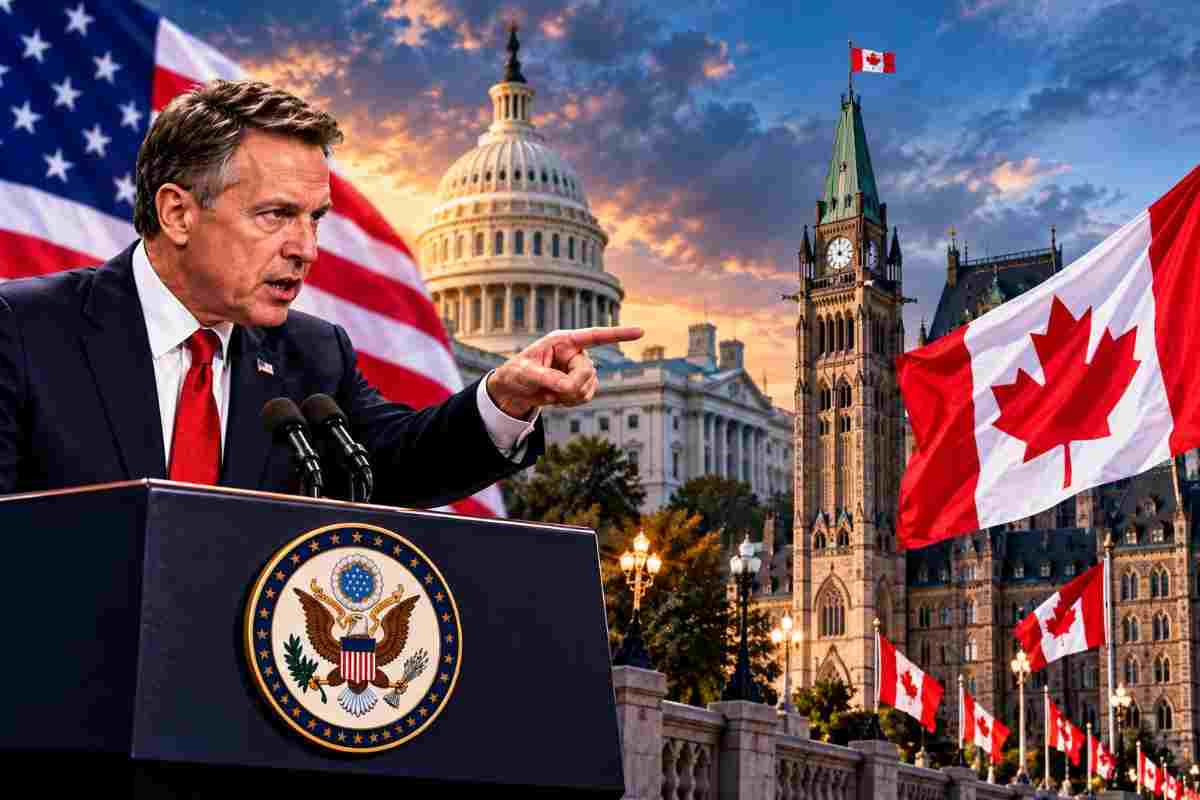
US Ambassador to Canada Pete Hoekstra has criticised Canadian political involvement in American affairs, warning Ottawa that the relationship between the two neighbours is changing amid disputes over trade, defence and political influence.
US Ambassador to Canada Pete Hoekstra has urged Canadian politicians to stay out of American domestic politics, saying Washington will continue pursuing its interests regardless of whether Ottawa agrees with its approach. His remarks have added another point of tension to an already strained relationship between the United States and Canada.
Speaking during an interview published on October 11, 2026, Hoekstra criticised what he described as political interference by Canadian officials and referred to comments made by former Canadian prime minister Justin Trudeau about foreign political figures entering American political debates.
“Keep your nose out of American politics,” Hoekstra said during the interview. He added that the United States would continue moving forward even if Canada did not want to remain a partner. The comments came as the two countries continue to face disagreements over tariffs, trade negotiations and their broader economic relationship.
Hoekstra Questions Canadian Political Involvement
During the interview with The Really Big Show, Hoekstra argued that Canadian political actions had crossed into territory Washington considers sensitive.
He specifically referred to political developments in Ontario and comments by Trudeau concerning foreign political leaders participating in discussions about American affairs. Hoekstra characterised the issue as political interference, although his remarks did not establish that Canadian officials had violated any American law.
The ambassador’s comments reflect the Trump administration’s broader emphasis on protecting American political decision-making from perceived outside influence.
However, political criticism, diplomatic statements and unlawful interference are distinct matters. Hoekstra’s allegations were presented during an interview, and the remarks alone do not establish that a legal violation occurred.
Canada-US Relations Face Growing Strain
The comments come at a difficult moment for relations between the neighbouring countries.
The United States and Canada maintain extensive economic ties, with businesses and workers on both sides of the border depending on cross-border trade. Their relationship also includes cooperation on defence, intelligence, border security and continental security through arrangements such as NORAD.
However, disagreements over American tariffs and the future of the Canada-United States-Mexico Agreement, known in Canada as CUSMA, have created uncertainty for businesses and policymakers.
US President Donald Trump has defended his administration’s trade position, while Canadian Prime Minister Mark Carney has said Canada is prepared to negotiate an agreement that benefits both countries. Carney has also stressed the importance of stability and credibility in any future deal.
In September, Carney said Canada was ready to resume negotiations when Washington was prepared to pursue an agreement that served the interests of both countries. The United States has maintained its existing position in the discussions, leaving the timing and outcome of further negotiations uncertain.
Ambassador Describes Tariff Dispute as a Trade Disagreement
Hoekstra also defended Washington’s approach to the trade dispute, rejecting the description of the situation as a trade war.
During the interview, he said the United States had offered Canada what he described as a highly favourable agreement and argued that Washington remained willing to engage if Canadian officials were prepared to reach a deal.
His comments reflect the US administration’s position that the disagreement can be resolved through negotiations, even as tariffs and countermeasures continue to affect the economic relationship.
Canada, meanwhile, has sought to protect its domestic industries and workers while exploring ways to reduce its vulnerability to trade disruptions.
The two countries’ competing positions illustrate the challenge of reaching an agreement when both governments face domestic economic and political pressures. Neither side has publicly established a definitive timeline for a comprehensive resolution.
Defence Cooperation Also Comes Under Discussion
The ambassador’s remarks extended beyond trade to the future of the bilateral security relationship.
During the interview, Hoekstra said the Canada-US relationship had fundamentally changed and suggested that continued American defence commitments should not be taken for granted indefinitely.
When asked whether the United States would always defend Canada, he responded that “always is a long time” and linked the issue to Canada’s commitments within NATO.
The remarks highlight continuing debate over defence spending and burden-sharing among NATO members. Canada and the United States remain partners in NORAD, which is responsible for aerospace warning, aerospace control and maritime warning for North America.
Hoekstra’s comments did not announce a change to existing defence arrangements. Instead, they underscored the administration’s position that allies should meet their defence commitments as security priorities evolve.
Political Rhetoric Adds Pressure to Diplomatic Ties
The ambassador’s warning is part of a wider period of increasingly direct public exchanges between political figures in the two countries.
Trade disputes, disagreements over national interests and criticism of each other’s policies have increasingly become part of public debate. Such exchanges can influence diplomatic relations even when formal channels of communication remain open.
For Canada, the United States remains its most important trading partner, making the relationship economically significant. For Washington, cooperation with Canada remains relevant to continental security, supply chains, energy and defence.
The challenge for both governments is to manage disagreements without undermining areas where cooperation remains mutually beneficial.
Although strong public statements can communicate political positions, any lasting improvement in relations is likely to depend on negotiations and decisions concerning trade, security and economic cooperation.
Conclusion
US Ambassador Pete Hoekstra’s warning that Canadian politicians should stay out of American politics adds to the growing tensions between Washington and Ottawa.
His comments reflect concerns within the Trump administration about foreign political influence, while also highlighting disagreements over tariffs, trade negotiations and defence commitments.
Canada and the United States continue to share extensive economic and security interests, but their relationship is facing renewed pressure as both governments defend their respective positions.
Whether the latest remarks affect diplomatic cooperation will depend on how the two countries manage their differences through future discussions. For now, trade and defence remain central issues in a relationship that continues to be important to both nations.