

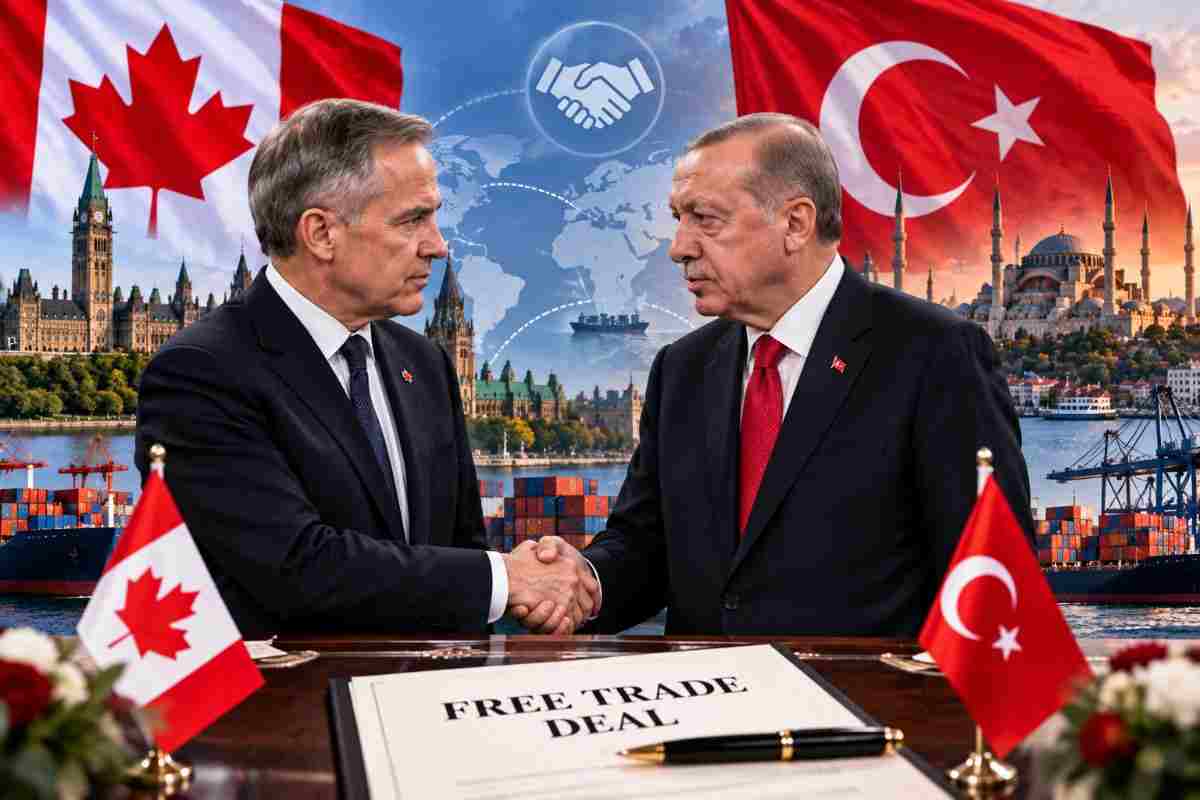
Canadian Prime Minister Mark Carney and Turkish President Recep Tayyip Erdoğan have agreed to deepen cooperation in trade, defence and energy, with both countries aiming to negotiate a free-trade agreement and significantly increase bilateral commerce.
Canada and Türkiye have launched a new strategic partnership designed to strengthen economic relations and expand cooperation across several key industries. The announcement came during Canadian Prime Minister Mark Carney’s visit to Türkiye, where he met President Recep Tayyip Erdoğan to discuss trade, investment, energy and defence cooperation.
The agreement marks a significant step in efforts by both countries to deepen their economic relationship. It also reflects Canada’s wider strategy of diversifying its international trading partnerships and reducing its dependence on the United States amid continuing trade tensions.
Canada and Türkiye Aim to Strengthen Economic Relations
The strategic partnership is intended to provide a framework for closer cooperation between the two NATO allies. The areas of focus include trade and investment, defence and security, energy, and people-to-people relations.
During their meeting in Ankara, Carney and Erdoğan discussed ways to expand commercial opportunities and encourage businesses in both countries to invest in new projects. The partnership is expected to be supported by a three-year action plan covering priority areas of cooperation.
The visit is particularly significant because it is the first bilateral visit to Türkiye by a Canadian prime minister. Although Carney previously travelled to Ankara for the NATO summit in July 2026, the latest visit is focused on strengthening relations beyond military cooperation and building a broader economic partnership.
Free-Trade Agreement Negotiations Expected to Advance
A central objective of the partnership is to advance negotiations toward a comprehensive Canada–Türkiye free-trade agreement.
The two countries formally announced the launch of negotiations in July 2026. Canadian officials have since undertaken public consultations to gather feedback from businesses, industry groups, provincial governments and other stakeholders about the potential benefits and implications of an agreement.
Speaking during the latest meeting, Erdoğan said the countries hoped to begin free-trade negotiations before the end of 2026. He also outlined an ambition to increase bilateral trade from approximately $3 billion to $5 billion initially, with a longer-term target of $10 billion.
However, a free-trade agreement has not yet been concluded. Negotiations will need to establish the terms of any eventual deal, including potential reductions in trade barriers and rules governing access to each other’s markets.
Canada’s stated objectives include improving market access for goods and services, strengthening supply chains and creating more predictable conditions for businesses and investors. Ottawa has also said that labour rights, environmental sustainability and the government’s ability to regulate in the public interest will remain considerations during negotiations.
Energy, Defence and Advanced Industries in Focus
Energy and defence are expected to be important components of the new partnership. Both countries are exploring opportunities for cooperation in nuclear energy, aerospace, sustainable mining and advanced technologies.
Türkiye is seeking to expand its energy infrastructure, including its nuclear power capacity, while Canada has expertise in nuclear technology and energy development. Closer cooperation could create opportunities for Canadian companies seeking international projects and Turkish businesses looking for additional investment and technical partnerships.
The two governments have also signed agreements covering areas including energy, defence and air transport during the visit. Further work is expected to identify practical projects and establish mechanisms for cooperation between government agencies and businesses.
Trade Figures Highlight the Potential for Growth
Official Canadian figures show that two-way merchandise trade between Canada and Türkiye reached approximately C$4.3 billion in 2025.
Canada exported around C$1.1 billion worth of merchandise to Türkiye, while imports from Türkiye totalled approximately C$3.2 billion. Canadian exports included lentils, aircraft and industrial materials, while imports included pharmaceutical products, textiles and other manufactured goods.
The proposed free-trade agreement could help businesses explore additional opportunities by addressing tariffs and other barriers to commerce. Its eventual impact, however, will depend on the terms negotiated and how effectively companies in both countries use any improved market access.
Human Rights Concerns Remain Part of the Wider Debate
The closer relationship has also drawn attention to questions beyond trade and investment. Amnesty International urged Carney to raise human rights concerns during his visit, including the treatment of political opposition figures, journalists and activists in Türkiye.
The issue highlights the broader challenge facing governments seeking stronger commercial and strategic ties while also addressing concerns about civil liberties and democratic rights.
Conclusion
Canada and Türkiye’s new strategic partnership establishes a framework for deeper cooperation in trade, energy, defence and investment. Both governments have expressed ambitions to increase bilateral trade substantially and move forward with free-trade negotiations before the end of 2026.
The immediate priority will be turning the political commitments into concrete agreements and projects. While a completed free-trade deal remains some way off, the partnership signals a shared intention to broaden economic ties and create new opportunities for businesses in both countries.