

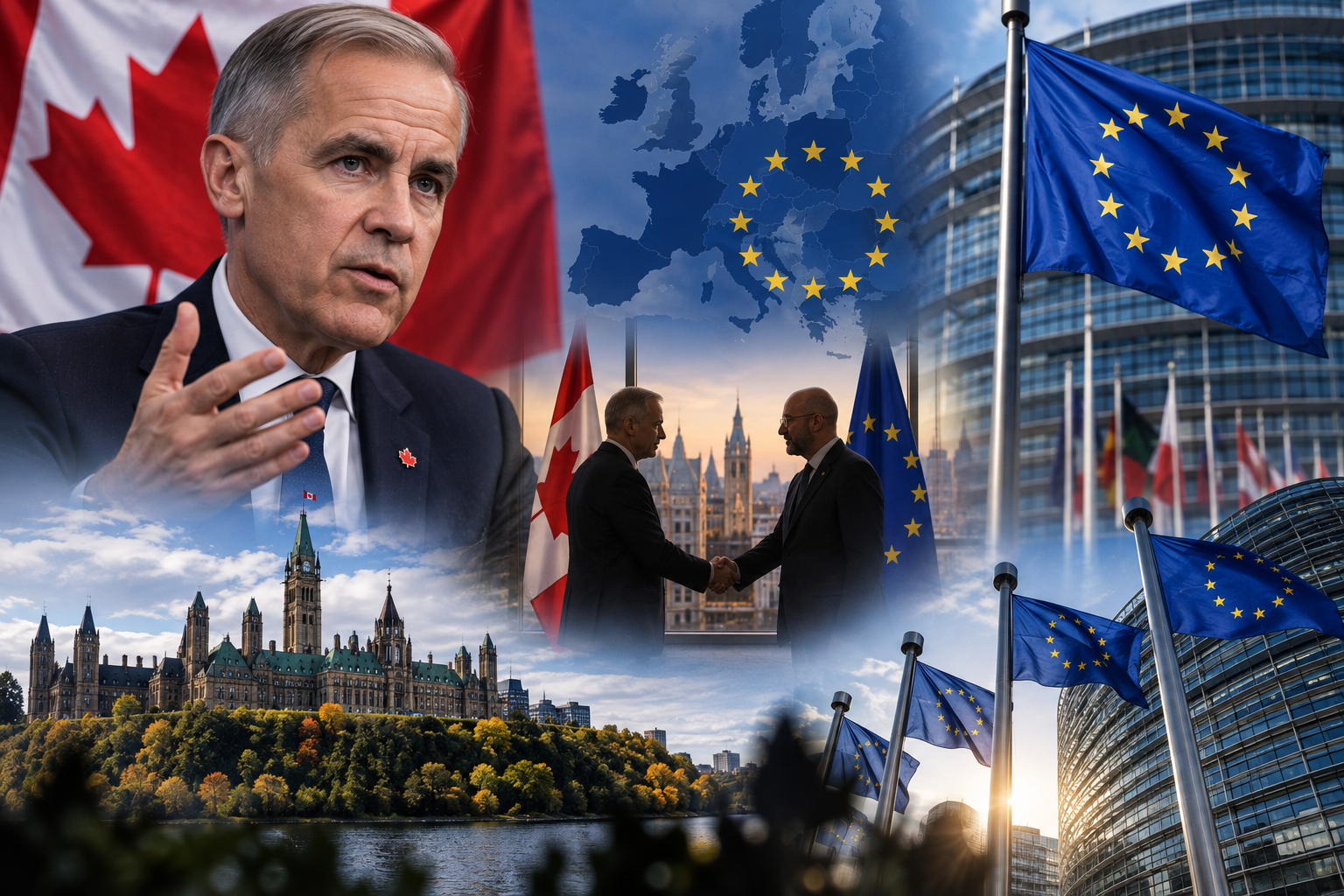
Subheading: Prime Minister Mark Carney is reportedly exploring an unprecedented closer relationship with the European Union as Canada seeks to reduce its economic dependence on the United States amid escalating trade tensions.
Canada Considers a New Relationship With Europe
Canadian Prime Minister Mark Carney is pushing an ambitious plan to deepen Canada’s relationship with the European Union, including exploring whether Canada could become an “associate member” of the bloc, according to a Wall Street Journal report published Sunday.
The proposed status does not currently exist within the European Union. According to the report, however, European and Canadian officials have been discussing whether a new arrangement could be created that would provide Canada with deeper economic and strategic integration without requiring full EU membership.
The initiative comes as Canada’s relationship with the United States has deteriorated sharply over trade and tariff disputes under President Donald Trump.
Carney Looks to Reduce Dependence on the U.S.
For decades, Canada’s economy has been closely connected to the United States, with the vast majority of Canadian exports heading south of the border. The recent escalation in trade tensions has encouraged Ottawa to accelerate efforts to diversify its economic relationships.
Carney has increasingly identified Europe as one of Canada’s most important alternative partners. His government has been pursuing deeper cooperation with the EU in areas including trade, defence, energy, artificial intelligence, critical minerals and technology.
The proposed associate-membership concept would potentially provide Canada with closer access to European markets while stopping short of formal membership in the 27-country bloc.
Trade and Strategic Cooperation at the Centre
According to the WSJ report, discussions between Canada and European governments are looking at ways to make the movement of Canadian goods, services and workers in strategic sectors easier.
Energy, artificial intelligence, defence and critical minerals are among the areas receiving particular attention. The two sides are also discussing possible cooperation on underwater cables, data centres, cloud infrastructure, satellite networks and energy transportation routes.
Such cooperation could give Canada greater access to European investment and markets while helping the EU strengthen its supply chains for resources and technologies considered strategically important.
Visa-Free Work Could Become Part of the Deal
The discussions could extend beyond trade and investment.
According to the WSJ report, Carney has also spoken with European leaders, including French President Emmanuel Macron, about the possibility of allowing Canadians to live and work in the European Union without traditional visa restrictions.
Such an arrangement would represent a major expansion of people-to-people ties between Canada and Europe. It could potentially benefit Canadian professionals, students and businesses seeking greater access to European opportunities.
Carney is scheduled to meet Macron on September 20 in Saint Pierre and Miquelon, the French territory off Canada’s Atlantic coast.
Carney Heads to the European Parliament
The push for stronger Canada-EU relations comes just ahead of Carney’s planned visit to Strasbourg.
The Canadian prime minister is expected to address the European Parliament following European Commission President Ursula von der Leyen’s State of the Union address. His appearance is expected to provide an opportunity to outline Canada’s vision for a deeper partnership with Europe.
European officials have already signalled that they are open to discussing a new and more ambitious relationship with Ottawa. The EU’s ambassador to Canada recently described the potential partnership as something that could be different from the bloc’s existing arrangements with other countries.
Existing CETA Deal Shows the Challenges
Despite the momentum, turning the idea into reality could prove difficult.
Canada and the EU already have the Comprehensive Economic and Trade Agreement, known as CETA. The agreement has been provisionally applied for years, but full ratification has still faced delays in several EU member states.
That history demonstrates the political and legal challenges involved in negotiating and implementing a much deeper Canada-EU arrangement. Any new framework would likely require extensive negotiations between Ottawa, Brussels and individual European governments.
A Major Shift in Canada’s Foreign Economic Strategy
Carney’s reported proposal represents a significant potential shift in Canada’s economic strategy.
Rather than replacing its relationship with the United States, Ottawa appears to be seeking a broader network of partnerships that would make Canada less vulnerable to political and trade decisions made in Washington.
The EU, meanwhile, offers Canada access to a large economic market and potential partners in areas ranging from defence and energy to technology and critical minerals.
Conclusion
Mark Carney’s reported push for an “associate member” relationship with the European Union could mark one of the most ambitious attempts in Canadian history to deepen economic and strategic ties with Europe.
The proposal is still at the discussion stage, and there is no existing EU mechanism that automatically provides such a status. But with Canada facing escalating trade tensions with the United States, Ottawa is clearly looking to Europe for new opportunities.
Whether Canada can turn the concept into a formal arrangement will depend on negotiations with EU institutions and member states. For now, Carney’s European initiative signals that Canada is preparing for a significantly more diversified economic and geopolitical future.