

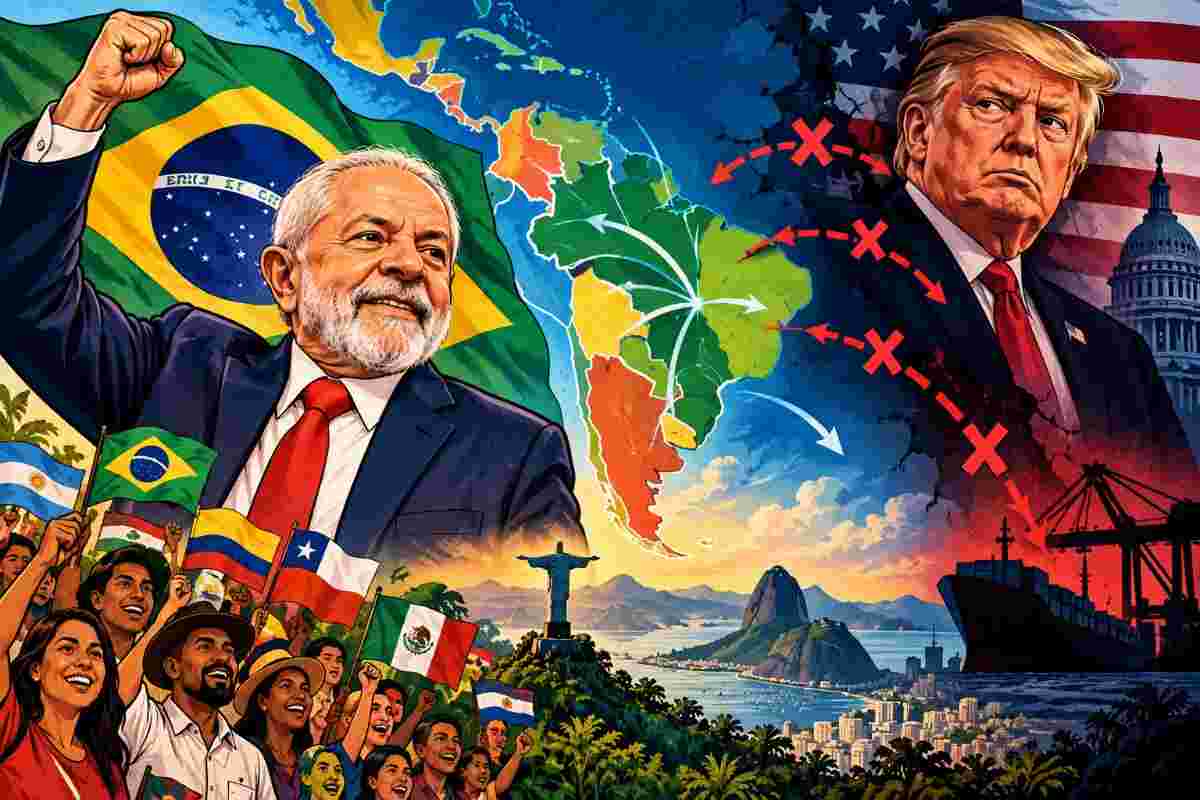
Brazilian President Luiz Inácio Lula da Silva has secured an unprecedented fourth presidential term, defeating conservative challenger Flávio Bolsonaro and dealing a setback to US President Donald Trump’s efforts to strengthen Washington’s influence through right-leaning governments across Latin America.
Lula’s victory in Sunday’s presidential runoff on October 25, 2026, marks a significant moment in Brazilian politics. The 80-year-old left-wing leader defeated Flávio Bolsonaro, the eldest son of former president Jair Bolsonaro, by approximately 51.8% to 48.2%, according to reported election results.
The result comes amid a broader political shift across Latin America, where conservative candidates have recently gained ground by campaigning on public security, immigration and economic concerns. Lula’s win interrupts that trend and ensures that Brazil, the region’s largest economy, will continue to be led by a president who has frequently defended an independent foreign policy and maintained strong economic ties with China.
The outcome also creates a challenge for the Trump administration, which has sought closer relationships with conservative leaders across the region.
Lula Delivers a Remarkable Political Comeback
Lula’s re-election represents another major comeback in a political career spanning several decades. A former metalworker and trade union leader, he first served as Brazil’s president from 2003 to 2010 before returning to office in 2023 after defeating Jair Bolsonaro in the 2022 election.
His latest victory appeared uncertain during parts of the campaign. Economic concerns, corruption controversies surrounding his political movement and changes in Brazilian society presented significant challenges for the incumbent.
Flávio Bolsonaro entered the runoff with momentum after performing strongly in the first round. His campaign emphasised law and order, economic change and closer relations with Washington.
Lula, meanwhile, focused on social welfare, poverty reduction and defending Brazil’s national sovereignty. He argued that his government had experience addressing economic inequality and protecting social programmes.
Higher-than-expected voter turnout and a stronger campaign effort in the final stages helped Lula secure another term, according to analysts cited in election coverage.
Why Lula’s Victory Matters to Donald Trump
The election result complicates Trump’s efforts to consolidate US influence in Latin America through partnerships with governments that share Washington’s positions on security, migration and regional diplomacy.
In recent months, several Latin American countries have moved towards conservative leadership, with political candidates promising tougher responses to organised crime and stronger cooperation with the United States.
Brazil would have represented a particularly significant addition to that network. As Latin America’s largest economy and a major diplomatic power, it plays an important role in regional institutions and international forums.
Flávio Bolsonaro had campaigned on closer ties with Trump and signalled interest in joining a US-led regional security initiative. His defeat means Washington will continue dealing with Lula, whose administration has resisted joining certain US-led security arrangements.
However, Lula’s victory does not necessarily mean that Brazil and the United States will cease cooperating. Both countries have important economic interests, and their governments have reasons to maintain dialogue on trade, investment and security.
Trade Disputes and National Sovereignty Shape Relations
Relations between Lula and Trump have been complicated by disagreements over trade policy and Brazil’s domestic political affairs.
The Trump administration imposed tariffs on Brazilian goods during the dispute surrounding the prosecution of former president Jair Bolsonaro, whose legal troubles have been a major source of political tension.
Lula used the dispute to emphasise Brazil’s independence and argue that the country should not be pressured into changing its domestic decisions to satisfy another government. His campaign framed the issue as a question of national sovereignty.
That message became an important part of his political appeal, particularly among voters concerned about foreign interference in Brazilian affairs.
The disagreement illustrates the challenges facing Washington as it attempts to deepen its influence in a region where governments have different economic priorities and foreign-policy interests.
Brazil also maintains substantial economic ties with China, its largest trading partner. Lula’s administration has sought to preserve those relationships while keeping channels open for cooperation with the United States and other Western economies.
Brazil’s Strategic Importance Extends Beyond Politics
Brazil’s importance to global economic and security interests extends well beyond its political leadership.
The country possesses substantial natural resources, including rare-earth minerals and niobium, which are important for advanced manufacturing, electronics and defence-related industries.
Access to critical minerals has become an increasingly important issue for governments seeking to strengthen supply chains and reduce dependence on a limited number of suppliers.
Brazil’s resources therefore give its government potential leverage in negotiations with major economic powers. Lula’s administration will have to balance opportunities for foreign investment with its stated objective of protecting national interests and maintaining control over strategic sectors.
The country’s position in the BRICS grouping, which includes major emerging economies, also gives it a platform to advocate a more multipolar international system.
Lula has traditionally supported stronger cooperation among developing countries and greater representation for emerging economies in global institutions. These priorities sometimes differ from Washington’s approach to international trade and security.
Domestic Challenges Could Limit Lula’s Freedom of Action
Despite his election victory, Lula faces significant challenges at home.
Conservative forces have strengthened their position in Brazil’s Congress, potentially making it more difficult for his administration to pass legislation and implement its economic programme.
The president will also face pressure to address public security, living costs, employment and the expectations of voters who supported his return to office.
His ability to deliver economic improvements will be important to maintaining public confidence throughout his new term.
The narrow election margin also demonstrates that Brazil remains politically divided. Lula will need to navigate disagreements with conservative lawmakers and voters while pursuing policies intended to improve living standards.
These domestic constraints could influence how assertively his government challenges Washington or seeks compromises with the Trump administration.
What Lula’s Victory Means for Latin America
Lula’s win interrupts a series of conservative victories across Latin America and reinforces the region’s political diversity.
It demonstrates that the electoral momentum behind right-leaning candidates is not uniform across every country. Domestic economic conditions, political personalities, public security concerns and attitudes towards foreign influence continue to shape national elections differently.
For the United States, Brazil’s political direction means that regional diplomacy will require engagement with governments that do not necessarily share Washington’s priorities.
For neighbouring countries, Lula’s renewed mandate could strengthen discussions about regional integration, economic cooperation and Latin America’s role in international affairs.
Nevertheless, the broader regional balance will depend on developments in individual countries rather than Brazil’s election alone.
Conclusion
Lula’s historic fourth-term victory marks a significant development in Brazilian politics and presents a challenge to Donald Trump’s efforts to expand US influence through conservative partners in Latin America.
The result reinforces Brazil’s commitment to pursuing an independent foreign policy while maintaining economic relationships with both China and the United States.
However, Lula’s next term will bring substantial domestic and international challenges, including a divided Congress, economic expectations and continuing disagreements with Washington.
The future of Brazil-US relations will depend on whether both governments can manage their differences while protecting their shared economic interests. Lula’s victory has changed the political landscape, but the extent of its impact on Trump’s regional ambitions will become clearer as the new administration takes shape.