

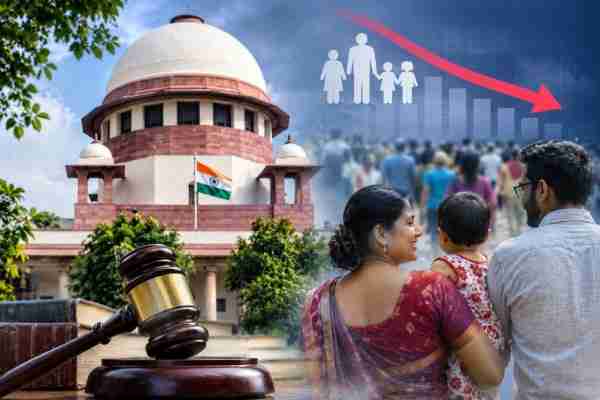
The Supreme Court of India has observed that laws penalising individuals for having more than two children have lost their relevance as the country’s fertility rate declines, raising important questions about reproductive freedom, democratic participation and the constitutional validity of restrictions on contesting local elections.
In a significant development on November 4, a Supreme Court bench comprising Justices P.S. Narasimha and Alok Aradhe said that the foundation of two-child restrictions, originally introduced to address concerns about population growth, had weakened considerably because of changing demographic conditions.
The court made the observations while hearing a petition filed by Mangala Bhimrao Ingle, a former sarpanch from Maharashtra who was disqualified from holding elected office after the birth of her third child.
The bench also referred the constitutional validity of such restrictions to a larger bench for reconsideration of a landmark 2003 Supreme Court judgment that had upheld the two-child norm. <Cite refs={[“turn516269search0″,”turn516269search2″,”turn516269search5”]}/>
Supreme Court Says Two-Child Restrictions Have Lost Relevance
The Supreme Court expressed concern that laws disqualifying individuals with more than two children from contesting local body elections may no longer reflect India’s current demographic situation.
The bench noted that India’s Total Fertility Rate (TFR) had declined from approximately 3 children per woman in 2003 to 1.9 currently.
A fertility rate of approximately 2.1 is generally considered the replacement level, which allows one generation to replace itself over time, assuming no migration.
According to the judges, the original argument that population growth required strict restrictions on family size has weakened as birth rates have declined.
The court warned that ignoring demographic changes could create future challenges, including an ageing population and a declining proportion of working-age citizens.
It also questioned whether restrictions introduced decades ago should continue to determine a person’s eligibility to participate in democratic institutions. <Cite refs={[“turn516269search0″,”turn516269search3”]}/>
Case Involves Maharashtra Woman Disqualified for Having Third Child
The observations came during proceedings in a case involving Mangala Bhimrao Ingle, who had served as the sarpanch of Kakoda Gram Panchayat in Maharashtra.
She was disqualified under Section 14(1)(j-1) of the Maharashtra Village Panchayats Act, 1959, which prevents individuals with more than two children from holding certain elected positions in local government.
A complaint was filed against Ingle following the birth of her third child. The Additional Collector in Buldhana subsequently disqualified her, and her appeal before the Additional Commissioner of Amravati Division was rejected.
The Bombay High Court upheld the disqualification in August 2025.
Ingle then approached the Supreme Court, challenging the decision and the legal provision under which she had lost her position.
The Supreme Court has now set aside the disqualification and stayed the proceedings against her while referring the broader constitutional question to a larger bench. <Cite refs={[“turn516269search1″,”turn516269search3″,”turn516269search5”]}/>
Court Raises Questions About Reproductive Autonomy Under Article 21
One of the most significant aspects of the judgment concerns the right to reproductive autonomy under Article 21 of the Indian Constitution.
The bench observed that disqualifying individuals from elections because they have more than two children effectively forces them to choose between having a family and participating in democratic governance.
According to the court, the number of children a person has does not necessarily have a direct connection with their ability to perform public duties or hold an elected position.
The judges also expressed concern that such restrictions could disproportionately affect women, particularly in situations where decisions about family size are influenced by family pressure and social circumstances.
Article 21 protects the right to life and personal liberty, and the Supreme Court has previously recognised reproductive choices as an important aspect of individual autonomy.
The latest observations indicate that the constitutional implications of family-size restrictions may need to be examined in light of changing social and demographic conditions. <Cite refs={[“turn516269search1″,”turn516269search4″,”turn516269search6”]}/>
Supreme Court Reconsiders Its Landmark 2003 Judgment
The latest development could have wider implications because it questions the reasoning behind the Supreme Court’s 2003 decision in Javed v. State of Haryana.
In that case, a three-judge bench upheld the constitutional validity of a provision under the Haryana Panchayati Raj Act, 1994, which disqualified individuals with more than two living children from contesting local elections.
The earlier judgment had accepted population control as a legitimate objective behind the restriction.
However, the present bench has questioned whether that reasoning remains appropriate after more than two decades of demographic changes.
By referring the issue to a larger bench, the Supreme Court has opened the possibility of reconsidering the constitutional position established in 2003.
The larger bench will have to examine whether two-child restrictions can continue to be justified under the Constitution and whether they violate fundamental rights. <Cite refs={[“turn516269search0″,”turn516269search2”]}/>
Several Indian States Still Have Two-Child Restrictions
The issue is particularly important because different states have adopted different policies regarding family-size restrictions for local elections.
According to information submitted to the Supreme Court by amicus curiae advocate Rukmini Bobde, seven states have repealed their two-child restrictions, while 15 states do not have such a policy.
States where provisions of this nature continue to exist include:
- Assam
- Goa
- Gujarat
- Maharashtra
- Odisha
- Uttarakhand
The restrictions generally apply to elections for panchayat members, sarpanches and certain other local government positions.
However, the exact provisions and eligibility conditions differ between state laws.
The Supreme Court’s decision to refer the issue to a larger bench could therefore have consequences beyond Maharashtra, depending on the final constitutional ruling. <Cite refs={[“turn516269search0″,”turn516269search3″,”turn516269search6”]}/>
Falling Birth Rates Raise New Demographic Concerns
India’s declining fertility rate has become an important subject of discussion among policymakers and population experts.
For several decades, population control policies were justified partly by concerns about rapid population growth, pressure on natural resources and the availability of public services.
However, declining birth rates are changing the country’s long-term demographic outlook.
A fertility rate below the replacement level can eventually contribute to an ageing population and a smaller proportion of working-age citizens.
This could increase pressure on healthcare services, pension systems and social security programmes while creating challenges for future economic growth.
The Supreme Court highlighted these possible consequences while explaining why policies introduced during an earlier demographic period may need reconsideration.
Importantly, India’s overall population has not started declining. The country continues to experience population growth because of demographic momentum and its large existing population. <Cite refs={[“turn516269search2″,”turn516269search6”]}/>
What Happens Next?
The Supreme Court’s decision to refer the matter to a larger bench does not automatically abolish two-child restrictions across India.
The larger bench will reconsider the constitutional validity of these provisions and the reasoning adopted in the 2003 Javed judgment.
Until a final ruling is delivered, the legal position of similar restrictions in different states will depend on the applicable laws and any relevant court orders.
For now, the immediate relief granted to Mangala Bhimrao Ingle allows her to continue following the Supreme Court’s order while the broader legal question remains pending.
The eventual judgment could have implications for local election eligibility, reproductive rights and the relationship between population policies and democratic participation.
Conclusion
The Supreme Court’s latest observations have brought India’s two-child restrictions back into national debate at a time when the country’s fertility rate has fallen below the replacement level.
By questioning the relevance of laws that penalise individuals for having more than two children, the court has highlighted the importance of adapting legislation to changing demographic realities.
The decision to refer the matter to a larger bench could reshape the legal framework governing local elections in several states.
However, the final outcome will depend on the larger bench’s examination of the constitutional questions surrounding reproductive autonomy, equality and the right to participate in democratic institutions.