
By CK Sharma | World Affairs | NewsBee Media Inc.
For decades the US was the pre-eminent power in international politics. Its economic might, its military reach, its diplomatic allies and its role in the international institutions of the post WWII world all helped to shape the international order that emerged.
That position has not gone. Washington is still one of the most influential powers in the world. The world situation is of course changing and the decisions taken in Beijing, New Delhi, Moscow and so on are having repercussions well beyond their own regions.
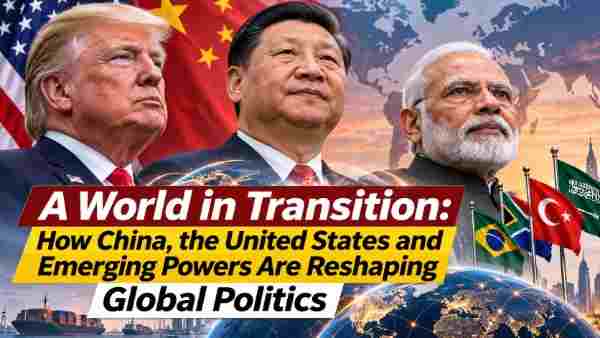
The question facing world leaders at the moment is not simply whether some other country will in fact take the US’s place as the world’s pre-eminent power. It’s whether the world is in the process of moving towards a system in which influence is shared amongst a number of major powers all of whom are going to be pursuing their own interests.
This shift is becoming ever more significant as competition over trade, technology, security and alliances is the key determinant of the relationship between nations.
The United States and China: Competition Beyond Military Power
The Washington/Beijing relationship remains by far the most important factor in the world’s politics.
Both sides have substantial economic interests in keeping the relationship stable, but there’s been a long history of friction over trade, technology, Taiwan and regional security.
The competition goes far beyond the military. Semiconductors, AI, telecommunications and access to key resources are all areas of strategic competition.
For the US the maintenance of its technological edge and its influence in the Indo-Pacific is a key priority. China is of course continuing to build up its economic and technological capabilities and is also seeking a greater role in international fora.
Neither side can easily divorce its strategic objectives from its economic relationship with the other. That makes the competition quite complicated with cooperation in some areas obviously co-existing alongside very serious disagreements.
China and Russia: A Partnership with Strategic Implications
Relations between China and Russia have become another key feature of the evolving international order.
Both sides have been vocal in their opposition to what they see as Western hegemony in global affairs. The degree of co-operation between them in the realms of diplomacy, trade and security has been widely noted, of course, and has certainly come to the fore in the wake of Russia’s invasion of Ukraine in 2022.
Their relationship should not be seen as one of alliance without reservations. China and Russia have very different economic agendas, very different strategic interests and very different regional ambitions.
For Beijing, maintaining access to international markets and preserving economic stability are key issues. Moscow, under the pressure of extensive Western sanctions, has been looking increasingly to alternative economic and diplomatic arrangements.
Their co-operation is a problem for the West, but that doesn’t mean they necessarily have the same long term objectives.
India’s Growing Importance in International Affairs
India is in a rather interesting position in all this.
One of the world’s largest economies and a major power in the region, India has been increasingly keen to build up its international stature without being permanently tied to any one geopolitical bloc.
Its relations with the US, Russia, the European countries and the other Asian economies are all in the context of a foreign policy which is essentially one of national interest and strategic independence.
India also has a significant role in the BRICS group (the BRICS groupings of countries which are seeking greater representation for the emerging economies in the global institutions).
However India’s approach has its own problems. You have to be very careful in maintaining relationships with countries that have competing interests, especially when there are international conflicts and governments are under pressure to take a side.
New Delhi’s decisions on trade, energy, defence and regional security will therefore continue to be crucial to the balance of power.
BRICS and the Question of a Multipolar World
The expansion of BRICS has in turn reignited the debate as to whether the emerging economies can in fact challenge the established dominance of the Western led institutions.
The group provides countries with an opportunity to talk about financial cooperation, development issues and reform of the international system.
For a number of the developing economies the case is pretty simple really: they are a growing part of the global economy and their contribution should be reflected in the institutions which make the international financial and political decisions.
It’s not a political or economic bloc in any real sense. The members have very different domestic agendas, very different economic structures and very different relationships with the rest of the world.
China and India for instance have very significant differences of opinion despite being in the same group. The other members of the group have their own regional and international interests as well.
This diversity gives BRICS considerable influence as a forum for cooperation, but it also constrains the extent to which the members can actually move in unison on some of the more difficult geopolitical issues.
What does this mean for smaller countries?
The shift in the balance of power isn’t just an issue for the big economies.
Countries in Africa, SE Asia, the Middle East and Latin America may find themselves in a position where they have more scope to negotiate trade deals, to attract investment and to develop relationships with a range of different global players.
However greater competition also brings with it its own risks.
Smaller states can be under economic pressure if the major powers decide to impose trade restrictions, introduce sanctions or simply want your backing on a particular issue.
Access to technology, energy supplies, international finance and critical infrastructure will increasingly be contingent upon the relationships that these countries maintain.
For the developing world the issue will be how to take advantage of the increased international competition without becoming too reliant on any one partner.
Is the world really becoming multipolar?
The multipolar order has come up a lot recently but the shift to a multipolar order should not be taken as a given.
The US still has an extensive network of military alliances, a huge amount of financial muscle and a very significant technological capability. China is a major power in both the economic and strategic spheres. India and the other emerging powers are all looking to play a bigger role on the world stage.
Russia is still a significant military and diplomatic player, even if its economic position is clearly constrained.
These developments point to a more distributed international influence. The great powers are not equal in their capabilities and the existing international system has not simply been replaced.
A more accurate description might be a period of geopolitical transition in which the existing institutions and alignments are under increasing pressure and new ones are emerging.
The Road Ahead
The future international order will be determined by the decisions that the great powers make over the coming years.
Competition over advanced technology, control of supply chains, energy security and influence in the region will continue to be a major driver of state relations. At the same time there will be a continuing need for co-operation on issues such as climate change, public health and economic instability which no one country in its own right can deal with.
For countries like India the changing environment is a mix of opportunities and difficult choices. The ability to maintain a degree of diplomatic flexibility whilst still protecting national interests may become increasingly important.
The world isn’t necessarily moving towards a new system in which some other superpower is going to be in charge. It could well be that we’re simply entering a period in which influence is more contested and international partnerships are less certain.
The real test for global leaders will be whether they can manage this competition without it spiralling out of control into wider instability. The balance of power is shifting, but the need for diplomacy and co-operation is as vital as ever.
CK SHARMA TORONTO ( EDITOR IN CHIEF )