
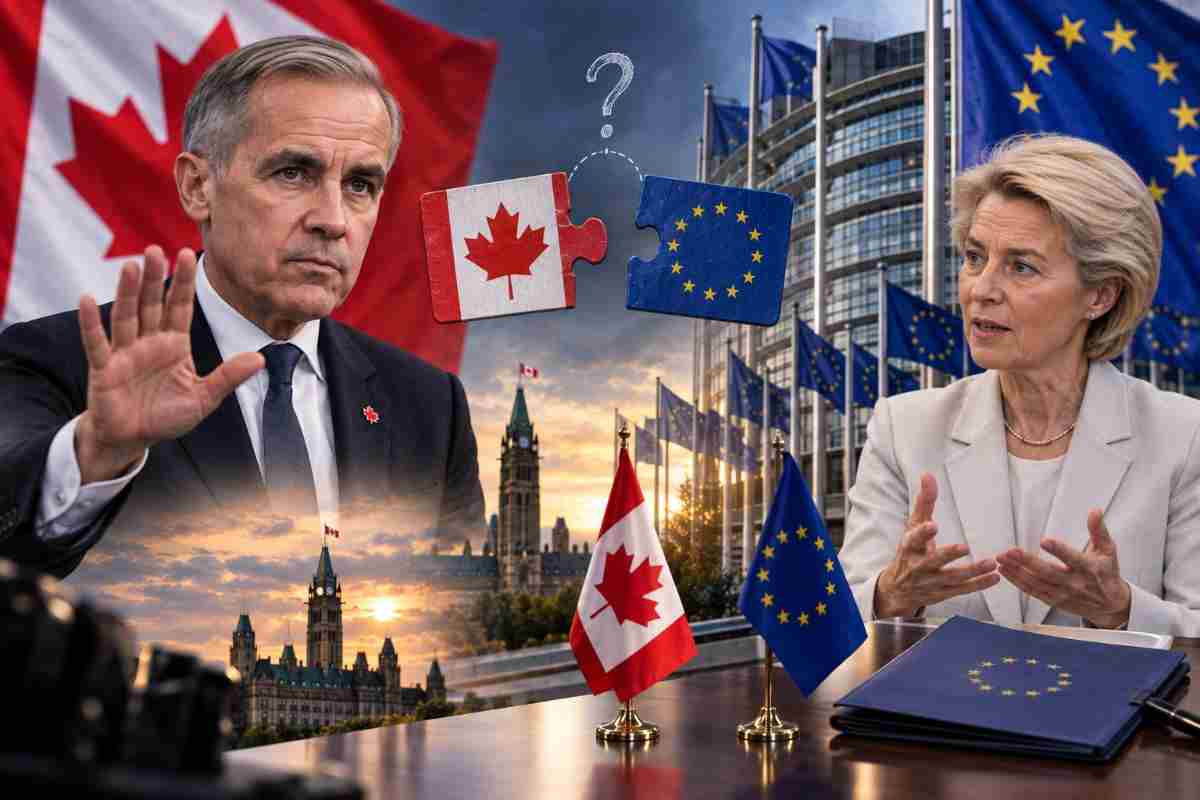
Subheading: Prime Minister Mark Carney says Canada wants a “unique alliance” with the European Union, even as European Commission President Ursula von der Leyen proposes making Canada the bloc’s first associate member.
Ottawa Avoids Committing to the New Title
Canada is not yet committing to the label “associate member” for its proposed closer relationship with the European Union, despite a major endorsement of the idea from European Commission President Ursula von der Leyen.
Von der Leyen proposed on Wednesday that Canada become the EU’s first associate member during her annual State of the European Union address in Strasbourg. Canadian Prime Minister Mark Carney was present in the European Parliament for the speech.
Carney has previously made clear that Canada is not seeking full EU membership. Instead, Ottawa has described its objective as a “unique alliance” built around shared interests, strategic cooperation and stronger economic ties.
Carney Focuses on a ‘Unique Alliance’
The Canadian government has been careful not to define the future relationship around a particular membership label.
Ahead of his European trip, Carney said Canada wanted to work with the EU based on common values, priorities and complementary strengths. His government has focused discussions on areas including critical minerals, energy, defence, research and advanced technologies.
Canadian officials have also indicated that Ottawa wants a relationship tailored specifically to Canadian priorities rather than simply copying arrangements used by countries such as Norway or Switzerland.
The emphasis reflects Canada’s effort to strengthen relationships with other major economies while its trade relationship with the United States remains under pressure.
Von der Leyen Opens the Door
Von der Leyen’s proposal has nevertheless moved the discussion into new territory.
Addressing Carney directly, she said she wanted to work with Canada on opening the door for it to become the EU’s first associate member. She presented the idea as part of a broader effort to strengthen partnerships with countries that share democratic values and strategic interests with Europe.
The European Commission president highlighted cooperation in artificial intelligence, climate policy, the Arctic, Ukraine, defence, raw materials and supply chains.
She also described plans for deeper cooperation in advanced manufacturing, technology and defence industries.
The ‘Associate Member’ Status Does Not Exist Yet
One of the biggest challenges is that “associate member” is not currently an established EU membership category.
The EU has 27 full member states, while its existing relationships with non-member countries vary considerably. Creating a new status for Canada would therefore require negotiations over what rights, obligations and institutional access such an arrangement would provide.
It is also unclear whether all EU member states would support the proposal in its current form.
Reuters reported that one EU diplomat expressed surprise at the announcement, while German officials said they supported deeper cooperation with Canada but suggested the terminology itself should be reconsidered.
Trade Remains a Central Issue
Canada and the EU already have an extensive economic relationship through the Comprehensive Economic and Trade Agreement, or CETA.
The agreement has been provisionally applied, but it has not yet been fully ratified by every EU member state. Canadian and European officials are therefore also looking at how existing agreements can be strengthened and implemented more effectively.
Carney’s European strategy comes as Ottawa seeks to diversify its international trade. Around 70% of Canadian exports go to the United States, making the American market a particularly important part of Canada’s economy.
Defence and Critical Minerals Could Drive Cooperation
Beyond trade, Canada and Europe are exploring closer cooperation in defence, critical minerals, energy and technology.
Canada has already become the first non-European country to participate in the EU’s SAFE defence procurement programme, creating opportunities for Canadian defence companies to take part in European procurement projects.
Critical minerals are another major area of interest, as Europe seeks secure supply chains for materials needed in batteries, advanced manufacturing and clean-energy technologies.
The Arctic could also become an important part of the partnership, given Canada’s geographic position and Europe’s growing interest in Arctic security and infrastructure.
Canada-EU Talks Are Still Developing
Despite the public discussion over associate membership, the precise structure of Canada’s future relationship with the EU remains undecided.
Carney is expected to address the European Parliament as discussions continue, while the next major stage of negotiations is expected at the Canada-EU summit scheduled for Montreal in October.
For now, Ottawa appears to be concentrating on the substance of a closer partnership rather than formally committing to the “associate member” designation.
Conclusion
Canada’s position on EU associate membership remains open but not formally committed. While Ursula von der Leyen has publicly proposed making Canada the European Union’s first associate member, Carney’s government continues to describe its goal as a “unique alliance” rather than membership.
The two sides are already working toward deeper cooperation in trade, defence, critical minerals, energy and technology. Whether that eventually develops into a new associate-member framework—or a different form of strategic partnership—will depend on negotiations between Canada and the EU’s 27 member states.
For now, the proposal has opened an important new discussion about the future of Canada-EU relations, but its final structure and legal status remain unresolved.