

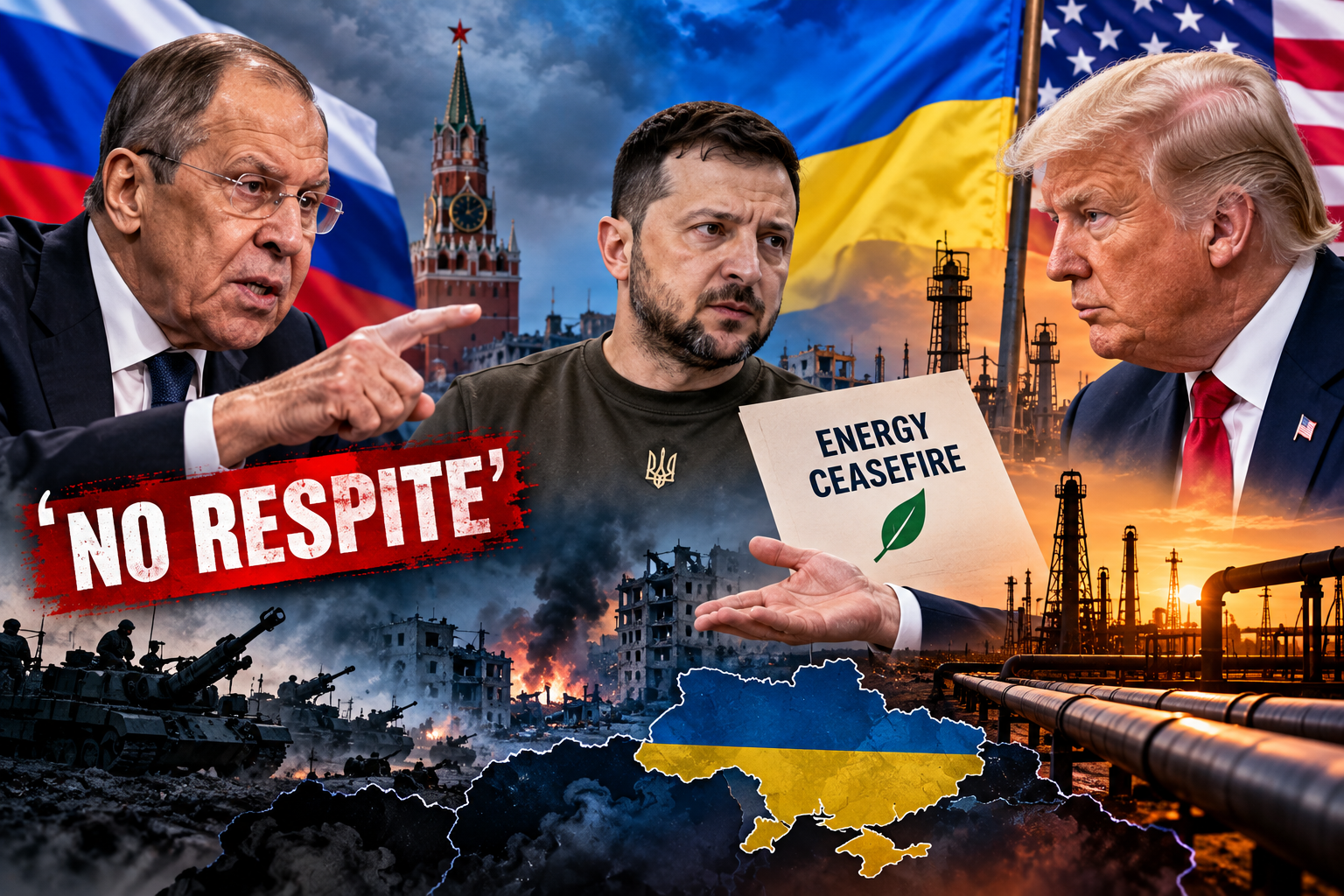
Russian Foreign Minister Sergey Lavrov says Ukraine does not deserve a pause in fighting, while President Volodymyr Zelenskyy signals readiness to halt attacks on Russian energy facilities if Moscow agrees to stop striking Ukraine’s energy infrastructure.
Russia and Ukraine remain divided over a proposed energy ceasefire announced by US President Donald Trump, with Russian Foreign Minister Sergey Lavrov rejecting the prospect of giving Kyiv a respite from the fighting. Ukrainian President Volodymyr Zelenskyy, meanwhile, has welcomed the possibility of suspending attacks on energy infrastructure, provided both sides comply.
The disagreement emerged on October 12, 2026, after Trump announced that Russia and Ukraine had agreed to stop attacking each other’s energy facilities. However, the announcement created uncertainty because Kyiv said it had not received the full details, while Moscow had not clearly confirmed that it accepted the proposed arrangement. Ukrainian officials subsequently reported further Russian strikes on energy infrastructure. <Cite refs={[“turn880872news14″,”turn880872search0″,”turn880872search2”]}/>
Lavrov Says Ukraine Does Not Deserve a Respite
Russian Foreign Minister Sergey Lavrov rejected the idea of offering Ukraine a temporary pause in hostilities, questioning whether Kyiv had earned such a concession.
Lavrov’s remarks came in response to questions about the energy ceasefire announced by Trump. He also expressed distrust of Ukrainian assurances, arguing that a pause could allow Ukraine to strengthen its military capabilities with assistance from European countries. <Cite refs={[“turn880872search0″,”turn880872search10”]}/>
The Russian position reflects Moscow’s preference for a broader settlement rather than a temporary suspension of selected attacks. Kremlin spokesperson Dmitry Peskov has similarly said Russia wants a long-term peace agreement rather than a short ceasefire.
Moscow has also rejected Zelenskyy’s proposal for a 60-day ceasefire that would create conditions for holding presidential elections in Ukraine. Russian officials have instead argued that any temporary pause should not provide Kyiv with an opportunity to regroup militarily. <Cite refs={[“turn880872news14″,”turn880872news5”]}/>
Zelenskyy Says Ukraine Is Ready for an Energy Ceasefire
Zelenskyy has said Ukraine is prepared to stop attacking Russian energy facilities if Moscow ends its strikes on Ukrainian energy infrastructure.
Speaking via video link to the Warsaw Security Forum on October 12, the Ukrainian president said his country supported the proposed arrangement but was waiting for details about its terms and implementation.
Ukraine has repeatedly targeted Russian oil refineries and other energy-related facilities as part of its campaign against infrastructure that Kyiv says supports Moscow’s war effort. Russia, in turn, has continued attacks on Ukrainian power stations, gas facilities and other energy targets.
Zelenskyy said Ukraine had refrained from attacking Russian refineries during the night following Trump’s announcement. He warned that Kyiv would respond if Russia continued striking Ukrainian energy infrastructure.
The Ukrainian president also called on Washington to ensure that Moscow respected any agreed restrictions, arguing that an energy ceasefire could become an important step toward broader efforts to end the war. <Cite refs={[“turn880872search1″,”turn880872search3″,”turn880872news14”]}/>
Russian Strikes Raise Questions Over the Proposed Truce
The proposed ceasefire faced immediate questions after Ukrainian authorities reported additional attacks on energy facilities and residential areas.
Zelenskyy said Russian drones had struck a gas production facility and that attacks had also affected other infrastructure. Ukrainian officials reported casualties in Kharkiv, where residential buildings and energy facilities came under attack.
Reuters reported on October 12 that Russian strikes had killed several people and wounded dozens across Ukraine. The attacks included incidents affecting energy infrastructure, prompting Kyiv to accuse Moscow of violating the ceasefire announced by Trump. <Cite refs={[“turn880872news14″,”turn880872search11”]}/>
The reports have raised concerns about whether the proposed arrangement is operational. Trump announced that the ceasefire would take effect immediately, but the precise scope, monitoring arrangements and consequences for violations remained unclear.
Russia has not publicly confirmed the terms of the agreement as described by the US president. Consequently, it remains uncertain whether both sides are operating under a mutually accepted and clearly defined set of conditions.
Trump’s Initiative Comes Amid Rising Fuel Prices
Trump’s push for an energy ceasefire comes as his administration faces concerns over rising fuel costs and the wider effects of disruptions to global energy supplies.
The US president has criticised Ukraine’s attacks on Russian oil refineries, arguing that they contribute to pressure on fuel markets. His administration has also pursued arrangements involving Russian diesel supplies in an effort to increase available fuel and ease price pressures.
Zelenskyy has disputed the suggestion that Ukrainian attacks are the principal reason for higher diesel prices, pointing instead to disruptions around the Strait of Hormuz and wider regional tensions.
The dispute illustrates how energy security has become intertwined with diplomacy and the military conflict. For Russia, oil and gas revenues remain important to government finances, while Ukraine’s energy infrastructure is essential to civilian life, industry and national defence. <Cite refs={[“turn880872news14″,”turn880872news15″,”turn880872search13”]}/>
European Allies Call for Continued Pressure on Moscow
European governments have expressed caution about the proposed energy truce, with officials stressing that any agreement must produce verifiable changes on the ground.
European Union foreign policy chief Kaja Kallas said she would welcome a ceasefire that prevented people from being killed, rather than one limited to energy facilities. She also called for continued pressure on Russia through sanctions.
German Chancellor Friedrich Merz similarly argued that Moscow would negotiate seriously only under pressure, indicating that Germany intended to maintain sanctions in response to Russia’s attacks on Ukrainian civilian energy infrastructure. <Cite refs={[“turn880872news14″,”turn880872search12”]}/>
European governments have continued to support Ukraine’s defence while urging Washington to maintain pressure on Moscow. Their position reflects concern that a limited truce could fail without clear commitments, monitoring and consequences for violations.
Zelenskyy Links Elections to a Wider Ceasefire
The dispute over energy attacks has also coincided with renewed discussion about presidential elections in Ukraine.
Zelenskyy said Ukraine could organise elections if Russia agreed to a full ceasefire lasting at least 60 days. He argued that voters and election workers would need adequate security, given the continuing threat from missiles and drones.
Ukraine has suspended national elections under martial law during the war. Zelenskyy has maintained that any vote would require conditions that allow citizens to participate safely and that meet the country’s legal requirements.
The Kremlin has rejected the proposed 60-day pause, reiterating its preference for a longer-term settlement. The disagreement means that neither a broader ceasefire nor an election timetable has been established. <Cite refs={[“turn880872news5″,”turn880872search2″,”turn880872search6”]}/>
Conclusion
The contrasting positions of Lavrov and Zelenskyy underline the continuing obstacles to a negotiated reduction in fighting between Russia and Ukraine. Moscow has rejected the idea of offering Kyiv a temporary respite, while Ukraine says it is ready to halt attacks on Russian energy facilities if Russia does the same.
Trump’s energy ceasefire announcement has created a possible opening for limited de-escalation, but reported attacks after the announcement and the absence of clear, mutually confirmed terms have raised doubts about its implementation.
For now, the key questions are whether Russia will formally accept the proposed restrictions, whether both sides can verify compliance and whether a limited pause in energy attacks can contribute to broader negotiations. Until those issues are resolved, the prospect of a lasting ceasefire remains uncertain.