

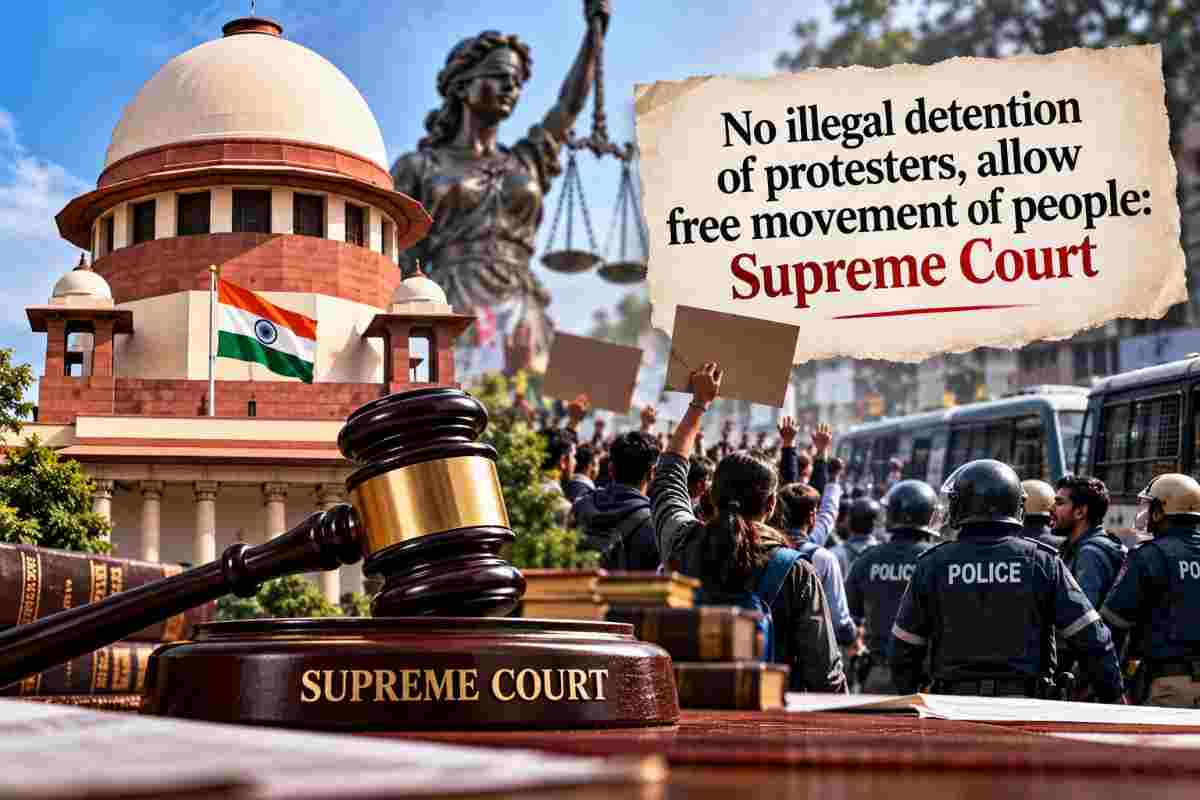
India’s top court has directed authorities to prevent unlawful detention, review security barricades and ensure normal public transport and internet services amid protests in the national capital over electoral-roll revisions.
The Supreme Court of India on Sunday, October 11, directed authorities to ensure that peaceful protesters are not illegally detained and that people can move freely across Delhi, subject to traffic regulations and applicable law. The directions came amid demonstrations against Chief Election Commissioner Gyanesh Kumar and alleged irregularities in the Special Intensive Revision (SIR) of electoral rolls.
A bench comprising Justices Joymalya Bagchi and V. Mohana issued the directions during a special Sunday hearing after petitions raised concerns about restrictions on public movement, metro services and the detention of protesters. The court also sought responses from authorities over alleged non-compliance with its earlier orders concerning public transport. <Cite refs={[“turn241742search1″,”turn241742search2″,”turn241742news5”]}/>
Supreme Court Emphasises Protection of Peaceful Protesters
The court made clear that people participating in peaceful assemblies must not be detained except through procedures established by law.
It particularly referred to peaceful and unarmed gatherings taking place outside areas where prohibitory orders under Section 163 of the Bharatiya Nagarik Suraksha Sanhita (BNSS) are in force.
Section 163 empowers executive magistrates to issue temporary directions in urgent situations to prevent disturbances to public peace and safety. Such orders can restrict gatherings under specified circumstances, but the Supreme Court stressed that authorities must act within the law when enforcing restrictions.
The directions do not grant protesters unrestricted permission to gather anywhere in Delhi. Instead, they require authorities to distinguish between lawful restrictions imposed for public safety and measures that unnecessarily interfere with peaceful assembly. <Cite refs={[“turn241742news5″,”turn241742search2”]}/>
Delhi Metro and Railway Services Must Operate Normally
The Supreme Court also directed that metro and railway services should operate normally unless restrictions are necessary because of a genuine public-order concern.
The issue arose after several Delhi Metro stations were closed or restricted during demonstrations planned in the capital. The restrictions caused concern among commuters and prompted petitions alleging that the measures had created unnecessary inconvenience.
During the hearing, Solicitor General Tushar Mehta informed the bench that restrictions had applied to 45 of the Delhi Metro network’s 303 stations on October 10. Authorities were asked to ensure that public transport arrangements complied with the court’s directions.
The bench indicated that transport services could be regulated where necessary but should not be shut down altogether without adequate justification. The aim is to maintain public safety while allowing ordinary commuters to continue travelling. <Cite refs={[“turn241742search0″,”turn241742search4”]}/>
Authorities Asked to Review Barricades and Allow Free Movement
The court directed officials to review barricading arrangements across Delhi and permit the free movement of people, subject to traffic regulations and legitimate security requirements.
Barricades had been placed at several locations as police prepared for demonstrations in central Delhi. The court said their necessity should be reassessed in light of law-and-order conditions and traffic requirements.
It also addressed access to the Supreme Court and other courts, directing that notices concerning prohibitory restrictions near court premises be removed where necessary to prevent confusion or obstruction.
The bench stressed that lawyers must be allowed to perform their professional duties without unnecessary hindrance. These directions seek to ensure that security arrangements do not prevent access to courts or disrupt essential public activities. <Cite refs={[“turn241742search2″,”turn241742search3”]}/>
Internet Services Should Remain Undisturbed, Subject to Law
Internet connectivity was another key issue during the hearing.
The Supreme Court directed that internet services should remain undisturbed, while clarifying that the administration retains powers available under applicable laws, including the Information Technology Act.
The direction came after internet restrictions and disruptions to public services were reported during the previous day’s security measures. The court’s approach indicated that restrictions must be assessed according to the law and the circumstances rather than imposed automatically because demonstrations are taking place.
Internet access is important during public gatherings because people rely on digital services for communication, navigation, news and essential transactions. The court’s directions seek to prevent unnecessary disruption while preserving lawful powers to respond to genuine security threats. <Cite refs={[“turn241742news5″,”turn241742search1”]}/>
Protests Over Electoral-Roll Revision Trigger Security Measures
The demonstrations were organised by activists associated with the Cockroach Janta Party (CJP) and other groups demanding the resignation of Chief Election Commissioner Gyanesh Kumar.
The protesters have raised objections to the Special Intensive Revision of electoral rolls, alleging that the exercise could unfairly affect voters. The allegations remain contested and have become part of a broader political dispute over the electoral-roll process.
Police detained large numbers of protesters during demonstrations on October 10, while senior CJP figures were also detained after arriving in Delhi. Authorities cited security and public-order concerns surrounding the planned gatherings.
Opposition groups and activists criticised the restrictions, while the authorities have maintained that security measures were necessary. Allegations of mistreatment of detainees have also circulated, although individual claims require independent verification. <Cite refs={[“turn241742news6″,”turn241742news7”]}/>
Court Seeks Explanation Over Alleged Non-Compliance
Alongside its directions on detention and movement, the Supreme Court issued notices seeking responses from the authorities named in a contempt petition.
The petition alleged that restrictions on metro services and other measures had violated earlier judicial directions. The court asked the concerned officials to submit affidavits explaining their actions and provide a compliance report.
Issuing notice does not mean that the court has already found the authorities guilty of contempt. The officials will have an opportunity to respond before the court decides how to proceed.
The matter is scheduled for further consideration, with related petitions concerning alleged mass detentions and restrictions expected to be heard alongside the main proceedings. <Cite refs={[“turn241742search1″,”turn241742search4”]}/>
Conclusion
The Supreme Court’s latest directions seek to balance public safety with constitutional protections for peaceful assembly, freedom of movement and access to essential services.
By calling for lawful detention procedures, normal public transport, uninterrupted internet services subject to law and a review of barricades, the court has emphasised that security measures must remain proportionate and legally justified.
The proceedings will continue as authorities respond to the court’s notices. The outcome could help clarify how restrictions should be imposed during major demonstrations while protecting both public order and fundamental rights.