

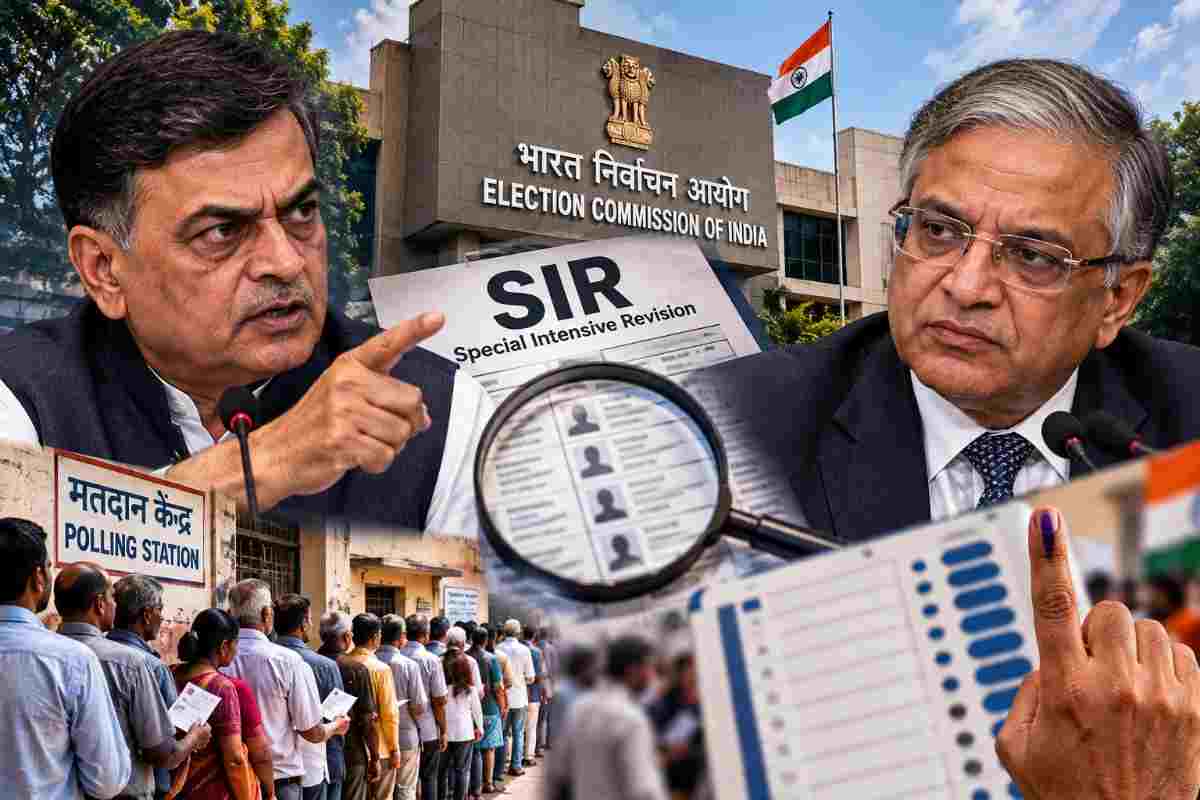
Former Union minister and ex-Home Secretary R.K. Singh has questioned the legality of the Special Intensive Revision, while the Election Commission maintains that the exercise is being conducted through lawful procedures.
Former Union minister and former Union Home Secretary R.K. Singh has accused Chief Election Commissioner Gyanesh Kumar of committing alleged “illegalities” during the Election Commission of India’s Special Intensive Revision (SIR) of electoral rolls.
In an open letter addressed to citizens, Singh questioned the legal basis and implementation of the nationwide voter-roll revision exercise. He alleged that several decisions connected with voter deletions, new registrations and the digital management of electoral rolls were contrary to provisions of the Representation of the People Act, 1950.
Singh’s intervention comes amid an ongoing debate over the SIR process and reported disagreements within the Election Commission over aspects of voter registration and electoral-roll management.
Singh Questions Legal Basis of Nationwide SIR
One of Singh’s main arguments concerns Section 21 of the Representation of the People Act, 1950.
He argued that an intensive revision can be ordered only in specified circumstances, with reasons recorded in writing and for a constituency or part of a constituency. On that basis, Singh questioned whether conducting an intensive revision across the country was legally permissible.
He also questioned whether the decision to undertake the nationwide exercise was taken by the full Election Commission or by the Chief Election Commissioner. These are Singh’s legal and procedural objections, rather than findings established by a court.
Allegations Over Deleted Voter Names
Singh also raised concerns about voters whose names were removed during the revision process.
He alleged that some voters were required to submit fresh applications through Form 6 and establish their eligibility after their names were excluded from the rolls. Singh argued that this effectively shifted the burden of proving eligibility onto voters.
He referred to a 1995 Supreme Court judgment involving electoral-roll disputes and argued that the responsibility for establishing grounds for deletion should rest with the relevant authorities or objectors rather than automatically with an already-enrolled voter.
The Election Commission, however, has continued to defend the SIR process and has said that its actions are being taken within the applicable legal framework.
Dispute Over Form 6
Another issue highlighted by Singh concerns Form 6, which is used for applications to register as a new voter.
Singh alleged that an additional appendix requiring applicants to provide details connected with their parents’ entries in the 2003 electoral roll was introduced without proper authority. He questioned how young voters would obtain historical electoral-roll information needed to complete such requirements.
The issue has also featured in reported disagreements among Election Commissioners. Following a September 26 meeting, the Election Commission said the older version of Form 6 would continue to be used when the SIR exercise was not underway, while the declaration attached to the SIR process had been upheld by the Supreme Court.
Questions Over Digital Electoral Rolls
Singh further questioned the centralisation of electoral-roll data and the role of digital systems in identifying what the Election Commission describes as discrepancies.
The controversy comes after reports that Election Commissioners Sukhbir Singh Sandhu and Vivek Joshi had raised objections on several occasions over decisions relating to voter registration, electoral-roll data and the SIR process.
According to The Indian Express, the two commissioners had formally raised concerns at least 14 times over a 10-month period. Their objections reportedly included questions about changes to voter-registration procedures and access to the digital electoral-roll database.
The Election Commission has subsequently announced a review of its voter-roll software, including an assessment of whether it complies with electoral laws and rules.
Singh Calls for Legal Action
Beyond questioning the process, Singh has called on opposition parties to consider filing criminal cases against the Chief Election Commissioner.
He argued that a parliamentary impeachment effort would not succeed because opposition parties do not have sufficient numbers. Singh instead urged opposition parties to unite and demand the resignation of the Chief Election Commissioner and the other Election Commissioners.
He also called for elections held while voter-related appeals were pending to be reconsidered, and separately advocated returning to ballot-paper voting. These are political demands made by Singh and do not represent decisions taken by the Election Commission or the courts.
Election Commission Faces Wider SIR Debate
Singh’s allegations come as the SIR has already become the subject of wider political and legal debate.
The Election Commission has defended the revision process, while critics have raised concerns about the possibility of eligible voters being excluded. The Supreme Court has previously considered challenges concerning the SIR and upheld the exercise while also clarifying the limits of the Election Commission’s authority regarding citizenship determination.
Separately, the Election Commission recently ordered a review of its voter-roll software following reports about internal concerns over changes to electoral-roll management. The Commission said a committee involving a senior election official and an independent technology expert would examine whether the software complied with legal requirements.
What Happens Next?
The controversy is likely to continue as the Election Commission reviews aspects of its electoral-roll systems and political parties debate the broader implications of the SIR.
Singh’s allegations place renewed attention on the legal authority behind voter deletions, the procedures for adding new electors and the role of centralised digital systems. Whether individual decisions amounted to violations of election law would ultimately depend on the relevant legal and judicial processes rather than the allegations alone.
For now, the dispute remains centred on how the SIR should be conducted and what safeguards should apply when electoral-roll entries are added, removed or challenged.
Conclusion
R.K. Singh has launched a strong challenge to the manner in which the Special Intensive Revision is being implemented, accusing CEC Gyanesh Kumar and the Election Commission of violating electoral law.
The allegations come amid separate reported disagreements within the Election Commission and a broader review of electoral-roll software. However, Singh’s claims remain allegations and should be distinguished from established judicial findings.
The continuing debate is likely to keep the focus on voter-roll accuracy, legal safeguards and the procedures used to ensure that eligible citizens can participate in elections.