

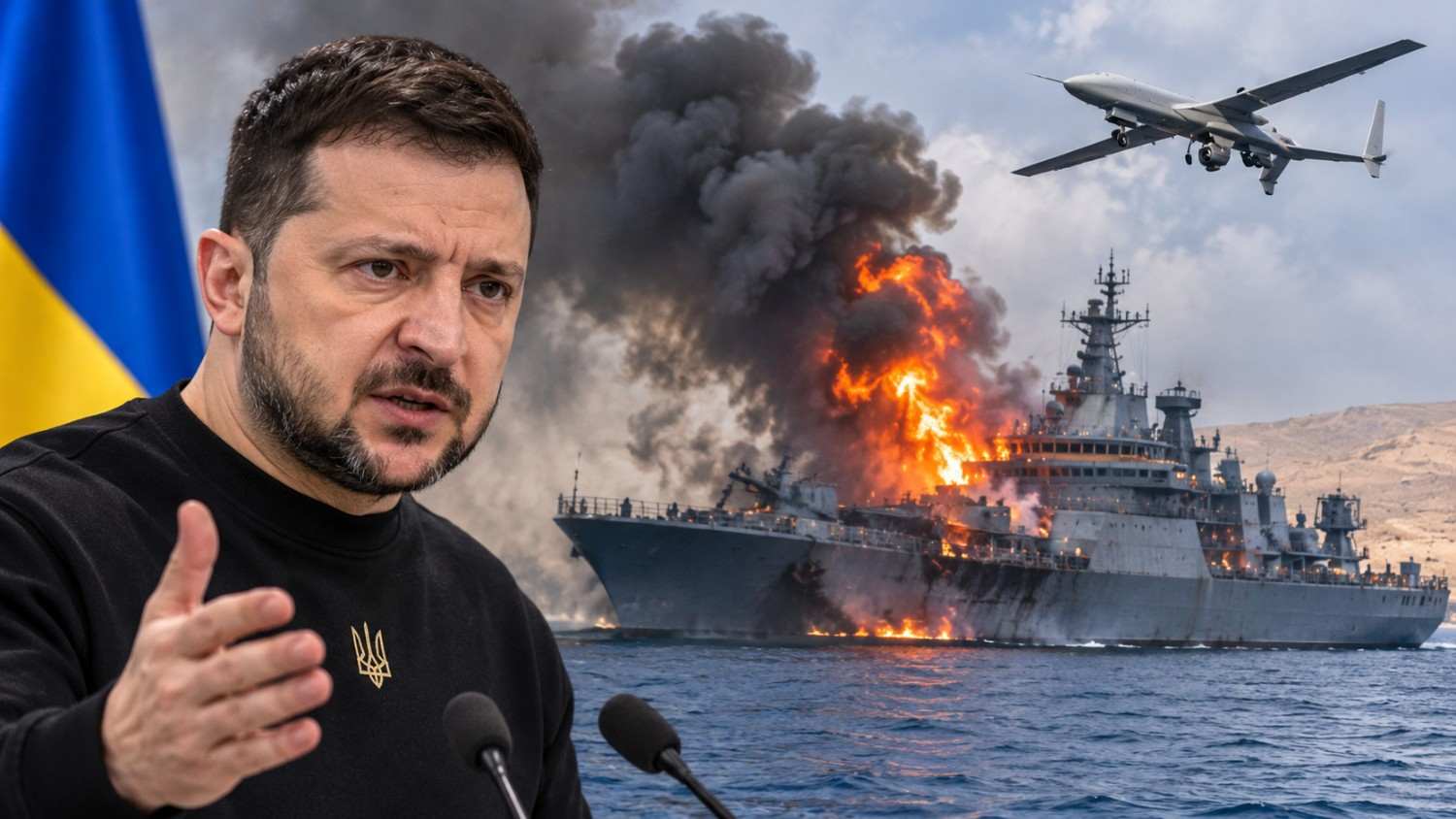
Ukrainian President Volodymyr Zelensky says Ukrainian forces have sunk the Russian corvette Merkury in a surprise drone operation at Benghazi Naval Base. The attack, carried out thousands of kilometres from the Ukrainian front line, marks a significant expansion of Kyiv’s campaign against Russian military assets and logistics networks.
By CK Sharma | World Affairs | NewsBee Media Inc.
Ukraine has claimed responsibility for a major attack on a Russian naval vessel stationed at a port in eastern Libya, marking an extraordinary development in the ongoing Russia-Ukraine war.
On November 23, 2026, Ukrainian President Volodymyr Zelensky announced that Ukrainian forces had used seven domestically produced naval drones to attack and sink the Russian corvette Merkury at Benghazi Naval Base. The operation reportedly took place on Sunday, November 22.
Zelensky described the operation as an exemplary military achievement, stating that Ukrainian forces had successfully hit their intended targets despite Russian efforts to intercept the drones.
The attack is particularly significant because it took place approximately 2,400 kilometres from the Ukrainian front line, demonstrating how Kyiv is increasingly targeting Russian military assets far beyond the immediate battlefield.
Russian Warship Merkury Targeted at Benghazi Port
According to Zelensky, the primary target was the Russian corvette Merkury, one of Russia’s newer naval vessels, which entered service in 2023.
The vessel was reportedly docked at Benghazi Naval Base in eastern Libya when the attack took place.
Ukrainian forces deployed seven naval drones to carry out the operation. Ukraine’s Security Service (SBU) later stated that the drones were launched from a so-called mothership positioned near the target.
Zelensky claimed that the attack successfully sank the warship and also destroyed a Russian Ka-27 military helicopter that was aboard the vessel.
However, Libyan officials briefed on the incident provided a slightly different account. According to information reported by the Associated Press, at least four drones were intercepted, while two struck the Russian corvette, causing severe damage.
Satellite imagery also showed the vessel largely capsized, with only part of its structure visible above the water.
Russia had not issued an immediate official response to Ukraine’s claims at the time of reporting.
Ukraine Also Claims Another Russian Vessel Was Hit
The Ukrainian president revealed that the operation involved another Russian-linked vessel, the dry cargo ship MV Angara.
Zelensky alleged that the ship had been used by Russia to transport military equipment and weapons.
Ukraine’s Security Service described the operation as a carefully planned mission intended to disrupt Russian naval logistics.
According to the Ukrainian account, the Merkury had regularly escorted Russian naval convoys, including the MV Angara.
The attack therefore appears to have targeted not only a warship but also the wider network supporting Russian military transportation and maritime operations.
Ukraine has increasingly relied on domestically developed naval drones to challenge Russia’s naval strength. These relatively small, remotely operated vessels can carry explosives and strike larger ships, often creating significant damage.
The latest operation demonstrates how Ukraine is attempting to use technology and unconventional tactics to offset Russia’s larger military resources.
Libya Becomes Part of the Wider Russia-Ukraine Conflict
The attack has raised serious concerns about Libya’s growing involvement in international military rivalries.
Libya has remained politically divided since the 2011 uprising that removed longtime leader Muammar Gaddafi. The country continues to have competing political and military authorities.
The internationally recognised Government of National Unity is based in Tripoli in western Libya, while eastern and southern parts of the country are controlled by forces associated with military commander Khalifa Haftar.
Russia has maintained close relations with Haftar’s forces and has sought to strengthen its military and strategic presence in the region.
The Russian vessel had reportedly docked at Benghazi to refuel and receive supplies under a cooperation agreement with the eastern-based Libyan authorities.
Following the attack, the eastern Libyan administration raised concerns about the possibility that Ukrainian drones had been launched from western Libyan territory.
Its authorities called for an international investigation into the suspected involvement of Ukrainian personnel and facilities in preparing the operation.
The allegations have not been independently established.
United Nations Calls for Investigation
The United Nations Support Mission in Libya (UNSMIL) expressed serious concern over the incidents involving the Russian vessel and other maritime activity near Benghazi.
The UN mission called for an immediate, independent and transparent investigation, while urging all parties to respect Libya’s sovereignty and territorial integrity.
It also warned against allowing the country to become a battleground for conflicts involving foreign powers.
“Libya cannot afford, and must not become a battleground for foreign conflicts,” the UN mission stated.
The warning reflects growing international concern that Libya’s fragile political situation could be further destabilised by military operations connected to the Russia-Ukraine war.
The incident also highlights the risks associated with foreign military personnel, weapons and naval assets operating in a country that remains politically divided.
Why the Attack Is Significant for Russia
The destruction of the Merkury, if confirmed as claimed by Ukraine, would represent a serious setback for Russia’s naval operations.
The vessel was among the newer additions to the Russian Navy and had been presented by Moscow as an example of its modern naval capabilities.
The attack also challenges the assumption that Russian military vessels and logistical networks are safe when operating far from Ukraine’s immediate coastline.
Throughout the war, Ukraine has repeatedly used naval drones and missiles to target Russian ships, particularly in the Black Sea.
These operations have forced Russia to reconsider how it protects its naval assets and maintains access to important maritime routes.
By striking a Russian warship in Libya, Ukraine has demonstrated the potential reach of its naval drone technology and its willingness to target Russian military infrastructure outside the traditional theatre of war.
For Moscow, the incident could create additional security concerns around its military relationships and maritime activities in the Mediterranean region.
A Wider Challenge for Mediterranean Security
The attack could also have implications beyond Russia and Ukraine.
The Mediterranean is an important strategic region connecting Europe, North Africa and the Middle East. It carries significant commercial shipping traffic and supports major energy and military routes.
Any expansion of the Russia-Ukraine conflict into this region could create additional risks for commercial vessels, regional governments and international maritime security.
The United Nations has already warned that Libya should not become a platform for external military confrontations.
The situation is particularly sensitive because several international powers maintain strategic interests in Libya and the wider North African region.
If further attacks take place, the consequences could extend beyond the immediate military confrontation between Moscow and Kyiv.
Conclusion
Ukraine’s reported attack on the Russian corvette Merkury in Libya represents a significant development in the Russia-Ukraine war.
The operation demonstrates Kyiv’s growing ability to use naval drones against Russian military assets at considerable distances from the battlefield. It also raises questions about the security of Russian naval logistics and Moscow’s wider military presence in North Africa.
However, the incident has created new concerns for Libya, whose political divisions make it particularly vulnerable to external conflicts.
While Ukraine has described the operation as a military success, the wider consequences remain uncertain.
The most important question now is whether this attack will remain an isolated operation or mark the beginning of a broader expansion of the Russia-Ukraine conflict into the Mediterranean.
For Libya and the international community, preventing further escalation will be essential to protecting regional stability.