

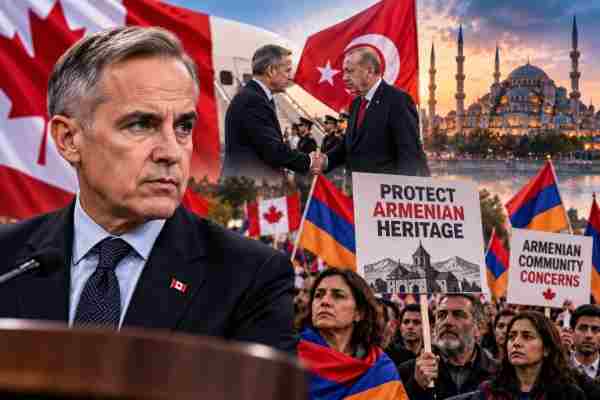
Prime Minister Mark Carney’s visit to Türkiye to strengthen trade, energy and defence ties has prompted concern among members of Canada’s Armenian community, who say historical grievances and unresolved human rights issues should remain part of Ottawa’s diplomatic considerations.
Canadian Prime Minister Mark Carney’s planned visit to Türkiye has sparked concern among members of the Armenian Canadian community, with some expressing alarm about the potential implications of closer bilateral relations. The concerns reflect longstanding tensions surrounding the Armenian genocide, Türkiye’s regional policies and Canada’s previous decisions on military exports.
Carney is scheduled to visit Ankara and Istanbul from October 21 to 24, 2026, for meetings with Turkish President Recep Tayyip Erdoğan, government officials and business leaders. The federal government says the trip is intended to expand cooperation in trade, investment, energy, mining, defence and advanced technology. It will mark the first dedicated bilateral visit to Türkiye by a Canadian prime minister.
For some Armenian Canadians, however, the visit raises questions about how Canada can pursue economic and security interests while maintaining its commitments to historical recognition, human rights and the protection of vulnerable communities.
Why the Visit Has Raised Concern
Canada is home to a substantial Armenian diaspora, with more than 60,000 Canadians of Armenian descent, according to the Prime Minister’s Office. Many community members maintain close cultural, family and historical connections with Armenia.
The Armenian genocide remains central to the community’s concerns about Türkiye. Historians estimate that approximately 1.5 million Armenians were killed or died during the mass deportations and killings carried out under the Ottoman Empire during the First World War.
Canada formally recognised the Armenian genocide in 2004, and the federal government has subsequently marked April 24 as a day of remembrance. Türkiye rejects the characterisation of the events as genocide, arguing that the deaths occurred amid wartime conditions and that the historical interpretation is disputed.
For Armenian Canadians, closer diplomatic engagement with Ankara can therefore carry significance beyond trade and investment. Some fear that prioritising strategic interests without addressing historical and contemporary grievances could weaken the emphasis placed on accountability and human rights.
The concerns do not necessarily mean that all members of the Armenian Canadian community oppose diplomatic engagement with Türkiye. Rather, they highlight disagreement over how Canada should balance economic cooperation with historical responsibilities and human rights considerations.
Trade and Defence Cooperation Are Central to Carney’s Agenda
Carney’s visit comes as Ottawa seeks to diversify Canada’s international partnerships and reduce its economic dependence on the United States.
The federal government has identified Türkiye as an important partner because it is a member of both NATO and the G20. Ottawa says expanding cooperation could create opportunities for Canadian businesses and strengthen the two countries’ economic and security relationship.
The two countries recorded approximately C$4.3 billion in bilateral merchandise trade in 2025, including C$1.1 billion in Canadian exports and C$3.2 billion in imports from Türkiye.
Their discussions are expected to cover energy, mining, aerospace, advanced technologies and defence. Canada and Türkiye have also begun negotiations toward a comprehensive free-trade agreement, following discussions between Carney and Erdoğan during the NATO summit in Ankara in July 2026.
The government views these areas as opportunities to strengthen Canada’s economic resilience and expand commercial relationships beyond its traditional markets.
However, the emphasis on defence cooperation has added sensitivity to the visit because of previous disputes over Canadian military exports to Türkiye and their reported use in the conflict involving Armenia and Azerbaijan.
Background: Canada’s Military Export Dispute With Türkiye
Canada and Türkiye have experienced tensions over military equipment exports, particularly in connection with the Nagorno-Karabakh conflict.
In 2020, Canada suspended certain military export permits to Türkiye after allegations that Canadian-made optical and targeting technology had been used by Azerbaijani forces in the conflict. The equipment was associated with drones used during the fighting.
The dispute became particularly sensitive among Armenian Canadians, who raised concerns about the consequences of military technology transfers for Armenian civilians and forces.
Canada later lifted its restrictions on military exports to Türkiye in 2024, subject to conditions and safeguards. The decision formed part of a broader effort to restore defence cooperation between the two NATO allies.
The issue continues to shape perceptions of the bilateral relationship. For critics of closer defence ties, the central question is whether Canadian safeguards can adequately address concerns about how exported equipment might be used.
For the government, defence cooperation is also connected to NATO’s collective security objectives and the potential benefits of working with an established alliance partner.
Armenia and Türkiye Have a Complicated Relationship
Relations between Armenia and Türkiye have historically been difficult, shaped by the legacy of the First World War, closed borders and disagreements over regional security.
The two countries have taken steps toward normalisation in recent years, including diplomatic discussions intended to restore direct contacts and improve cross-border relations. Progress has remained limited, however, and the historical dispute over the Armenian genocide continues to be a major obstacle.
The conflict between Armenia and Azerbaijan over Nagorno-Karabakh has added another layer of complexity. Türkiye has maintained close ties with Azerbaijan, while many Armenians view Ankara’s support for Baku through the lens of regional security and the history of violence against Armenians.
Against this background, Canada’s engagement with Türkiye is being viewed by some members of the Armenian diaspora as part of a wider regional political picture rather than simply a bilateral trade initiative.
The Canadian government has also maintained relations with Armenia. In May 2026, Carney met Armenian Prime Minister Nikol Pashinyan and discussed the countries’ bilateral relationship and shared priorities. The meeting marked the first official visit to Armenia by a Canadian prime minister in nearly a decade.
Ottawa Faces the Challenge of Balancing Competing Priorities
Carney’s visit highlights a familiar challenge in Canadian foreign policy: how to pursue economic and security interests while responding to concerns about human rights and historical accountability.
Türkiye’s position as a NATO ally gives it strategic importance for Canada, particularly in defence cooperation and regional security. Its economic potential also makes it relevant to Ottawa’s efforts to diversify trade and investment.
At the same time, the concerns raised by Armenian Canadians demonstrate that foreign-policy decisions can have domestic consequences, especially for communities with direct historical and cultural connections to the countries involved.
The government has framed the visit around practical cooperation and the creation of economic opportunities. Critics, meanwhile, want greater clarity on how Canada will address sensitive historical and human rights issues as the relationship develops.
The visit itself does not establish that Canada is changing its position on the Armenian genocide or abandoning its relationship with Armenia. Its longer-term significance will depend on the agreements reached, the safeguards attached to defence cooperation and the government’s subsequent policy decisions.
Conclusion
Carney’s visit to Türkiye has brought renewed attention to the competing priorities shaping Canada’s foreign policy. Ottawa hopes to expand trade, energy and defence cooperation with a NATO ally, while some Armenian Canadians fear that closer relations could diminish attention to historical grievances and regional security concerns.
The debate reflects the lasting impact of the Armenian genocide, the continuing dispute over its historical interpretation and the legacy of military export tensions between Canada and Türkiye.
As the visit proceeds, the challenge for the federal government will be to pursue its economic and strategic objectives while explaining how human rights, historical recognition and responsible defence cooperation will remain part of Canada’s approach.
The outcome of the meetings, and any commitments announced by the two governments, will help determine whether the strengthened relationship can advance without deepening concerns among affected communities.