
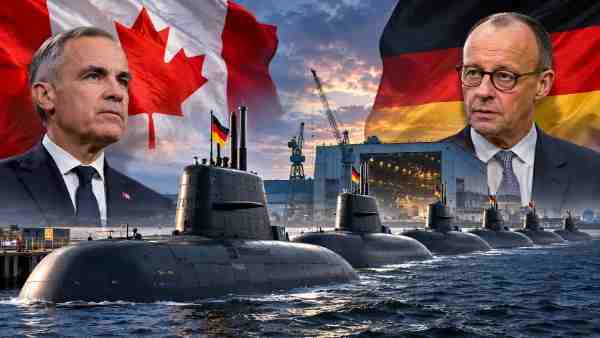
Canada is considering restructuring its proposed submarine purchase from Germany into two phases, with an initial commitment to buy eight submarines and the possibility of acquiring four more later, as the government weighs defence requirements, rising costs and long-term military technology developments.
Canadian negotiators have proposed dividing the planned purchase of up to 12 Type 212CD submarines from German manufacturer Thyssenkrupp Marine Systems (TKMS) into two separate batches, according to confidential sources cited by CBC News on November 4.
Under the proposal, Canada would initially commit to purchasing eight submarines, while retaining the option of acquiring another four in the future.
The proposal was reportedly discussed during meetings in Ottawa last week between Canadian government officials, representatives of TKMS and Norway’s defence company Kongsberg.
The discussions come only months after Prime Minister Mark Carney selected the German proposal as the preferred option for replacing Canada’s ageing submarine fleet. However, the final contract has not yet been signed. <Cite refs={[“turn236157search0″,”turn236157search1”]}/>
Canada Weighs a Two-Phase Submarine Purchase
According to CBC News, Canadian officials have been discussing the possibility of splitting the submarine order for several weeks.
The proposed arrangement would allow the government to secure eight submarines initially while postponing the decision on the remaining four.
Officials are reportedly concerned about committing the full financial amount immediately, particularly because submarine deliveries will take place over an extended period.
The first deliveries are expected in the mid-2030s, with the complete programme continuing for more than a decade.
The government also wants to preserve flexibility for future administrations, which may face different defence priorities, financial conditions and technological developments.
However, the proposal could affect the economic investment commitments associated with the original German offer. <Cite refs={[“turn236157search0″,”turn236157search3”]}/>
Germany Selected for Canada’s Biggest Defence Procurement
In July 2026, Prime Minister Mark Carney announced that Germany’s TKMS had been selected as Canada’s preferred supplier for the Canadian Patrol Submarine Project.
The company was chosen over South Korean defence manufacturer Hanwha Ocean following a competitive procurement process.
The preferred submarine is the Type 212CD, a modern conventional submarine developed through cooperation between Germany and Norway.
The programme is designed to provide Canada with up to 12 submarines to replace its ageing Victoria-class fleet.
Carney described the procurement as the largest defence purchase in Canadian history and said the agreement would strengthen the country’s ability to protect its extensive coastline and Arctic interests.
The government also emphasised that the submarines would improve Canada’s ability to operate alongside NATO allies in the Atlantic, Pacific and Arctic oceans. <Cite refs={[“turn236157search1″,”turn236157news9”]}/>
Submarine Costs Could Exceed $100 Billion Over Their Lifetime
Financial considerations are among the main factors behind the proposed restructuring.
According to CBC’s reporting, purchasing all 12 submarines is estimated to cost between C$20 billion and C$24 billion.
However, the overall expenditure could be significantly higher when maintenance, repairs, training, infrastructure and operational expenses are included.
The full lifecycle cost is expected to exceed C$100 billion over approximately two decades.
Breaking the purchase into two phases could allow the government to manage its financial commitments more gradually and reassess requirements before ordering the remaining four vessels.
Defence analyst Dave Perry has warned that reducing the initial commitment could also have disadvantages, particularly if Germany and its industrial partners reduce the scale of their promised investments in Canada.
He noted that large procurement orders can provide stronger negotiating leverage when securing industrial benefits. <Cite refs={[“turn236157search0”]}/>
Germany’s Economic Investment Package Also at Stake
The submarine agreement involves more than the purchase of military equipment.
Germany and TKMS have proposed a substantial economic investment package intended to create employment and strengthen Canadian industries.
The proposals include investments in carbon capture technology in Alberta, modernisation of the Port of Churchill in Manitoba and opportunities connected to critical minerals and liquefied natural gas exports.
The package also includes plans for a heavy torpedo manufacturing facility and cooperation in developing and testing advanced missile technologies.
These commitments are an important part of the Canadian government’s procurement strategy, which aims to ensure that major defence purchases generate long-term economic benefits for domestic businesses and workers.
German officials are reportedly examining how a reduced initial order could affect the proposed C$86 billion investment package.
The final value and implementation of these commitments will depend on the outcome of negotiations between the two governments and the manufacturer. <Cite refs={[“turn236157search0″,”turn236157search5”]}/>
Why Canada Needs New Submarines
Canada’s existing Victoria-class submarine fleet is ageing and increasingly difficult to maintain.
The Royal Canadian Navy currently has four Victoria-class submarines, but only one was reported to be seaworthy when Carney announced the German selection in July.
Canada has one of the world’s longest coastlines, stretching across the Atlantic, Pacific and Arctic regions.
Modern submarines are considered important for monitoring maritime activity, gathering intelligence, protecting underwater infrastructure and supporting military operations alongside allied forces.
The Type 212CD is designed with low acoustic and magnetic signatures, making it difficult to detect.
It also features air-independent propulsion technology, allowing it to remain underwater for extended periods without regularly surfacing.
Its Arctic operating capabilities and NATO interoperability were important factors in Canada’s decision to select the German proposal. <Cite refs={[“turn236157search1″,”turn236157search2”]}/>
Germany and Norway Hope Canada Will Purchase All 12 Submarines
Germany and Norway have a strong interest in ensuring that Canada remains committed to the full 12-submarine programme.
Both countries are already involved in the Type 212CD project and view Canada’s participation as an important opportunity to expand cooperation within NATO.
Thomas Röwekamp, head of Germany’s parliamentary defence committee, said Germany and Norway were working to make the agreement successful.
He expressed hope that Canada would ultimately order all 12 submarines.
The German-Norwegian programme has also offered to reallocate production capacity from existing orders to accelerate Canadian deliveries.
This arrangement is expected to allow the first four submarines to reach Canada by 2034, earlier than the previously anticipated schedule. <Cite refs={[“turn236157search0″,”turn236157search4”]}/>
Final Contract Expected by the End of 2027
Canada has set a deadline of no later than the end of 2027 to finalise the submarine procurement contract.
TKMS has confirmed that negotiations with the Canadian government remain ongoing and described the discussions as productive.
However, the company has declined to comment on specific details of the proposed two-phase arrangement.
The Canadian government has similarly avoided discussing confidential negotiations, stating that its priority is to secure the best possible agreement for the country.
The final contract will determine the number of submarines purchased, delivery schedules, industrial investment commitments and the financial responsibilities of the participating parties.
Conclusion
Canada’s proposal to purchase eight German submarines initially, with another four potentially acquired later, reflects the government’s effort to balance national defence requirements with long-term financial commitments.
The proposed restructuring could provide greater flexibility for future governments, but it may also affect the economic investment package offered by Germany and its industrial partners.
The Type 212CD programme remains central to Canada’s plan to replace its ageing submarine fleet and strengthen its presence across the Atlantic, Pacific and Arctic regions.
With negotiations continuing, the final decision on whether Canada will purchase eight or all 12 submarines is expected to become clearer as Ottawa works towards its end-of-2027 contracting deadline.