

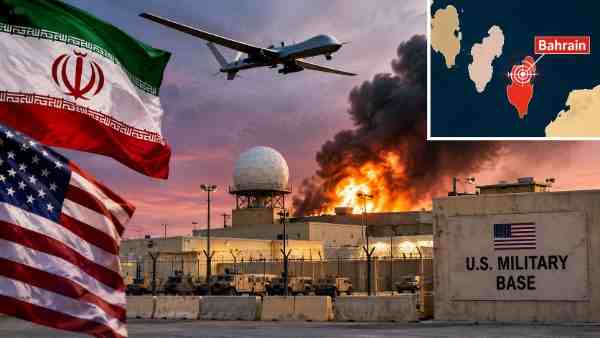
Iran’s Islamic Revolutionary Guard Corps (IRGC) claims it launched six drones towards a US air-defence radar system at a military installation in Bahrain. Bahrain says its air-defence forces intercepted several incoming attacks before they could reach their targets, raising fresh concerns about regional security.
Tensions across the Gulf escalated on Sunday, November 15, after Iran claimed responsibility for a drone attack targeting a US military installation in Bahrain.
Iran’s Islamic Revolutionary Guard Corps said it launched six drones towards an American air-defence radar system located at the Al-Rifaa helicopter base in Bahrain. The attack was described by Iranian state media as retaliation for what Tehran called hostile US military actions.
Bahrain confirmed that its air-defence systems had intercepted several Iranian aerial attacks but did not immediately provide details about the damage or identify the specific targets.
The incident marks another serious development in the nearly nine-month conflict involving Iran, the United States and Israel, which has repeatedly threatened security across the Middle East.
Iran Claims Six Drones Targeted US Radar System
According to statements carried by Iranian state media, the IRGC Aerospace Force launched six drones targeting a US air-defence radar installation at the Al-Rifaa helicopter base.
Iran described the operation as the second phase of its response to American military actions against Iranian targets.
The drone operation reportedly focused on military radar equipment rather than civilian infrastructure.
However, the Iranian claim that the installation was successfully struck has not been independently verified. Neither the US military nor Bahraini authorities immediately confirmed that the radar system had sustained damage.
The latest announcement follows another Iranian claim on November 13, when the IRGC said it had targeted a US early-warning radar facility in Bahrain.
At that time, the US military said it had intercepted two Iranian drones and reported no damage or casualties.
Bahrain Says Air Defences Intercepted Incoming Attacks
Bahrain’s military said its air-defence systems confronted and destroyed several incoming Iranian aerial threats before they could achieve their objectives.
The country’s Defence Force accused Tehran of continuing what it described as a systematic hostile approach towards Bahrain.
The Interior Ministry issued public safety warnings and instructed residents to remain calm, move to the nearest safe location and follow official announcements.
Sirens and explosions were reported in different parts of the kingdom during the early morning hours.
The alerts marked Bahrain’s first nationwide public safety warnings since September, when the country had also faced Iranian drone and missile attacks.
Bahraini authorities did not immediately report any confirmed casualties from Sunday’s incident.
Why Bahrain Is an Important US Military Location
Bahrain occupies a strategically important position in the Persian Gulf and hosts the headquarters of the US Navy’s Fifth Fleet.
The fleet is responsible for American naval operations across a large region that includes the Persian Gulf, Red Sea and parts of the Indian Ocean.
The country’s military facilities and infrastructure have therefore become important locations during the ongoing confrontation between Washington and Tehran.
Iran has repeatedly targeted American military assets in Gulf countries since the conflict began in February.
Bahrain was among the countries that experienced extensive Iranian missile and drone attacks during the early stages of the war. Although the intensity of attacks had declined in recent months, the latest incidents indicate that the threat has not disappeared.
US-Iran Conflict Continues Despite Diplomatic Efforts
The latest drone attack comes at a time when diplomatic efforts to end the war remain stalled.
The conflict began on February 28, 2026, following US and Israeli strikes against Iran. Tehran responded with missile and drone attacks targeting Israeli positions and US military facilities across the Gulf.
The confrontation has expanded beyond direct military exchanges, affecting regional infrastructure, energy supplies and international shipping.
US President Donald Trump has indicated that Washington may avoid further major military escalation if Iran and Iran-backed groups refrain from new attacks.
However, the United States has maintained its naval blockade of Iranian ports, while Tehran continues to challenge American military and economic pressure.
The latest incident demonstrates how quickly tensions could rise again despite the broader reduction in fighting.
Strait of Hormuz Remains Another Major Concern
The security situation in the Gulf is also closely connected to developments around the Strait of Hormuz, one of the world’s most important maritime energy routes.
The waterway connects the Persian Gulf with international shipping routes and carries a significant share of global oil and gas shipments.
Iran has restricted shipping through the strategic passage during the conflict, while the United States has imposed restrictions on Iranian maritime trade.
On Sunday, Iran’s Revolutionary Guards also claimed that oil tankers had struck naval mines near the Strait of Hormuz. Those reports had not been independently verified at the time of publication.
Any further disruption to commercial shipping could affect global energy markets, insurance costs and international trade.
Regional Governments Express Concern
The renewed attacks have increased concerns among Gulf countries about the possibility of another major escalation.
Saudi Arabia condemned the attacks on Bahrain and expressed solidarity with the kingdom.
The incident has also highlighted the security challenges faced by countries hosting American military facilities while attempting to avoid becoming directly involved in the wider confrontation.
Regional governments have repeatedly called for restraint and respect for national sovereignty.
However, continued military exchanges and the lack of progress in diplomatic negotiations have made the security environment increasingly uncertain.
What Happens Next?
The immediate question is whether the latest drone operation caused any damage to American military equipment or infrastructure in Bahrain.
Iran has claimed that its forces targeted the US radar installation, while Bahrain maintains that its air-defence systems intercepted several incoming attacks before they reached their objectives.
Further information from US and Bahraini military authorities will be important in establishing the actual impact of the incident.
For now, the latest attack represents another warning that the conflict involving Iran and the United States remains far from a stable resolution.
With military facilities, energy infrastructure and international shipping routes exposed to continued risks, developments in Bahrain could have consequences well beyond the Gulf region.
Source: Reuters, CBS News, The Washington Post, RFE/RL and The National.