

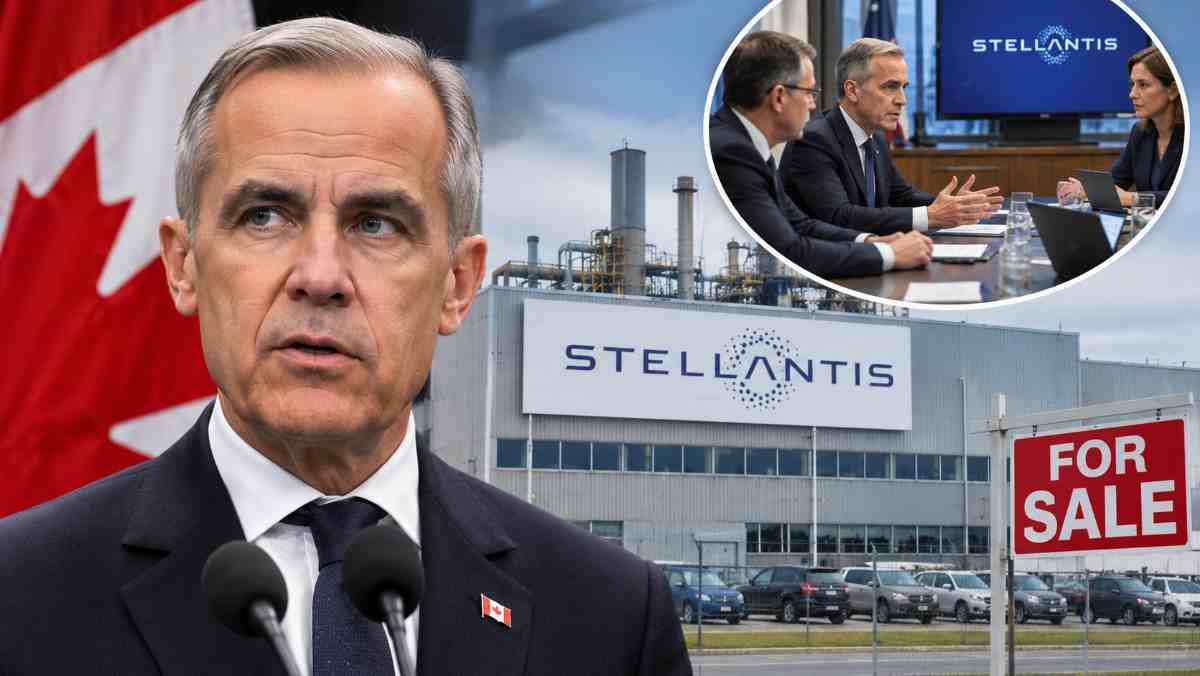
Canada’s federal government was closely involved in private discussions that led to the sale of Stellantis’ idle Brampton assembly plant to defence manufacturer Roshel, according to sources familiar with the negotiations. The deal has sparked a major dispute over thousands of jobs and government funding.
The Canadian government was actively involved in discussions leading to the sale of Stellantis’ Brampton vehicle assembly plant to Canadian armoured vehicle manufacturer Roshel, according to three sources with direct knowledge of the negotiations.
The development has raised questions about Ottawa’s role in a transaction that Prime Minister Mark Carney has publicly criticised as a betrayal of Canadian workers.
Stellantis announced on November 9, 2026, that it had signed an agreement to sell the Brampton, Ontario, facility and its associated equipment to Roshel for an undisclosed amount.
The plant has remained largely inactive since 2023, leaving more than 2,200 workers on layoff pay. Roshel plans to transform the facility into an advanced manufacturing centre focused on defence production and other industrial opportunities.
According to sources cited by BNN Bloomberg, federal officials were actively and intensively involved in the private discussions surrounding the transaction. The government also did not stand in the way of the agreement during those discussions.
However, the federal government’s involvement in negotiations has not stopped Carney from publicly challenging Stellantis over its obligations to Canadian workers.
What Led to the Sale of the Brampton Plant?
Stellantis, the automotive group behind brands including Jeep, Chrysler and Dodge, halted operations at its Brampton assembly plant in 2023 as part of plans to retool the facility for future vehicle production.
The company had initially intended to manufacture the next generation of the Jeep Compass at the site. Work on preparing the facility began in early 2024 but was paused in 2025.
Stellantis subsequently announced that production of the Jeep Compass would move to Illinois in the United States, leaving the Brampton facility without a confirmed vehicle production programme.
The decision created uncertainty for thousands of employees and local suppliers who depended on the plant.
In September 2026, Stellantis signed a memorandum of understanding with Roshel regarding a possible sale. The two companies continued discussions before announcing the completed asset purchase agreement in November.
The transaction is expected to close by the end of 2026, subject to regulatory and other closing conditions.
Carney Calls the Sale a Betrayal of Workers
Despite the reported government involvement in discussions, Carney strongly criticised Stellantis following the announcement.
Speaking on November 10, the prime minister described the company’s decision as a betrayal of Canadian workers and the commitments it had made to the country.
He said the government would use the full force of available legal and policy measures to protect workers and safeguard public money.
Carney argued that Stellantis had obligations under previous agreements with the federal and Ontario governments, including commitments relating to its Canadian manufacturing presence.
The prime minister also said that the government would not allow the company to walk away from those responsibilities without consequences.
Industry Minister Mélanie Joly similarly stated that the sale did not erase Stellantis’ commitments to its employees.
She urged the automaker, Roshel, Unifor and the Ontario government to participate in discussions focused on protecting jobs and finding a resolution for affected workers.
Government Funding Adds to the Controversy
One of the biggest issues surrounding the sale is the public money previously provided to support Stellantis’ Canadian manufacturing operations.
In 2023, the federal and Ontario governments announced a joint commitment worth approximately C$15 billion over 10 years to support major automotive and electric vehicle battery investments, including facilities in Windsor.
The broader agreements included expectations that Stellantis would maintain its manufacturing presence in Ontario through 2035.
The Brampton plant’s future became a major point of disagreement after the company moved its planned Jeep production to the United States.
The federal government has previously warned that it could pursue legal action if Stellantis failed to meet its contractual obligations.
Stellantis has said it is prepared to voluntarily return government support received for the original Brampton retooling plan. However, the company has not publicly disclosed the financial details of the proposed repayment.
The government is now facing pressure to clarify how much public funding must be returned and whether the sale complies with existing agreements.
Roshel Plans to Turn the Facility Into a Defence Manufacturing Hub
Roshel, a Brampton-based Canadian defence technology company, intends to give the facility a new industrial purpose.
The company specialises in designing and manufacturing armoured vehicles used for military, security and other specialised operations.
Roshel founder and CEO Roman Shimonov has said the company plans to establish a Centre of Excellence for advanced manufacturing at the site.
The proposed facility is expected to support Canadian defence production, strengthen domestic manufacturing capabilities and create opportunities for businesses supplying the defence industry.
The companies have also announced a strategic cooperation framework to explore future collaboration in vehicle technologies and related defence services.
Roshel has indicated that it wants to bring the facility back into productive use. Its plans could create employment opportunities in the region, although the number of positions and the timeline for hiring remain uncertain.
Reuters also reported on November 10 that Roshel was discussing opportunities with several automakers to manufacture civilian vehicles at the Brampton facility alongside its defence operations.
Unifor Condemns the Agreement
The sale has drawn strong criticism from Unifor, the union representing Stellantis employees in Canada.
National president Lana Payne described the transaction as an underhanded deal and accused Stellantis of abandoning its responsibilities towards workers.
The union has argued that selling an automotive assembly plant threatens more than individual jobs. It also puts pressure on the wider network of parts manufacturers, suppliers, transport companies and other businesses connected to the automotive industry.
Unifor has called for a fair resolution for affected employees and has warned that the loss of vehicle production at Brampton represents a serious setback for Canada’s automotive sector.
The union had already been involved in difficult contract negotiations with Stellantis before the sale was announced. Workers had also voted overwhelmingly to authorise a potential strike.
Payne has said the union will continue evaluating its options while seeking commitments from the company and government.
Thousands of Workers Face an Uncertain Future
More than 2,200 employees were affected when the Brampton plant stopped production in 2023.
Although Roshel’s plans could eventually create new manufacturing jobs, it remains unclear how many former Stellantis employees will return to work or whether they will receive comparable wages, benefits and employment conditions.
Roshel has indicated that former workers could be prioritised during future recruitment. However, the company has not guaranteed that all affected employees will be rehired.
Stellantis has said it remains committed to working with Unifor on a fair resolution for its employees under the applicable collective agreement and labour laws.
The issue is particularly important for Brampton, where the assembly plant has supported local families and a wider industrial supply chain for decades.
What Happens Next?
The federal government is expected to bring Stellantis, Roshel, Unifor and the Ontario government together for discussions on the future of the facility and its workers.
The key questions include whether Stellantis must repay public funding, what employment protections will be offered and how the new owner intends to use the facility.
The sale could give the Brampton site a new future in Canada’s defence manufacturing industry. However, it has also exposed tensions between the government’s industrial strategy, the responsibilities of major corporations and the protection of workers.
For Carney’s government, the challenge will be to ensure that the transaction does not leave thousands of employees without a fair outcome after years of uncertainty.
Source: BNN Bloomberg, Reuters, Global News, The Canadian Press and official Stellantis announcements.