

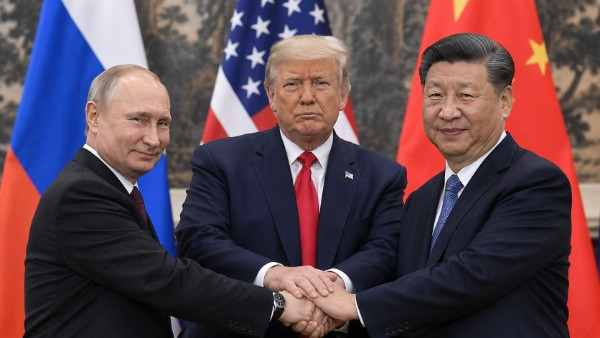
US President Donald Trump, Russian President Vladimir Putin and Chinese President Xi Jinping have issued a joint ‘Declaration Toward Peace’ following their historic meeting in Shenzhen. The four-point statement focuses on nuclear security, United Nations reforms, energy cooperation and the immunity of state officials, but does not offer a solution to the ongoing wars in Ukraine or Iran.
The leaders of the United States, Russia and China have released a joint peace declaration after holding their first-ever trilateral summit in Shenzhen, China, on Thursday, November 19, 2026.
The meeting brought together three of the world’s most powerful leaders at a time of growing international instability, with conflicts in Ukraine and the Middle East, rising nuclear concerns and increasing competition over global influence.
The discussions lasted approximately 80 minutes and took place at Kylin Villa, on the sidelines of the Asia-Pacific Economic Cooperation (APEC) summit.
Following the meeting, Chinese state media and the Kremlin published a joint document titled the ‘China-Russia-US Heads of State Declaration Toward Peace’.
The declaration outlines four areas of cooperation, including international security, nuclear risk reduction, energy supplies and reform of global institutions.
However, despite its title, the document does not establish a ceasefire or peace agreement for any ongoing conflict.
Four Major Commitments in the Peace Declaration
The joint declaration contains four main commitments agreed upon by Trump, Putin and Xi.
1. United Nations Reform
The three countries agreed to pursue reforms of the United Nations to make the organisation more effective in addressing international challenges.
As permanent members of the UN Security Council, the United States, China and Russia have significant influence over international security decisions.
Their commitment to reform reflects a shared position that the organisation should be better equipped to respond to changing global circumstances.
However, the declaration does not specify which reforms will be introduced or how they will be implemented.
2. Increasing Global Energy Supplies
The three leaders also agreed to increase the production and supply of refined petroleum products for the benefit of all countries.
They reaffirmed the importance of maintaining stable energy flows, particularly as international conflicts continue to affect oil markets and energy transportation routes.
The commitment comes amid concerns about disruptions to energy supplies following tensions involving Iran and instability in other important regions.
3. State Sovereignty and Immunity of Officials
Another important provision concerns the principle of state consent and immunity for government officials.
The declaration states that international legal institutions, including the International Criminal Court (ICC), should not abuse their jurisdiction.
This provision is particularly significant for Putin, who is subject to an ICC arrest warrant over alleged war crimes involving the deportation of Ukrainian children.
The United States has also imposed sanctions on the ICC and its officials over investigations involving American personnel and allies.
The declaration does not change the ICC’s legal framework, but it signals the three governments’ shared position on the limits of international judicial authority.
4. Nuclear Security and Risk Reduction
The final commitment concerns nuclear weapons and international security.
The three leaders reaffirmed that a nuclear war cannot be won and must never be fought.
They also agreed to conduct dialogue on reducing nuclear risks and preventing the proliferation of nuclear weapons.
This commitment is important because the United States and Russia possess the world’s two largest nuclear arsenals, while China has been expanding its own nuclear capabilities.
The agreement provides a diplomatic basis for further discussions, although it does not establish specific limits on nuclear weapons or create a new arms-control treaty.
Why the Meeting Matters
The trilateral summit represents an unusual diplomatic moment because it brings together the leaders of the world’s three major nuclear powers.
The United States, Russia and China have very different political systems, economic priorities and strategic interests.
Washington and Beijing remain engaged in competition over trade, technology and influence in the Indo-Pacific.
Relations between Washington and Moscow have been strained by the war in Ukraine and Western sanctions against Russia.
China and Russia, meanwhile, have strengthened their economic and diplomatic partnership in recent years.
Bringing all three leaders together provides an opportunity to discuss issues that cannot easily be addressed through separate bilateral negotiations.
The meeting also highlights the importance of direct communication between major powers, particularly when international security risks are increasing.
Ukraine War Remains Unresolved
One of the biggest questions surrounding the summit was whether the three leaders would make progress towards ending the war in Ukraine.
Trump has repeatedly expressed his interest in negotiating an end to the conflict, while Putin has maintained demands concerning territory and security arrangements.
Ukraine, however, insists that any settlement must respect its sovereignty and territorial integrity.
Putin said at the beginning of the trilateral meeting that the three countries shared interests in resolving regional conflicts, including the war in Ukraine.
However, the final declaration does not mention Ukraine or establish any framework for ending the fighting.
Ukrainian officials were also not represented at the meeting, raising concerns about discussions concerning their country’s future taking place without direct Ukrainian participation.
For now, the declaration provides no evidence of a breakthrough in the peace negotiations.
Iran Conflict and Energy Security
The conflict involving Iran was another important issue surrounding the summit.
Military tensions in the Middle East have created uncertainty for international energy markets, particularly because of the importance of the Strait of Hormuz for global oil transportation.
The United States has maintained pressure on Tehran, while China and Russia have criticised aspects of Washington’s approach.
The declaration’s commitment to increasing refined petroleum production and maintaining stable energy supplies reflects the economic importance of avoiding major disruptions.
However, the document does not identify specific measures to resolve the conflict or establish a diplomatic settlement involving Iran.
Controversy Over the International Criminal Court
The declaration’s position on the International Criminal Court could become one of its most controversial elements.
The ICC investigates and prosecutes individuals accused of serious international crimes, including genocide, war crimes and crimes against humanity.
Putin is subject to an arrest warrant issued by the court in March 2023 over the alleged unlawful deportation and transfer of Ukrainian children.
By emphasising state consent and immunity for government officials, the three leaders have expressed concern about the jurisdiction of international legal institutions.
Critics may view this position as an attempt to limit international accountability, while the three governments present it as a defence of national sovereignty and legal protections for state officials.
The declaration does not cancel existing arrest warrants or automatically change international legal obligations.
A Different Approach to Global Power Politics
The meeting also reflects the changing nature of international diplomacy.
For decades, the United States played the leading role in shaping many global institutions and security arrangements.
China’s growing economic and military influence and Russia’s continued role in international security have made global decision-making more complicated.
The three countries are permanent members of the UN Security Council and possess considerable influence over international affairs.
Their willingness to issue a joint declaration suggests that cooperation between major powers remains possible even when their interests conflict.
However, it also raises questions about how smaller countries and international institutions will respond when the world’s most powerful governments coordinate their positions on issues such as sovereignty, legal accountability and global security.
What Happens Next?
The immediate question is whether the declaration will lead to practical cooperation or remain primarily a diplomatic statement.
The three governments have committed themselves to discussions on nuclear risk reduction, energy security and United Nations reform.
Turning those commitments into concrete agreements will require further negotiations and cooperation between their governments.
Nuclear arms control is particularly complicated because the United States and Russia have much larger nuclear arsenals than China, while Beijing has previously resisted joining negotiations on the same terms.
Similarly, reforming the United Nations would require agreement among a much wider group of countries.
The declaration therefore represents an initial diplomatic commitment rather than a completed international settlement.
A Historic Meeting, but No End to Global Conflicts
The meeting between Trump, Putin and Xi has produced a document that places nuclear security, energy cooperation and international institutional reform at the centre of their shared agenda.
It is a significant diplomatic development, but its limitations are equally important.
The wars in Ukraine and Iran remain unresolved, disagreements over international law continue, and the three governments have yet to demonstrate how their commitments will be implemented.
For the international community, the real test will be whether the declaration leads to meaningful action.
The summit may have created a new channel for cooperation among the world’s three major powers, but lasting peace will require more than a joint statement.
Source: Reuters, Agence France-Presse (AFP), The New Indian Express, Anadolu Agency and Chinese state news agency Xinhua, November 19, 2026.