

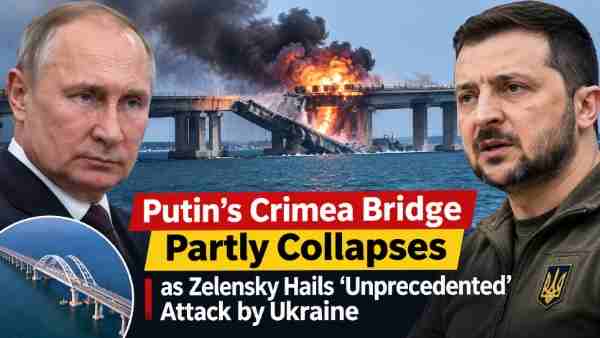
A section of the strategically important Kerch Bridge linking Russia to occupied Crimea appears to have collapsed following Ukrainian drone and missile strikes. President Volodymyr Zelensky says the attack was the final stage of a carefully planned operation, while Moscow has promised to rebuild the crossing.
A major Ukrainian attack on the Kerch Bridge, which connects mainland Russia with the occupied Crimean Peninsula, has caused serious structural damage and disrupted transport across one of Moscow’s most strategically important crossings.
The attack, carried out on Tuesday, November 17, 2026, marked the second consecutive day that Ukrainian forces targeted the bridge. Images and videos shared by Ukrainian officials appeared to show a large section of the road bridge collapsing into the Kerch Strait.
Ukrainian President Volodymyr Zelensky described the strikes as an unprecedented military operation that had been planned over several weeks.
Russia confirmed that the bridge had sustained damage and temporarily suspended traffic. However, the full extent of the destruction remains uncertain, as independent verification of the footage was not immediately possible.
The incident comes at a sensitive moment in the Russia-Ukraine war, just days before Russian President Vladimir Putin is expected to meet US President Donald Trump and Chinese President Xi Jinping in China.
Ukraine Claims Major Success Against Crimea Bridge
Zelensky confirmed that Ukrainian forces had carried out the attack, saying it was a response to repeated Russian strikes against Ukraine’s civilian and critical infrastructure.
According to the Ukrainian president, the operation was conducted in seven stages and involved close coordination between the country’s Security Service, known as the SBU, and its military leadership.
Ukrainian forces reportedly targeted Russian air-defence systems, radar installations and electronic warfare equipment before launching the final strikes against the bridge.
The operation involved several types of Ukrainian-developed drones and missiles.
Zelensky said the road section was struck by Palianytsia drones, while the railway section was targeted using Neptune missiles and other weapons.
Videos released after the attack appeared to show the bridge’s main road arch severely damaged, with parts of the structure lying in the water.
Reuters reported that it could not independently verify the images or establish the complete extent of the damage.
Two People Killed, Traffic Suspended
Sergei Aksyonov, the Russian-installed governor of Crimea, said two people were killed during the latest attack.
Authorities suspended traffic across the bridge while emergency services and investigators assessed the situation.
The crossing is approximately 19 kilometres long and carries both road and railway traffic between Russia’s Krasnodar region and Crimea.
Russian officials initially provided limited details about the damage. The Kremlin had described an earlier strike this week as causing only minor damage, but images released after Tuesday’s attack suggested that the latest incident was considerably more serious.
Reports later indicated that some railway services had resumed, although road access remained disrupted.
The full operational status of the bridge was not immediately clear.
Kremlin Promises to Rebuild the Bridge
The Russian government condemned the attack and said the damaged crossing would be restored.
Kremlin spokesperson Dmitry Peskov confirmed that Putin had been informed about the incident.
Peskov said Russia would rebuild the bridge and suggested that the restored structure would be stronger than before.
Russia’s Investigative Committee also opened a criminal investigation under terrorism-related provisions, accusing Ukrainian forces of carrying out the attack.
Moscow has repeatedly described Ukrainian strikes on the crossing as terrorist acts.
Ukraine, however, considers the bridge a legitimate military target because of its role in supporting Russian operations in occupied Ukrainian territory.
The two governments remain sharply divided over the legal and military status of the crossing.
Why the Crimea Bridge Matters to Russia
The Kerch Bridge is more than a transport connection. It is one of the most prominent symbols of Russia’s control over Crimea.
Russia annexed the peninsula from Ukraine in 2014, a move that remains internationally disputed and is not recognised by most countries.
Following the annexation, Moscow began constructing the bridge to establish a permanent road and railway connection between Crimea and mainland Russia.
President Putin personally inaugurated the road section in 2018.
The bridge later became an important supply route for Russian troops, military equipment, fuel and other resources during the full-scale invasion of Ukraine that began in February 2022.
Although Russia has since established alternative supply routes through occupied areas of southern Ukraine, the Kerch Bridge remains important for civilian transport, economic activity and military logistics.
Its symbolic importance also makes it a high-profile target for Ukrainian forces.
Russia Faces One of the Largest Ukrainian Drone Attacks of the War
The bridge strike occurred during a wider wave of Ukrainian drone operations against Russian territory.
Russia’s Defence Ministry claimed that its air-defence systems intercepted 1,441 drones across 22 regions overnight, exceeding the previous day’s reported total.
The figures, which could not be independently verified, suggest a significant increase in the scale of Ukrainian aerial operations.
Russian authorities also reported drone activity around Moscow and several industrial regions.
Ukraine has intensified attacks against Russian oil refineries, fuel storage facilities and other infrastructure in recent weeks.
Kyiv says these operations are intended to weaken Russia’s ability to finance and sustain its military campaign.
Russian officials have acknowledged disruptions in some regions, although the overall impact of the strikes remains difficult to establish independently.
Russia Strikes Kyiv Bridges and Energy Infrastructure
While Ukraine targeted the Kerch Bridge, Russia launched its own attacks against infrastructure in the Ukrainian capital.
Kyiv Mayor Vitali Klitschko said Russian strikes damaged the city’s Northern and Southern bridges across the Dnipro River.
The attacks also affected sections of Kyiv’s metro system and disrupted electricity and water supplies.
Several regions across Ukraine reported additional power outages following strikes against energy facilities.
Russian authorities said their forces had targeted military, transport and energy infrastructure.
Ukrainian officials reported injuries in the Cherkasy region and damage in several other areas.
The attacks demonstrate how both sides are increasingly targeting infrastructure that supports transportation, energy supplies and military logistics.
Attack Comes Ahead of Trump-Putin-Xi Meeting
The timing of the Kerch Bridge attack has attracted international attention because Putin is preparing to visit China for a series of high-level diplomatic meetings.
A trilateral meeting involving Putin, Trump and Xi is expected to take place in Shenzhen later this week.
Ukraine is likely to be among the subjects discussed during the diplomatic engagements.
The Kremlin has suggested that the timing of the attack could be connected to the upcoming talks, although no evidence establishing such a connection has been publicly presented.
Meanwhile, American diplomatic efforts to negotiate an end to the Russia-Ukraine war are continuing.
US representatives have held discussions with Ukrainian, Russian and European officials regarding possible security arrangements and future negotiations.
However, major disagreements over territory, security guarantees and the conditions for ending the war remain unresolved.
Could the Bridge Attack Affect Russia’s Military Supplies?
The damage to the Kerch Bridge could complicate Russian transport operations, particularly if repairs require an extended closure.
The crossing has historically provided a direct route for moving personnel, equipment and supplies into Crimea.
However, Russia is not entirely dependent on the bridge.
Moscow also controls a land corridor through occupied parts of the Zaporizhzhia and Kherson regions, allowing supplies to reach Crimea by road and rail.
Ferry services across the Kerch Strait may provide additional capacity, although they cannot necessarily replace the bridge’s full transport function.
The extent of disruption will depend on how much of the road and railway infrastructure has been damaged and how quickly repairs can be completed.
What Happens Next?
The immediate focus is on assessing the structural condition of the Kerch Bridge and determining how long transport restrictions will remain in place.
Russian authorities have promised reconstruction, while Ukraine has presented the operation as a major military achievement.
The incident also raises questions about the effectiveness of Russian air defences around one of the country’s most heavily protected infrastructure projects.
For Ukraine, the attack demonstrates its continuing ability to strike high-profile targets despite Russia’s military presence in Crimea.
For Moscow, the damage represents both a logistical challenge and a symbolic setback.
With diplomatic negotiations continuing and military operations intensifying, the latest attack highlights the distance that remains between the two countries and a lasting settlement.
Source: Reuters, BBC News, Sky News, Al Jazeera and The Irish Times, November 17, 2026.