

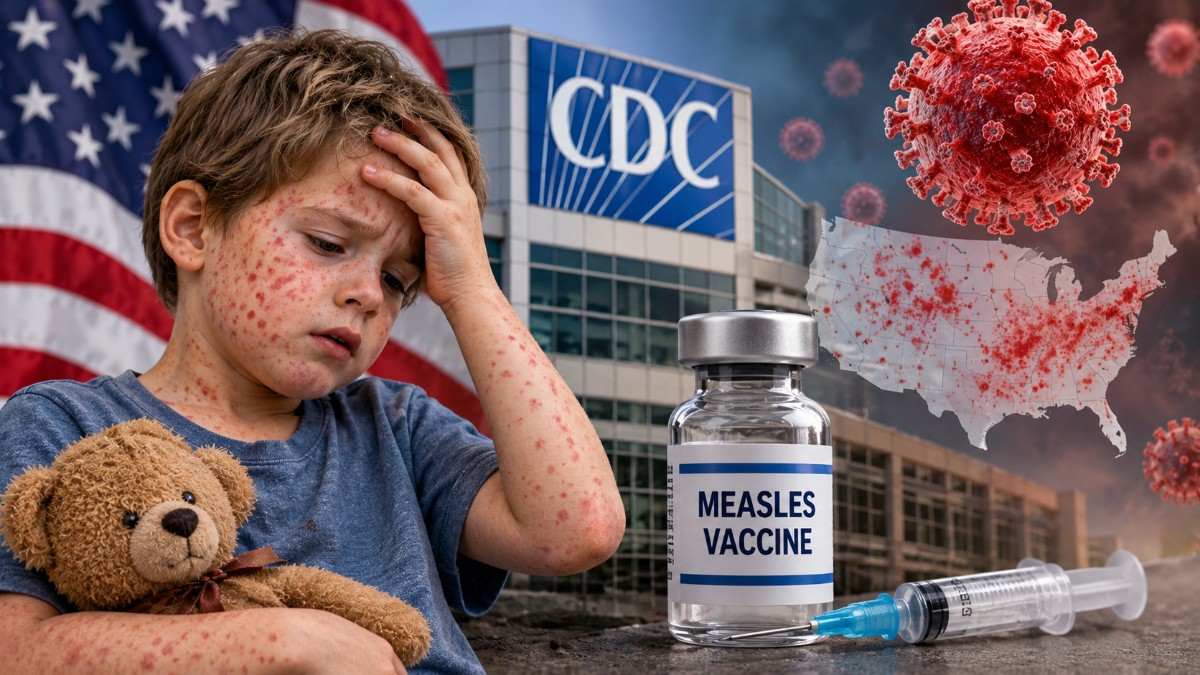
The United States has officially lost its measles elimination status after more than a year of continuous transmission, marking a major setback for public health. The decision follows Canada’s loss of the same status in 2025, while Mexico and Bolivia have also been affected.
By CK Sharma | World Affairs | NewsBee Media Inc.
The United States has lost its official measles elimination status after more than 26 years, marking a significant reversal in the country’s public health progress. The decision was announced on November 17, 2026, by the Pan American Health Organization (PAHO), following evidence that measles transmission had become established again within the country.
The development comes after Canada lost its measles elimination status in November 2025. Mexico and Bolivia have also lost their status following prolonged outbreaks, raising concerns about the resurgence of a highly contagious disease across North and South America.
The decision does not mean measles is spreading everywhere in the United States. Instead, it confirms that the virus has circulated continuously within the country for at least 12 months, meeting the international criteria for re-established endemic transmission.
Why the United States Lost Its Measles-Free Status
The United States first achieved measles elimination status in 2000 after years of vaccination efforts and strong public health measures.
Under international standards, a country is considered to have eliminated measles when continuous transmission of the virus has been interrupted for at least 12 months. However, elimination does not mean that imported cases cannot occur. Countries can experience cases brought in from abroad without losing their status, provided they prevent sustained local transmission.
According to PAHO, the US outbreak began on January 20, 2025. The same measles virus genotype and lineage continued circulating for at least 12 months, reaching the threshold for the re-establishment of endemic transmission in January 2026.
After reviewing epidemiological and laboratory evidence, the regional verification commission recommended withdrawing the country’s elimination status. PAHO Director Jarbas Barbosa accepted the recommendation.
The decision represents a major setback for a country that had successfully maintained its elimination status for more than two decades.
More Than 5,400 Measles Cases Reported in 2026
The loss of status comes amid a significant increase in measles infections across the United States.
According to data reported by the US Centers for Disease Control and Prevention (CDC), more than 5,400 measles cases had been recorded in 2026 by November 12. The country has also reported multiple deaths associated with the disease.
The current outbreak situation represents the highest annual measles caseload in the United States since 1991.
Measles is among the most contagious infectious diseases. An infected person can transmit the virus to as many as 18 people who are susceptible to infection.
Symptoms typically include fever, cough, runny nose, red eyes and a distinctive skin rash. In severe cases, the disease can lead to pneumonia, brain inflammation, hospitalisation and death.
Young children, pregnant women and people with weakened immune systems are particularly vulnerable to serious complications.
Canada Lost Its Status First, Followed by Mexico and Bolivia
The United States is not the only country facing this setback.
Canada lost its measles elimination status in November 2025 after a prolonged outbreak resulted in more than 12 months of continuous transmission. The development also meant that the Americas lost its regional verification as a region free from endemic measles transmission.
The latest PAHO review confirmed that Mexico and Bolivia have also lost their national elimination status.
According to the organisation, the sustained transmission periods began on different dates:
- United States: January 20, 2025.
- Mexico: February 1, 2025.
- Bolivia: April 16, 2025.
The decision highlights the growing challenge of controlling measles across the region, particularly in communities where vaccination coverage has fallen below the levels needed to prevent sustained outbreaks.
PAHO reported that the Americas had recorded 58,213 confirmed measles cases and 82 deaths as of November 13, 2026, compared with 12,806 cases during the same period in 2025.
Falling Vaccination Coverage Raises Concerns
Public health experts have repeatedly warned that declining vaccination rates and gaps in immunisation coverage can allow measles to spread rapidly.
The measles, mumps and rubella (MMR) vaccine remains the most effective protection against the disease. Health authorities recommend maintaining at least 95 per cent coverage with both doses in every community to prevent outbreaks and protect vulnerable populations.
However, national vaccination averages can hide local gaps. Some communities may have significantly lower coverage, creating conditions in which the virus can spread quickly once introduced.
Vaccine misinformation, concerns about vaccination and difficulties accessing healthcare services have all contributed to challenges in maintaining adequate immunisation coverage.
The loss of elimination status does not indicate that the vaccine has stopped working. Instead, it demonstrates the consequences of allowing immunity gaps to persist.
US Health Authorities Face Pressure to Restore Elimination Status
Following the announcement, US health authorities face renewed pressure to strengthen vaccination programmes, improve disease surveillance and respond more rapidly to suspected infections.
US Health and Human Services Secretary Robert F. Kennedy Jr. said the country would work to stop measles outbreaks, protect families and regain its elimination status.
The department has also indicated that it will continue recommending MMR vaccination as the most effective way to prevent measles.
The American Medical Association described the loss of elimination status as a deeply troubling and preventable setback, highlighting the importance of vaccination and public health preparedness.
PAHO has urged countries across the Americas to strengthen vaccination campaigns, improve laboratory surveillance and ensure that outbreak response teams can quickly identify and contain new infections.
Can the United States Regain Its Measles Elimination Status?
Health authorities say the loss of elimination status is not permanent.
Countries can regain recognition by demonstrating that sustained endemic transmission has been interrupted and providing sufficient epidemiological and laboratory evidence for an independent review.
Canada has already made progress in controlling the outbreak that led to its loss of status. Canadian health authorities announced in October 2026 that the multijurisdictional outbreak had ended. However, the country must still meet the required verification criteria before its elimination status can be restored.
The United States, Mexico and Bolivia will face a similar challenge.
PAHO has pointed to previous successes in the Americas, particularly the interruption of transmission in Venezuela and Brazil, which helped the region regain its measles elimination status in 2024.
Conclusion
The United States losing its measles elimination status after 26 years is a major warning about the consequences of declining vaccination coverage and prolonged disease transmission.
Following Canada’s setback in 2025, the addition of the United States, Mexico and Bolivia demonstrates that measles remains a serious public health challenge across the Americas.
Although the decision does not mean that every community is experiencing an outbreak, it confirms that sustained transmission has returned.
Restoring elimination status will require stronger immunisation programmes, reliable disease surveillance and public confidence in vaccination. The experience of the Americas shows that measles elimination is achievable, but maintaining it requires continuous effort.