

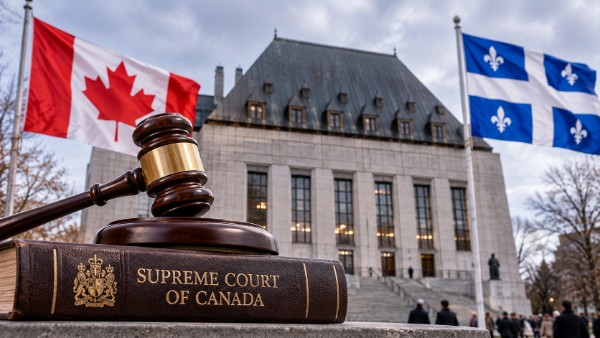
The Supreme Court of Canada has upheld most of Quebec’s controversial secularism law, confirming the province’s authority to use the notwithstanding clause to protect the legislation from certain Charter challenges.
By CK Sharma | World Affairs | NewsBee Media Inc.
Canada’s Supreme Court has delivered a landmark ruling upholding most of Quebec’s controversial secularism law, known as Bill 21, in a decision that could have significant consequences for religious freedom, provincial powers and constitutional rights across the country.
In a 532-page judgment released on Friday, November 27, 2026, the country’s highest court confirmed that Quebec had validly invoked the notwithstanding clause to protect the legislation from challenges under certain provisions of the Canadian Charter of Rights and Freedoms.
The decision represents a major victory for Quebec’s government, which has defended the law as an essential part of the province’s commitment to state secularism.
However, the ruling has also renewed criticism from religious communities and civil liberties organisations, which argue that the legislation disproportionately affects religious minorities, particularly Muslim women who wear hijabs.
What Does Quebec’s Bill 21 Actually Do?
Introduced in 2019, Bill 21, formally known as the Act respecting the laicity of the State, establishes rules intended to maintain religious neutrality within Quebec’s public institutions.
The law prohibits certain public employees in positions of authority from wearing visible religious symbols while performing their duties.
Those affected include teachers, police officers, judges and other public-sector employees covered by the legislation.
Religious symbols prohibited under the law include Muslim hijabs, Sikh turbans, Jewish kippahs and Christian crosses.
The legislation also requires individuals providing or receiving certain government services to have their faces uncovered.
Quebec’s government has argued that the restrictions are necessary to maintain a secular state and ensure neutrality in public institutions.
Critics, however, say the law limits individual religious freedom and creates barriers for qualified people seeking employment or career advancement in the public sector.
Supreme Court Confirms Quebec’s Use of the Notwithstanding Clause
One of the most important aspects of Friday’s decision concerns Section 33 of the Canadian Charter, commonly known as the notwithstanding clause.
The provision allows federal or provincial governments to temporarily override certain Charter protections when passing legislation.
Quebec invoked the clause pre-emptively when it introduced Bill 21 in 2019, allowing the legislation to remain in force despite constitutional challenges involving fundamental freedoms.
The Supreme Court confirmed that Quebec had validly exercised this constitutional power.
The ruling also clarified that courts can still examine whether legislation protected by the notwithstanding clause is inconsistent with Charter rights, even if that examination cannot automatically invalidate the law.
This distinction could have implications beyond Quebec, as other provinces have also used the notwithstanding clause to protect controversial legislation from constitutional challenges.
One Provision Ruled Unconstitutional
Although the Supreme Court upheld most of Bill 21, it identified a specific constitutional problem involving Section 8 of the legislation.
The provision required elected members of Quebec’s National Assembly to sit with their faces uncovered.
The court ruled that this requirement infringes the democratic rights protected under Section 3 of the Canadian Charter, to the extent that it applies to members of the National Assembly.
Section 3 protects citizens’ rights to vote and to seek election to legislative bodies.
The court’s ruling therefore confirms that the law is not entirely immune from constitutional scrutiny, even though its central provisions remain in force.
The judges also examined arguments involving gender equality and minority-language education rights. The court did not invalidate Bill 21 on those grounds.
Carney Says Federal Government Respects the Decision
Canadian Prime Minister Mark Carney said he respects the Supreme Court’s clarification of the Constitution and the application of the notwithstanding clause.
Speaking to reporters in Yellowknife, Carney emphasised that the federal government’s responsibility is to defend the Charter of Rights and Freedoms.
He also indicated that his government would not use the notwithstanding clause to override Charter protections.
Carney’s response reflects the broader political sensitivity surrounding the decision, particularly as Canada continues to debate the balance between provincial autonomy and individual rights.
Quebec Government Celebrates the Ruling
Quebec Premier Paul St-Pierre Plamondon welcomed the judgment, describing it as a victory for the province’s secularism policy.
He said the decision provided legal clarity and reaffirmed the authority of Quebec’s National Assembly to use the notwithstanding clause.
Former Quebec Premier François Legault, who was in office when Bill 21 was introduced, also celebrated the ruling.
For supporters of the legislation, the decision confirms that Quebec has the constitutional authority to define its own approach to secularism and the relationship between religion and public institutions.
Religious Freedom Groups Express Disappointment
The ruling has been met with disappointment by organisations representing religious minorities and civil liberties advocates.
Critics argue that Bill 21 disproportionately affects people whose religious beliefs require them to wear visible symbols.
Muslim women wearing hijabs have been among the most directly affected, particularly those seeking teaching positions in public schools.
Sikh communities have also raised concerns about restrictions affecting individuals who wear turbans as part of their religious identity.
Opponents say the law can prevent qualified candidates from entering or advancing within certain public-sector professions.
The decision has therefore intensified an ongoing debate about whether state secularism can be maintained without restricting the religious expression of individuals working in public institutions.
A Major Constitutional Precedent for Canada
Beyond Quebec, the Supreme Court’s ruling could influence how governments across Canada use the notwithstanding clause in the future.
Provinces including Alberta, Saskatchewan and Ontario have invoked the provision in recent years to protect legislation from certain constitutional challenges.
By clarifying the scope of Section 33 and the ability of courts to examine legislation protected by it, the Supreme Court has provided important guidance for future constitutional disputes.
The decision also highlights the continuing tension between parliamentary authority, provincial autonomy and the protection of individual rights.
Conclusion
The Supreme Court’s decision marks a defining moment in Canada’s constitutional debate.
Quebec has secured the continued validity of most of Bill 21, while the court has clarified that the notwithstanding clause does not completely prevent judicial examination of legislation.
For supporters, the ruling reinforces Quebec’s authority to maintain its model of state secularism. For critics, it raises serious concerns about the consequences for religious minorities and equal participation in public life.
Although the legal challenge has reached Canada’s highest court, the political and social debate surrounding Bill 21 is far from over. The province’s use of the notwithstanding clause must be renewed every five years, with the next renewal expected in 2029.
The ruling may therefore settle much of the legal dispute, but it leaves an important national question unresolved: how should Canada balance provincial authority, state secularism and the religious freedoms of its citizens?