

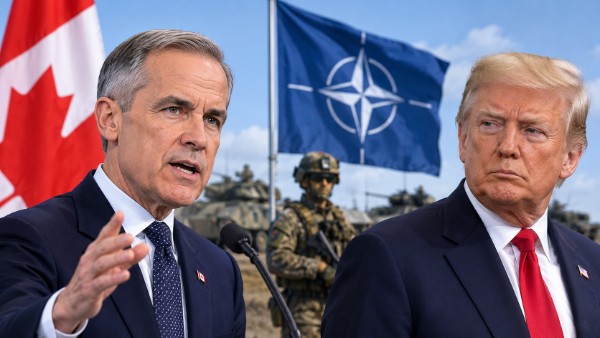
Canadian Prime Minister Mark Carney says defence spending has not been a point of disagreement in his conversations with US President Donald Trump, while NATO’s deputy commander has praised Canada’s contribution to European security.
By CK Sharma | World Affairs | NewsBee Media Inc.
Canadian Prime Minister Mark Carney has said that US President Donald Trump has not raised the Pentagon’s recent criticism of Canada’s defence spending during their conversations, as tensions continue over military readiness and NATO commitments.
Speaking to reporters in Ottawa on Wednesday, November 25, Carney said his discussions with Trump have focused primarily on resolving international conflicts rather than the concerns publicly expressed by US defence officials.
His comments came days after the Pentagon released a sharply worded fact sheet questioning Canada’s military capabilities, defence investment and ability to contribute effectively to the protection of North America.
At the same time, NATO’s deputy commander, British Air Chief Marshal Sir John Stringer, offered a more positive assessment of Canada’s military contribution, particularly its leadership role in the alliance’s mission in Latvia.
Carney Says Trump Has Not Raised the Issue
Addressing the Pentagon’s criticism, Carney emphasised that the US president himself had not brought the matter up during their discussions.
“The commander-in-chief of the U.S. military is the president of the United States,” Carney said, adding that his conversations with Trump were focused on conflict resolution around the world.
He also defended Canada’s defence commitments, arguing that the country was taking greater responsibility for its own security and playing an important role in NATO’s operations.
Carney pointed to Canada’s military presence in Europe, particularly Operation Reassurance in Latvia, as evidence of its contribution to the alliance.
He also highlighted increased military investment and improvements in compensation for members of the Canadian Armed Forces.
NATO Deputy Commander Praises Canada’s Contribution
While the Pentagon questioned Canada’s military readiness, NATO’s deputy commander delivered a notably different assessment.
Speaking to CBC News in Ottawa, Air Chief Marshal Sir John Stringer said he was pleased with Canada’s contribution to NATO’s deterrence mission in Eastern Europe.
Stringer described Canada as a country that was rebuilding and modernising its military capabilities across its air, land and maritime forces.
He specifically highlighted Canada’s role in Latvia, where Canadian forces lead a multinational NATO brigade tasked with strengthening the alliance’s eastern flank.
Canada currently has approximately 2,200 troops in Latvia, with plans to increase the deployment to around 2,600.
Asked about Canada’s military contribution, Stringer said he was “happy when I look at Canada.”
He also noted that several NATO countries were rebuilding military capabilities after years of relatively low defence spending, placing Canada’s efforts within a wider alliance-wide challenge.
Stringer avoided directly criticising the Pentagon’s assessment, saying he would not be drawn into comments made by individual member states.
Pentagon’s Criticism Raises Questions About Military Readiness
The Pentagon released its fact sheet on November 23, arguing that Canada had not made the necessary decisions and investments to meet NATO’s defence commitments.
The document questioned Canada’s operational readiness across its armed forces and criticised what it described as a lack of focus in military modernisation.
It also raised concerns about Canada’s review of its planned purchase of 88 American-made F-35 fighter jets. Pentagon officials warned that a mixed fleet could create additional personnel and operational challenges, particularly for NORAD, the joint North American defence command operated by Canada and the United States.
The criticism followed a classified directive issued by US Defence Secretary Pete Hegseth that placed restrictions on certain interactions between American and Canadian military personnel, including participation in think-tank events and social engagements without prior approval.
US officials have said the restrictions are intended to ensure that engagements advance American defence objectives. They have also indicated that the directive does not affect military operations.
Canada Defends Its Defence Spending Plans
The Canadian government has rejected the suggestion that it is failing to take defence responsibilities seriously.
Defence Minister David McGuinty has maintained that Canada is a sovereign country and does not report to Washington.
He has also said that cooperation between Canadian and American forces through NORAD and NATO remains unchanged.
Canada has committed approximately C$81.8 billion in additional defence spending over five years as part of efforts to rebuild its armed forces.
The country has also reached NATO’s previous target of spending 2 per cent of gross domestic product on defence. Under the alliance’s newer commitment, members have agreed to work towards spending 5 per cent of GDP on defence and related security investments by 2035.
However, questions remain about Canada’s ability to meet the new target and address existing equipment and personnel shortages.
Canadian officials have acknowledged that military readiness needs improvement, while pointing to accelerated procurement, recruitment and modernisation programmes.
A Wider Debate Over NATO’s Future
The contrasting assessments from the Pentagon and NATO’s military leadership highlight a broader debate about how defence contributions should be measured.
Washington has focused on spending levels, operational readiness and the need for Canada to strengthen continental defence capabilities.
NATO’s deputy commander, meanwhile, has highlighted Canada’s existing operational contribution in Europe and its ongoing efforts to rebuild military capacity.
Both issues remain important to the alliance as European governments respond to Russia’s military activities and growing security concerns across the Arctic and Eastern Europe.
Conclusion
Carney’s comments suggest that the Pentagon’s criticism has not become a direct subject of his discussions with Trump, although the public disagreement remains significant.
NATO’s praise for Canada’s contribution in Latvia provides another perspective on the country’s role within the alliance, even as questions about defence spending and readiness continue.
For Canada, the challenge will be to maintain its operational commitments while delivering the military investment and modernisation needed to meet future NATO and North American security requirements.
The coming months will show whether Ottawa and Washington can manage their differences without allowing the dispute to weaken their longstanding defence partnership.