

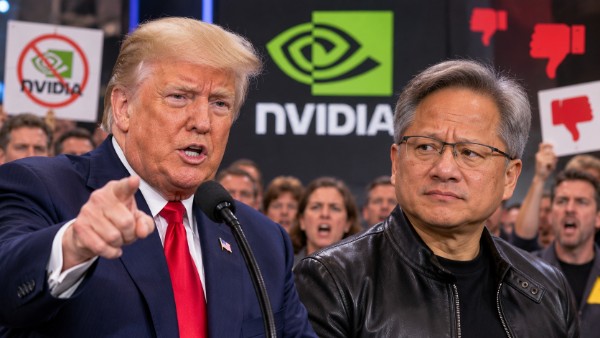
US President Donald Trump is facing criticism from lawmakers and national security experts after claiming personal responsibility for persuading Nvidia’s board to bring back chief executive Jensen Huang. The decision has raised questions about political interference in corporate governance, national security risks and the growing influence of major technology companies in Washington.
By CK Sharma | World Affairs | NewsBee Media Inc.
US President Donald Trump has come under growing criticism after publicly claiming that he convinced the board of technology giant Nvidia to reinstate its chief executive, Jensen Huang, following his resignation earlier this month.
In a telephone interview with CNBC on November 23, Trump said he had spoken directly and indirectly with members of Nvidia’s board and persuaded them to bring Huang back.
“I spoke to them. Let me put it this way: And I convinced them. I made the deal,” Trump said.
The president described the decision as important for the United States, arguing that the country needed to protect highly talented individuals working in strategically important industries.
However, his involvement has triggered criticism from lawmakers across the political spectrum, particularly because Huang’s departure was connected to allegations involving a woman suspected of having links to Chinese intelligence.
The controversy has now developed into a wider debate about the relationship between government, private businesses and national security.
Why Jensen Huang Left Nvidia
Jensen Huang, co-founder of Nvidia, stepped down as chief executive earlier in November following reports concerning alleged extramarital relationships.
One of the reported relationships involved Alice Huang, a Chinese businesswoman suspected by US intelligence of having connections to the Chinese government.
The allegations raised concerns about potential national security risks, particularly because Nvidia plays a central role in the development and supply of advanced artificial intelligence chips.
Nvidia’s technology is strategically important to the United States because advanced processors are essential for artificial intelligence development, military applications, data centres and other sensitive technologies.
The reports also prompted questions about whether information or technology connected to the company could have been exposed to foreign intelligence interests.
Huang’s resignation therefore attracted attention beyond ordinary corporate leadership issues.
The company initially indicated that it was not considering bringing him back. However, following pressure from Trump and other supporters, Nvidia’s board reversed its position and reinstated him as chief executive and president.
Trump Claims He Personally Convinced the Board
Trump has been openly supportive of Huang’s return.
Before Nvidia announced its decision, the president had publicly urged the company to reconsider its position, describing Huang as one of the world’s most brilliant minds.
In his CNBC interview, Trump went further by taking direct credit for the outcome.
He said the US government had conducted a thorough investigation and found that Huang had done nothing wrong.
Trump also argued that the potential national security risks had been examined and that the administration had provided assurances to Nvidia’s board.
The White House defended the president’s involvement, with communications director Steven Cheung describing Trump’s participation as significant to the decision.
According to reporting by Axios, Trump and Vice President JD Vance were involved in efforts to persuade Nvidia’s directors that Huang’s return was important for the company and the American economy.
The board ultimately voted unanimously to reinstate Huang.
However, Trump’s statements have raised questions about how much influence the White House should have over decisions made by the board of a privately owned technology company.
Lawmakers Raise National Security Concerns
The decision has attracted criticism from both Democratic and Republican lawmakers.
Democrats have questioned whether the administration is giving sufficient attention to national security concerns while supporting a prominent technology executive.
Some lawmakers have also raised concerns about the possibility of political influence affecting decisions involving companies that operate in strategically sensitive industries.
Senator Elizabeth Warren has called for greater transparency regarding the national security assurances provided to Nvidia’s board.
Republican lawmakers have also expressed concerns about Huang’s reinstatement and the company’s relationship with China.
The controversy has strengthened calls for congressional scrutiny of Nvidia’s leadership, export-control compliance and potential exposure to foreign intelligence operations.
Several House committees are preparing to question Huang about the allegations and related national security concerns.
Huang is scheduled to participate in a closed-door interview with House committee chairs on December 1, while Nvidia’s general counsel, Tim Teter, is expected to appear the following day.
He has also agreed to testify before the Senate Banking, Housing and Urban Affairs Committee, although a date has not yet been confirmed.
The China Connection Adds to the Controversy
One of the most sensitive aspects of the controversy involves the alleged links between Alice Huang and Chinese intelligence.
US intelligence officials reportedly suspected that she had connections to Beijing, although the allegations have not been established as proven facts.
The US Justice Department has not concluded whether she was a Chinese intelligence operative.
The issue is particularly important because Washington has spent years restricting China’s access to advanced American semiconductor technology.
Nvidia produces some of the world’s most powerful AI processors, making the company central to America’s technological competition with China.
Any possibility of sensitive information reaching foreign intelligence networks could therefore have implications beyond the company itself.
The administration’s support for Huang has consequently raised questions about whether economic competitiveness and the protection of national security are being balanced appropriately.
Nvidia’s Importance to the US Economy
Nvidia is one of the most influential companies in the global technology industry.
Its graphics processing units and AI accelerators are widely used by technology companies, cloud computing providers, research institutions and governments.
The company has become a central supplier in the rapidly expanding artificial intelligence industry.
Its market performance also has a considerable influence on broader US financial markets.
Following Huang’s resignation, Nvidia shares experienced pressure. After his reinstatement was announced, the company’s stock surged, adding significant value to its market capitalisation.
The recovery strengthened arguments from Huang’s supporters that keeping him in charge was important for the company’s stability and America’s position in the global AI industry.
However, critics argue that the economic importance of a company should not place its leadership beyond proper scrutiny.
The situation highlights a difficult question for Washington: how can the United States protect its technological advantage while ensuring that national security standards and corporate accountability remain intact?
Questions Over Political Influence and Corporate Independence
Trump’s intervention has also revived debate about the independence of private companies.
Corporate boards are generally responsible for appointing executives, evaluating leadership performance and protecting the interests of shareholders.
The president’s public admission that he personally persuaded Nvidia’s board has raised questions about whether political pressure played an excessive role in the decision.
Supporters of Trump’s approach argue that the government has a legitimate interest in protecting strategically important companies and preventing the loss of highly valuable American talent.
Critics, however, believe that direct presidential involvement in a private company’s leadership decision could create an uncomfortable precedent.
There are also broader concerns about how national security investigations are handled when the individuals involved have significant economic and political influence.
Conclusion
The reinstatement of Jensen Huang has become much more than a corporate leadership story.
Trump’s claim that he personally convinced Nvidia’s board to bring back its chief executive has placed the president at the centre of a growing debate involving national security, corporate independence and America’s technological competition with China.
While supporters believe Huang’s experience is essential to maintaining the United States’ leadership in artificial intelligence, critics argue that the allegations surrounding his resignation require careful examination before concerns can be dismissed.
With congressional questioning expected in December and investigations continuing, the controversy is unlikely to disappear quickly.
Ultimately, the issue is not simply whether Jensen Huang should lead Nvidia again. It is whether political influence, economic interests and national security can be balanced without weakening public confidence in the institutions responsible for protecting them.