

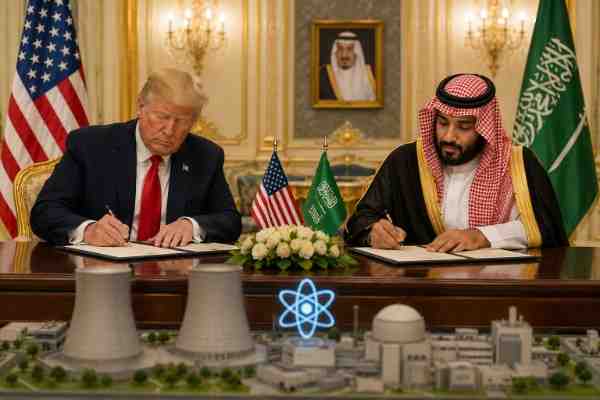
Proposed 30-Year Agreement Would Support Saudi Civilian Nuclear Program, Drawing Global Attention
Summary
The United States is preparing to announce a landmark nuclear cooperation agreement with Saudi Arabia that would allow the kingdom to develop a civilian nuclear energy program with American support. According to officials familiar with the proposal, the agreement could permit Saudi Arabia to enrich uranium under specific conditions, making it one of the most significant U.S.–Saudi strategic agreements in recent years. The proposed deal is expected to face close scrutiny in Washington due to concerns over nuclear proliferation and regional security.
Landmark Civil Nuclear Agreement
The proposed agreement is expected to establish a 30-year framework for cooperation between the United States and Saudi Arabia on civilian nuclear energy. American companies would play a major role in developing Saudi Arabia’s nuclear infrastructure, including feasibility studies for uranium enrichment facilities and the construction of nuclear power plants.
Supporters of the deal argue that it would strengthen long-term energy cooperation while ensuring the United States remains a key partner in Saudi Arabia’s nuclear ambitions instead of competitors such as China or Russia.
Saudi Arabia’s Energy Vision
Saudi Arabia has long sought to develop nuclear energy as part of its Vision 2030 strategy to diversify its economy and reduce dependence on oil. Officials say civilian nuclear power would help generate electricity, support desalination projects, and free up more crude oil for export.
Saudi leaders have maintained that the program is intended for peaceful purposes, although previous statements linking Saudi nuclear ambitions to Iran’s nuclear activities have continued to fuel international debate.
Concerns Over Uranium Enrichment
The possibility that Saudi Arabia could enrich uranium domestically has become the most controversial aspect of the proposed agreement. While uranium enrichment is permitted for peaceful nuclear energy under international safeguards, the same technology can also be used to produce material suitable for nuclear weapons if restrictions are removed.
Several U.S. lawmakers and nuclear non-proliferation experts have expressed concern that the reported agreement does not include some of the stricter monitoring measures traditionally required in similar U.S. nuclear cooperation agreements.
Congressional Review Expected
Before taking full effect, the agreement is expected to be submitted to the U.S. Congress for review. Lawmakers from both political parties are expected to examine the safeguards, inspection mechanisms, and strategic implications of the proposal before deciding whether to allow it to proceed.
Analysts believe the agreement could become a major topic of debate as Washington weighs its strategic partnership with Saudi Arabia against concerns over nuclear proliferation in the Middle East.
Conclusion
The proposed U.S.–Saudi nuclear agreement represents a significant development in Middle East diplomacy and energy cooperation. While supporters view it as an opportunity to strengthen strategic ties and expand peaceful nuclear energy, critics warn that allowing uranium enrichment could increase regional security risks. As the agreement moves toward congressional review, its safeguards and long-term implications are expected to remain under close international scrutiny.