

American Lawmaker Urges Cooperation Over Blame as Cross-Border Wildfires Continue to Threaten Communities
Summary
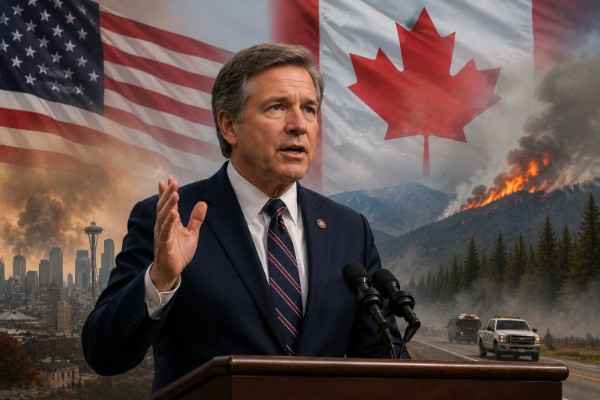
A U.S. senator has come to Canada’s defense amid growing political criticism over wildfire smoke drifting into the United States, calling for cooperation instead of blame as a major American wildfire spread into British Columbia. The senator argued that wildfires are a shared North American challenge driven by extreme weather conditions and stressed that both countries have a long history of helping each other during natural disasters.
The remarks come as smoke from ongoing wildfires continues to affect air quality across parts of Canada and the United States, while firefighters on both sides of the border work to contain rapidly spreading blazes.
Senator Calls for Cross-Border Cooperation
Responding to complaints from some U.S. politicians about smoke drifting south from Canadian wildfires, the senator rejected efforts to blame Canada for the crisis. Instead, he emphasized that wildfire smoke does not recognize international borders and said both nations should focus on sharing resources, firefighting expertise, and emergency support.
The lawmaker also noted that Canadian firefighters have repeatedly assisted American states during severe wildfire seasons, while U.S. crews have similarly provided support to Canada when needed. He described the long-standing partnership as essential to protecting lives and communities on both sides of the border.
U.S. Wildfire Spreads into British Columbia
At the same time, a wildfire that began in the United States crossed into British Columbia, prompting emergency officials to increase monitoring and deploy additional firefighting resources. Authorities said changing winds and dry conditions allowed the blaze to move across the international boundary, highlighting how wildfire emergencies frequently affect both countries.
Emergency crews continue working to contain the fire while protecting nearby communities and critical infrastructure. Officials have warned that hot temperatures and strong winds could allow the fire to expand further if weather conditions do not improve.
Smoke Continues to Impact Air Quality
Wildfire smoke has created poor air quality across large parts of western Canada and several U.S. states. Health authorities have advised residents, particularly children, older adults, pregnant women, and people with respiratory conditions, to limit outdoor activities when smoke levels become hazardous.
Experts say wildfire smoke contains fine particulate matter that can cause breathing difficulties, eye irritation, and cardiovascular problems, especially during prolonged exposure. Air quality alerts remain in effect in several affected regions as officials continue monitoring changing weather patterns.
Wildfire Season Remains Severe
Canada continues to battle hundreds of active wildfires, while several western U.S. states are also experiencing large and difficult-to-control blazes. Fire officials say prolonged drought, high temperatures, and strong winds have created ideal conditions for fires to spread rapidly across forests and grasslands.
Environmental experts warn that increasingly intense wildfire seasons are becoming more common, making international cooperation and coordinated emergency planning increasingly important for both Canada and the United States.
Conclusion
As wildfire smoke continues to drift across the Canada-U.S. border and an American wildfire spreads into British Columbia, calls for cooperation have grown louder than political criticism. The U.S. senator’s defense of Canada underscores the shared nature of the wildfire crisis, emphasizing that effective cross-border collaboration remains the best way to protect communities, manage increasingly severe fire seasons, and reduce the impact of smoke on millions of people across North America.