

Washington Says Dozens of Iranian Military Targets Were Hit in Retaliation as Regional Tensions Escalate
Summary
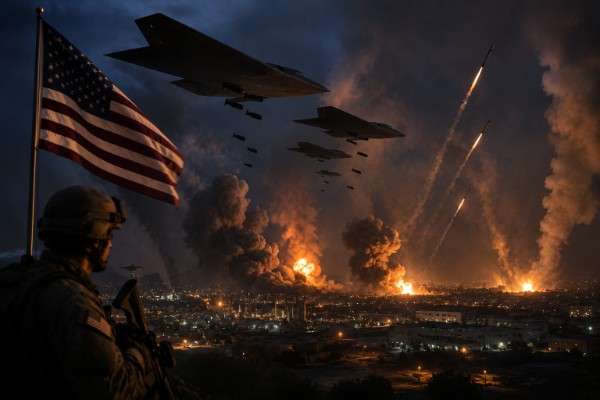
The United States has carried out what officials described as a “heavy wave” of airstrikes against Iran after an attempted missile attack targeting American troops stationed in the Middle East. U.S. Central Command (CENTCOM) said the operation struck dozens of military targets linked to Iran’s Islamic Revolutionary Guard Corps (IRGC), calling it a direct response to the attempted attack on U.S. forces.
President Donald Trump said the United States would respond forcefully to any attack on its military personnel, while Iran condemned the strikes and reported casualties in areas that were hit. The latest exchange has heightened fears of a broader regional conflict and raised fresh concerns over stability in the Middle East.
U.S. Targets Iranian Military Facilities
According to CENTCOM, the two-hour operation targeted command centers, missile and drone facilities, coastal surveillance systems, and maritime defense infrastructure associated with the IRGC. U.S. officials said the strikes were intended to reduce Iran’s ability to launch future attacks against American personnel and regional allies.
Military officials described the operation as a “powerful response” and said the strikes were carefully planned to focus on military objectives following the attempted ballistic missile attack on U.S. bases in the region.
Retaliation Follows Attempted Missile Attack
The U.S. said the airstrikes came after Iranian forces launched ballistic missiles toward American military installations, including bases in Jordan. U.S. and allied air defense systems intercepted the incoming missiles, preventing significant damage and casualties.
Following the attempted attack, President Trump vowed decisive retaliation, stating that the United States would respond strongly to protect its forces and deter future aggression.
Iran Reports Casualties and Condemns the Strikes
Iranian state media reported that the airstrikes caused casualties, including civilian deaths on Qeshm Island, while government officials accused Washington of escalating the conflict. Tehran warned that it reserved the right to respond to what it described as an act of aggression against its territory.
Iran has not yet released a comprehensive assessment of the damage, but officials said emergency services were deployed to affected areas following the attacks.
Diplomatic Efforts Face New Challenges
The latest military escalation comes as diplomatic efforts aimed at reducing tensions have struggled to gain momentum. Recent discussions involving regional mediators had sought to ease hostilities, but the renewed exchange of attacks has cast doubt on the prospects for near-term negotiations.
Analysts warn that continued military action by both sides could increase the risk of a wider regional conflict involving additional countries and armed groups operating across the Middle East.
Global Markets and Security in Focus
The renewed fighting has also renewed concerns over the security of key shipping routes, particularly the Strait of Hormuz, through which a significant portion of the world’s oil exports passes. Energy markets and international governments are closely monitoring developments amid fears that further escalation could disrupt global trade and fuel supplies.
Conclusion
The United States’ latest wave of airstrikes against Iran marks another major escalation in an already volatile regional conflict. While Washington says the operation was a necessary response to an attempted attack on American troops, Tehran has condemned the strikes and warned of possible retaliation. As military tensions continue to rise, international attention remains focused on preventing the crisis from expanding into a broader regional confrontation.