

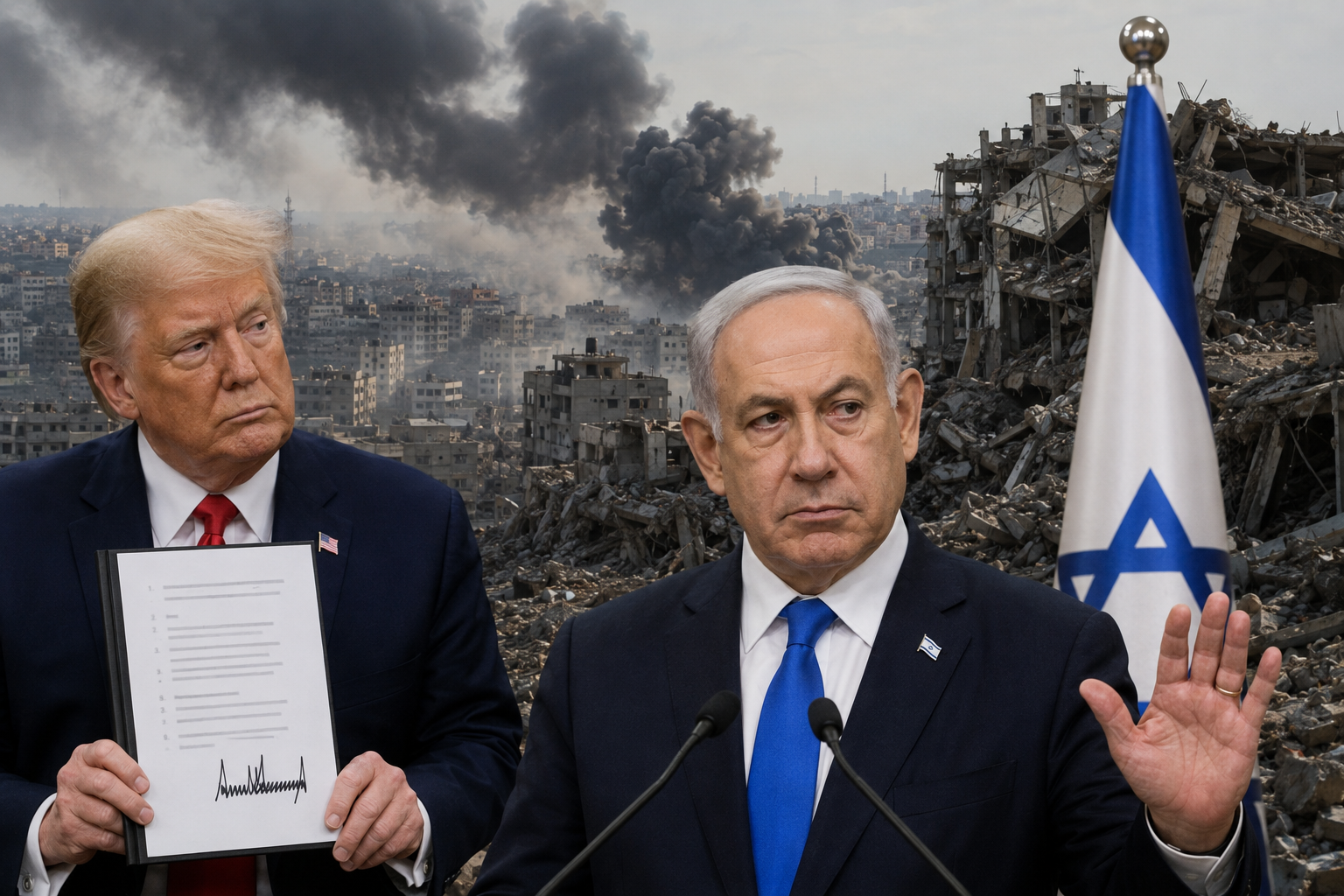
Israeli Prime Minister Says Israel Will Not Withdraw From Gaza Until Hamas Gives Up Its Weapons, Putting U.S.-Backed Peace Efforts Under Pressure
Summary
Israeli Prime Minister Benjamin Netanyahu has rejected U.S. President Donald Trump’s 15-point plan for Gaza, saying Israel will not withdraw its forces from the territory until Hamas is fully disarmed. The announcement represents a significant setback for the U.S.-backed peace initiative and highlights deep disagreements between Washington and the Israeli government over how the next phase of the Gaza conflict should proceed.
Netanyahu said Israel would not accept a partial or symbolic disarmament of Hamas and insisted that all heavy and light weapons must be removed before Israeli forces leave Gaza. The disagreement comes as the Trump administration seeks to advance a broader framework involving Hamas disarmament, Israeli troop withdrawal and international stabilization efforts.
Netanyahu Rejects 15-Point Framework
Speaking at a cabinet meeting, Netanyahu said Israel does not accept the 15-point document proposed through Trump’s Board of Peace. He made clear that Israeli forces would not withdraw from Gaza simply as part of a phased process unless Hamas is genuinely disarmed.
The Israeli leader said discussions with American officials were continuing and acknowledged that some elements of the U.S. proposal were acceptable to Israel, while others were not. He also emphasized that his government was prepared to disagree with Washington when Israeli security interests were at stake.
Hamas Position Creates Another Obstacle
Hamas has expressed support for the broader peace framework but has its own conditions. The group has indicated that weapons could be handed over as part of a future arrangement, but it has sought an Israeli halt to military operations and a withdrawal of Israeli forces before proceeding with the process.
The disagreement over the order of events has become one of the biggest obstacles to implementing the proposed agreement. Israel wants Hamas to disarm first, while Hamas has pushed for Israeli forces to withdraw as part of the process.
U.S. Plan Seeks Phased Withdrawal
The Trump-backed proposal envisions a phased process in which Hamas would give up its weapons while Israel gradually withdraws from parts of Gaza. An international stabilization force would also play a role in maintaining security as the territory moves toward a new administrative arrangement.
The plan is intended to create conditions for reconstruction and a longer-term political settlement, but the Israeli rejection means negotiations will likely have to be revised before implementation can move forward.
Growing Pressure on Netanyahu
Netanyahu’s position is supported by members of his governing coalition who have strongly opposed any Israeli withdrawal that could allow Hamas to retain military capabilities. Far-right politicians have also demanded that Israel maintain control over security in Gaza and prevent Hamas from rebuilding its armed forces.
At the same time, continued fighting and the humanitarian situation in Gaza have increased international pressure for a durable settlement. Any delay in the peace process could further complicate efforts to provide stability and begin large-scale reconstruction.
Tensions With Washington
The rejection also presents a challenge for relations between Netanyahu’s government and the Trump administration. Although Israel and the United States remain close allies, the latest disagreement shows that their positions on Gaza are not fully aligned.
Washington is pushing for a diplomatic framework that would move toward Hamas disarmament and an Israeli withdrawal, while Netanyahu insists that Israeli forces must remain until Israel is convinced that the threat from Hamas has been eliminated.
Conclusion
Israel’s rejection of Trump’s 15-point Gaza plan has created a major hurdle for efforts to advance the next stage of the peace process. Netanyahu’s insistence on complete Hamas disarmament before any Israeli withdrawal directly conflicts with the phased approach supported by Washington and creates further uncertainty over Gaza’s future.
With negotiations continuing and major differences still unresolved, the coming weeks will be crucial in determining whether the U.S.-backed framework can be revised into an agreement acceptable to Israel and Hamas.