

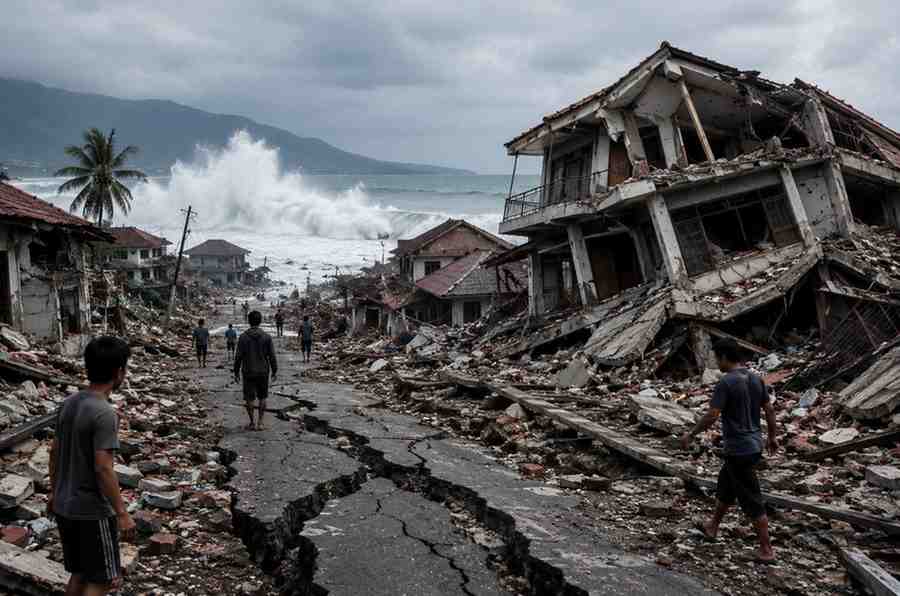
Flores Island Hit by Major Tremor as Buildings Collapse, Landslides Block Roads and Thousands Flee to Safety
Summary
A powerful magnitude 7.7 earthquake struck off the coast of Indonesia’s Flores Island early Saturday, killing at least 47 people and causing widespread destruction across parts of East Nusa Tenggara province. The earthquake collapsed homes and public buildings, triggered landslides and prompted thousands of residents to leave their homes amid fears of a tsunami.
Authorities warned that the death toll could rise as rescue teams continue reaching remote communities cut off by damaged roads, landslides and communication disruptions.
Strong Earthquake Hits Flores
The earthquake struck at around 5:58 a.m. local time, with the epicentre located roughly 68 kilometres north-northwest of Ende at a depth of about 10 kilometres.
The shallow depth contributed to intense shaking across parts of Flores Island. Residents reported buildings shaking violently, while many people rushed outdoors as the ground continued to tremble.
The hardest-hit areas include Sikka, Manggarai, East Manggarai and Nagekeo, where emergency crews have been working to assess the scale of the destruction.
Buildings Collapse and Villages Are Cut Off
The earthquake caused at least 157 homes to collapse and damaged nearly 200 others. More than 100 public facilities, including schools, health centres and churches, were also damaged or destroyed.
Landslides blocked major roads, including sections of the Trans-Flores highway, making it difficult for rescuers and emergency supplies to reach some communities. Officials said some remote villages were effectively cut off and could not yet be fully assessed.
Power outages and disrupted communications have added to the difficulties facing emergency responders.
Thousands Evacuate
Around 2,000 residents have been moved into temporary shelters after their homes were damaged or because authorities feared additional hazards.
Many residents have remained outside rather than returning to damaged buildings because of continuing aftershocks. Emergency officials have warned people to stay away from structures that may have been weakened by the initial earthquake.
Tsunami Warning Issued and Later Lifted
Indonesia’s authorities initially issued a tsunami warning for affected coastal areas and instructed residents to move toward higher ground.
The warning was later lifted after monitoring showed that there was no continuing major tsunami threat. However, small tsunami waves were recorded in several locations, with the largest reaching around 1.61 metres in a coastal village in East Manggarai.
Officials continue to monitor coastal areas as aftershocks remain possible.
Hundreds of Aftershocks Recorded
The main earthquake was followed by more than 235 aftershocks, with the strongest reaching approximately magnitude 6.2.
The continuing seismic activity has complicated rescue operations and increased fears among residents who have already lost homes or suffered damage to their communities.
Authorities have urged residents to remain cautious and follow instructions from emergency services.
Rescue Operations Face Major Challenges
Search and rescue teams are working through collapsed buildings and damaged roads to locate survivors and recover victims.
Three helicopters and a rescue vessel have been deployed to support emergency operations and transport supplies. However, landslides, damaged infrastructure and communication problems are slowing the response in some of the worst-affected areas.
Officials expect the casualty figures and damage assessment to change as rescuers reach isolated communities.
Indonesia’s Earthquake Risk
Indonesia lies along the Pacific Ring of Fire, one of the world’s most seismically active regions. The country regularly experiences earthquakes and volcanic activity because several tectonic plates meet beneath and around the Indonesian archipelago.
The latest disaster has again highlighted the country’s vulnerability to major earthquakes, particularly in remote coastal communities where access for emergency services can be difficult.
Conclusion
The magnitude 7.7 earthquake off Flores Island has caused a major humanitarian emergency, with at least 47 people confirmed dead, dozens injured and thousands forced into temporary shelters. Collapsed buildings, landslides, damaged roads and continuing aftershocks are making rescue operations increasingly difficult.
With emergency teams still searching affected communities, authorities fear the death toll could rise. The lifting of the tsunami warning has reduced one immediate threat, but residents remain on alert as Indonesia continues to deal with the devastating aftermath of one of its strongest recent earthquakes.