

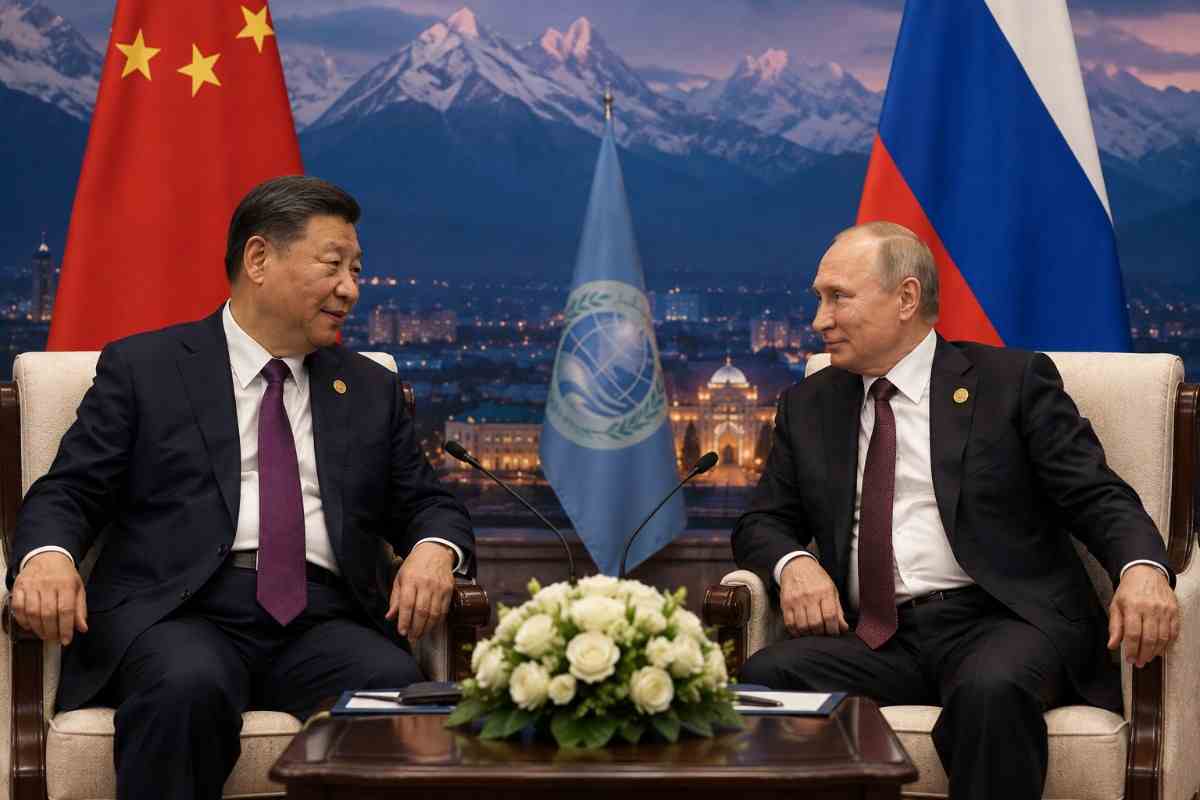
Chinese and Russian Leaders Also Exchange Views on Global and Regional Issues as They Meet on the Sidelines of the SCO Summit
Summary
Chinese President Xi Jinping and Russian President Vladimir Putin have held high-level talks in Bishkek, Kyrgyzstan, where they discussed strengthening ties between their countries, including the possibility of making their visa-free travel arrangement permanent.
The meeting took place on the sidelines of the Shanghai Cooperation Organisation (SCO) Summit 2026, bringing together two leaders whose countries have continued to deepen political, economic and strategic cooperation amid growing global uncertainty. Xi and Putin also exchanged views on major international and regional issues of common concern.
Putin Proposes Permanent Visa-Free Travel
One of the key issues discussed during the meeting was the future of visa-free travel between Russia and China.
Putin said Russia was ready to work with Beijing to make the visa-free regime permanent if China considered the proposal useful. The current arrangement has already contributed to a significant increase in travel between the two countries.
According to Putin, tourist trips between Russia and China increased by 43 per cent during the first half of 2026, highlighting the growing level of people-to-people contact. Russia introduced reciprocal visa-free entry arrangements for Chinese citizens after China implemented similar measures for Russian travellers, and the two countries later extended visa-free travel through the end of 2027.
A permanent arrangement could further increase tourism, business travel and cultural exchanges between the two neighbouring powers.
Xi Says China-Russia Ties Will Grow Stronger
Xi emphasized the importance of continued strategic cooperation between Beijing and Moscow.
According to reports from the meeting, Xi said that under the strategic guidance of both leaders and through continued cooperation, the foundations of China-Russia relations would become stronger and their future prospects would remain positive.
Xi also noted that the international environment was becoming increasingly uncertain and unpredictable. However, he said that the global desire for peace, development and cooperation remained unchanged.
China has indicated that it is prepared to work with Russia and other countries to support changes in global governance and promote a more multipolar international system.
Global and Regional Issues Discussed
Beyond bilateral relations, Xi and Putin exchanged views on international and regional developments.
The discussions came at a time of significant geopolitical tension, including the continuing conflict involving Russia and Ukraine, instability in West Asia and growing competition between major global powers.
Both China and Russia have increasingly used platforms such as the SCO to strengthen cooperation with countries outside Western-led political and economic alliances. The Bishkek summit provided an opportunity for leaders to discuss regional security, economic cooperation and the changing global balance of power.
SCO Summit Brings Major Leaders Together
The SCO summit in Bishkek has brought together leaders from several major Eurasian countries, including China, Russia and India.
Founded in 2001, the Shanghai Cooperation Organisation has grown into a major regional grouping with members including China, Russia, India, Pakistan, Iran, Belarus and several Central Asian countries.
Although the organization is not a unified military or political alliance, it has become an increasingly important platform for discussions on security, economic cooperation and regional affairs.
For China and Russia, the SCO also provides an opportunity to strengthen relations with countries that share concerns about the influence of Western powers in international affairs.
Growing Economic and People-to-People Ties
The proposed permanent visa-free regime reflects a broader effort by Moscow and Beijing to strengthen their relationship beyond government and military cooperation.
Tourism, trade, energy and technology have become increasingly important parts of China-Russia relations. Russia has also become more economically dependent on trade with China as Western sanctions and geopolitical tensions have limited Moscow’s economic links with Europe and the United States.
For Beijing, stronger ties with Moscow provide access to energy resources and reinforce China’s influence across Eurasia.
Conclusion
The meeting between Xi Jinping and Vladimir Putin in Bishkek highlighted the continued strengthening of China-Russia relations at a time of growing global uncertainty.
Putin’s proposal to make visa-free travel permanent could further increase tourism and people-to-people exchanges, while discussions on international and regional issues demonstrated the broader strategic importance of the relationship.
As both countries seek to expand their influence and strengthen partnerships across Eurasia, the Bishkek meeting has underlined their shared interest in closer cooperation. The future of the proposed permanent visa-free arrangement will now depend on further discussions between Moscow and Beijing.