
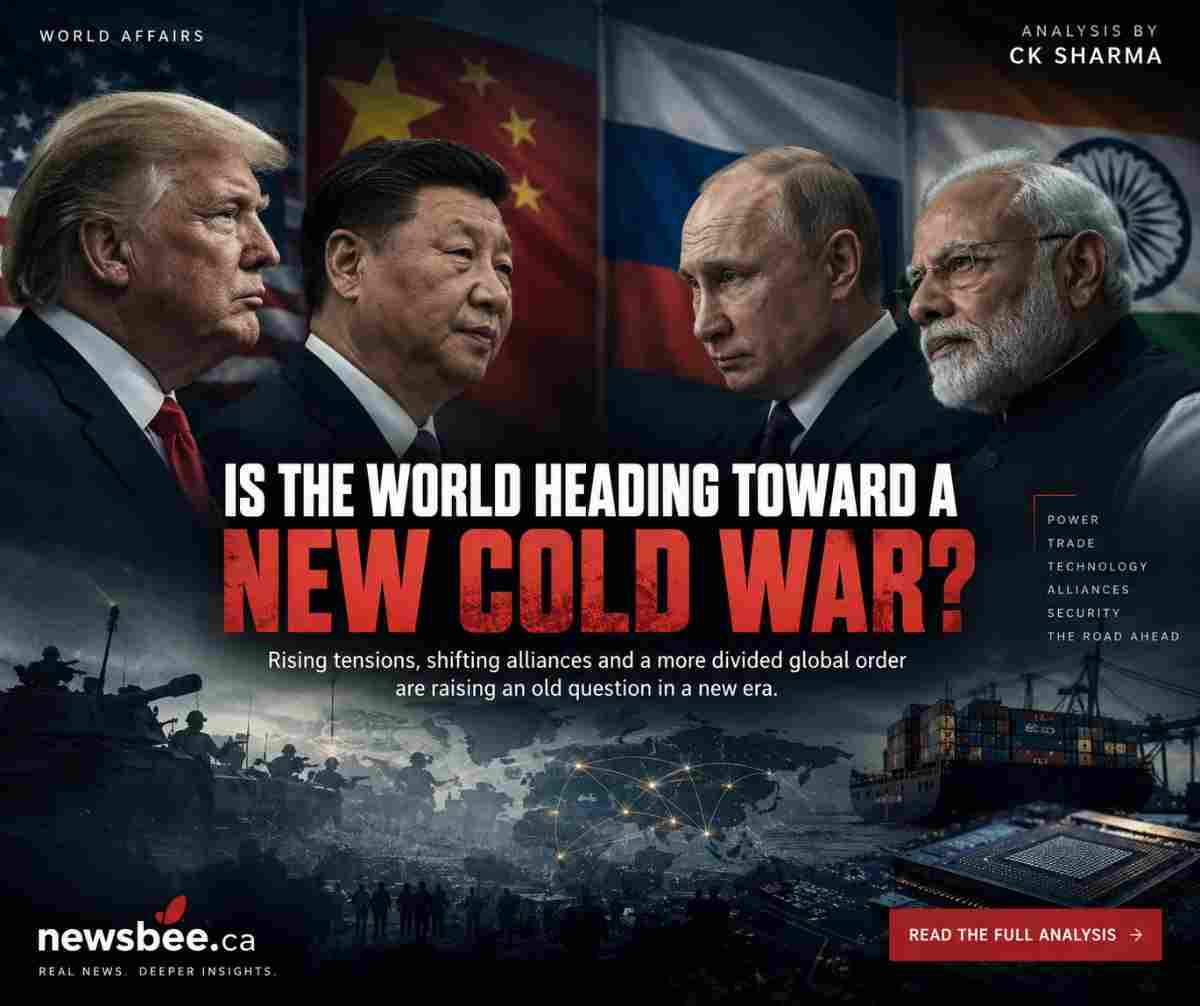
Rising tensions between the United States, China and Russia are reshaping global alliances and pushing countries to rethink their place in an increasingly divided world
Summary
The world is entering a period of growing geopolitical competition that is beginning to remind many observers of the Cold War era. The United States remains the dominant military and economic power, while China is expanding its influence across Asia, technology and global trade. Russia continues to challenge the Western-led security order, particularly through its war in Ukraine. At the same time, countries such as India are trying to maintain strategic relationships with competing powers rather than choosing one side. Global military spending reached a record $2.89 trillion in 2025, with the United States, China and Russia accounting for about 51 per cent of the total.
The question is no longer whether the world is becoming more competitive. It is whether these rivalries are creating the foundations for a new form of Cold War.
The Old Cold War Had Two Sides. Today’s World Is More Complicated
The original Cold War was largely defined by the rivalry between the United States and the Soviet Union. Two military alliances dominated international politics, and much of the world was forced to navigate between the American and Soviet camps.
Today’s situation is different.
There is no single division separating the world into two clearly defined groups. The United States has strong alliances across Europe and Asia, but countries such as India, Brazil and several nations in the Middle East are pursuing their own interests rather than automatically aligning with Washington or Beijing.
China and Russia have also developed closer strategic ties, but that does not mean they form a traditional military alliance comparable to NATO. Their interests overlap in several areas, particularly in challenging aspects of the U.S.-led international system, but their economic and strategic priorities are not identical.
That makes today’s geopolitical competition less predictable than the Cold War.
Washington and Beijing Are Competing on More Than Military Power
The most important rivalry in the emerging global order may be between the United States and China.
The competition is no longer limited to military strength. Technology, artificial intelligence, semiconductors, electric vehicles, telecommunications, critical minerals and supply chains have all become part of the contest.
Washington wants to reduce strategic dependence on China in sensitive industries, while Beijing is investing heavily in domestic technology and manufacturing capabilities.
China’s military expansion is another major factor. According to SIPRI, Chinese military expenditure increased by 7.4 per cent in 2025 to an estimated $336 billion. It was the country’s 31st consecutive annual increase in military spending.
Much of the attention is focused on the Indo-Pacific, particularly Taiwan and the South China Sea. Any serious military crisis involving Taiwan could have consequences for global trade, semiconductor supplies and relations between Washington and Beijing.
For now, both countries have strong reasons to avoid a direct war. Their economies remain deeply connected, and the costs of a major conflict would be enormous.
But competition is clearly becoming a permanent feature of their relationship.
Russia Has Changed Europe’s Security Calculations
Russia’s war in Ukraine has added another dimension to the changing global order.
The conflict has pushed European countries to increase military spending and rethink their long-term security arrangements. SIPRI estimates that European military expenditure increased by 14 per cent in 2025 to $864 billion, with Russia’s military spending reaching an estimated $190 billion.
The result is a Europe that is spending more on defence and paying greater attention to military preparedness.
For Russia, the conflict has also deepened its confrontation with the United States and European governments. Moscow continues to oppose what it sees as Western expansion of influence, while Washington and its allies view Russia as a major challenge to European security.
That confrontation does not perfectly replicate the U.S.-Soviet rivalry of the twentieth century, but it has revived many of the strategic tensions that defined that period.
Military Spending Tells Its Own Story
Perhaps the clearest indication of growing insecurity is the amount governments are spending on defence.
Global military expenditure rose to approximately $2.89 trillion in 2025, marking the 11th consecutive year of growth, according to SIPRI. The United States remained the world’s largest military spender at $954 billion, followed by China at an estimated $336 billion and Russia at about $190 billion. Together, the three countries accounted for 51 per cent of global military expenditure.
These numbers do not automatically mean that a new world war is approaching.
Countries increase defence spending for many reasons, including regional threats, technological competition and concerns about the reliability of existing security arrangements.
But the trend does reveal something important: governments are preparing for a world in which geopolitical uncertainty may last for years.
The Rise of a More Multipolar World
One of the biggest differences between today’s situation and the Cold War is the growing importance of countries outside the traditional Western and Russian spheres.
India is perhaps the clearest example.
New Delhi maintains a strong strategic relationship with Russia while also expanding defence, technology and economic cooperation with the United States and its allies. India is also a member of BRICS, which has expanded significantly and now includes 11 member countries.
The expanded BRICS grouping represents a substantial share of the world’s population and economy, but its members do not always agree on geopolitical issues. India, China, Russia and other members have different national interests and relationships with the West.
That is why describing BRICS simply as an anti-American alliance would be misleading.
Instead, its growth reflects a broader desire among emerging powers for greater influence in international institutions and global decision-making.
India and Other Middle Powers Have More Room to Maneuver
Countries such as India, Saudi Arabia, Brazil, Indonesia and several others are increasingly trying to avoid being locked into one geopolitical camp.
This could become one of the defining characteristics of the coming decades.
During the original Cold War, many countries were pressured to choose between Washington and Moscow. Today, governments have more opportunities to develop relationships with multiple powers simultaneously.
India’s approach demonstrates this clearly. New Delhi can cooperate with Washington on technology and Indo-Pacific security while maintaining its long-standing relationship with Moscow.
This flexibility gives middle and emerging powers greater diplomatic room, but it also requires careful balancing.
As competition between major powers intensifies, maintaining good relations with everyone becomes increasingly difficult.
Is This Really a New Cold War?
The comparison is useful, but it has limits.
There are similarities: military build-ups, competing alliances, technological restrictions, sanctions, information battles and disputes over strategic territories.
But there are also major differences.
The global economy is far more interconnected than it was during much of the twentieth-century Cold War. China is deeply integrated into international trade, and countries such as India have built relationships with both Western and non-Western powers.
The world is also more multipolar.
Instead of two superpowers controlling most major geopolitical decisions, several countries now have the economic, military or diplomatic influence to shape international events.
So perhaps the better description is not a “new Cold War,” but a period of long-term strategic competition in a multipolar world.
What Happens Next?
The biggest challenge will be preventing competition from turning into confrontation.
Taiwan remains one of the most sensitive flashpoints in Asia. Ukraine continues to shape relations between Russia and the West. The Middle East remains vulnerable to conflicts that can quickly affect global energy markets. At the same time, competition over artificial intelligence, semiconductors and critical minerals is creating new economic fault lines.
None of these issues guarantees a major conflict.
In fact, the enormous cost of direct confrontation may encourage governments to continue competing through trade, technology, diplomacy, sanctions and proxy relationships rather than open warfare.
But the risks cannot be ignored.
A military accident, miscalculation or sudden political crisis could force countries into decisions they did not originally intend to make.
Conclusion
The world is not simply returning to the Cold War. The reality is more complicated.
The United States remains the most powerful military spender, China is rapidly expanding its economic and strategic influence, and Russia continues to challenge the European security order. At the same time, countries such as India and Brazil are seeking greater independence in international affairs rather than choosing between two fixed camps.
That makes the emerging global order harder to predict, but also more diverse.
The real question may not be whether a new Cold War has already begun. It is whether the world’s major powers can manage their competition without allowing it to become a direct confrontation.
For now, diplomacy remains possible and economic interdependence still provides powerful incentives to avoid war. But with military spending rising, alliances changing and strategic competition spreading into technology and trade, the international system is clearly entering a different era.
The next Cold War, if that is what this becomes, may not look like the first one. It could be fought less through armies standing across borders and more through technology, economics, influence, cyber capabilities and competing visions of how the world should be governed.
CK SHARMA TORONTO ( EDITOR IN CHIEF )