

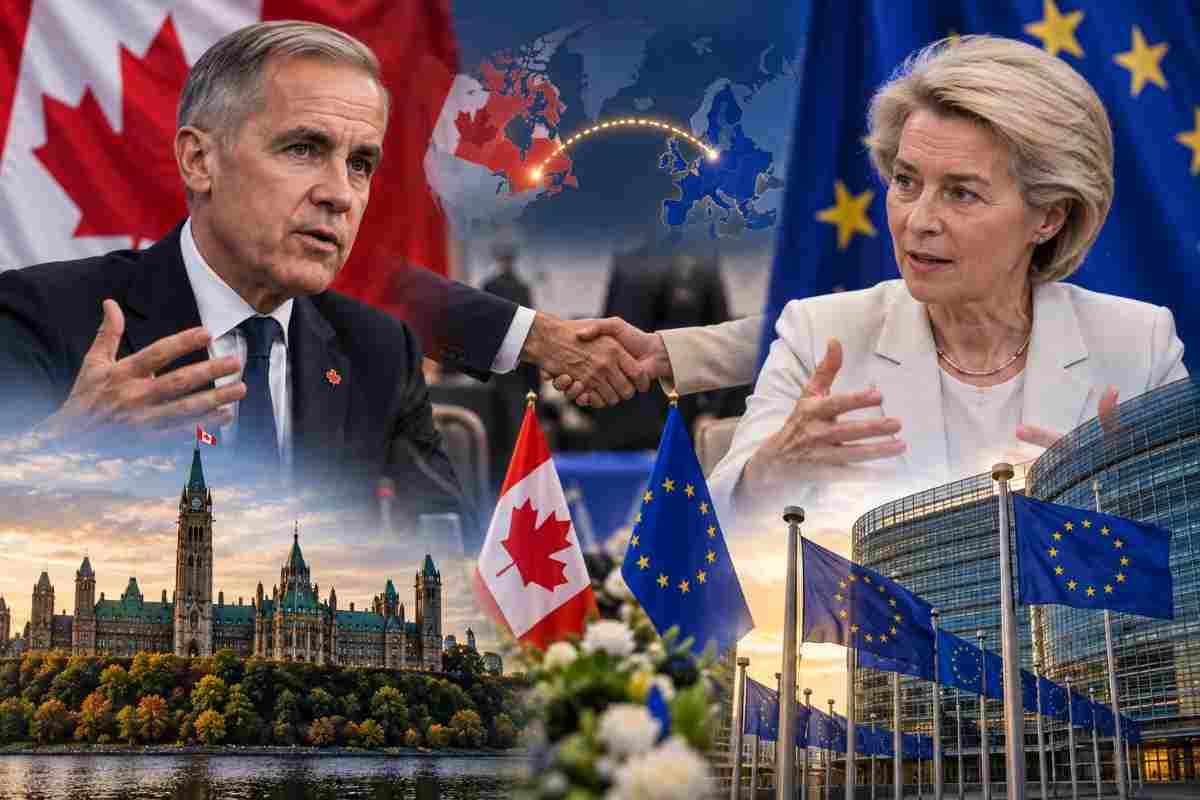
Subheading: European Commission President Ursula von der Leyen has proposed making Canada the European Union’s first associate member, deepening economic, defence and strategic cooperation as Ottawa seeks closer ties with Europe.
Von der Leyen Makes Landmark Proposal
European Commission President Ursula von der Leyen has thrown her support behind a new and potentially unprecedented relationship between Canada and the European Union, proposing that Canada become the bloc’s first “associate member.”
Speaking during her annual State of the European Union address at the European Parliament in Strasbourg on Wednesday, von der Leyen said Europe needed to rethink its partnerships and specifically called for opening the door to Canada. Canadian Prime Minister Mark Carney was present in the chamber during the speech.
The proposal represents a significant development after Carney had spent recent days advocating a “unique alliance” between Canada and Europe without seeking full EU membership.
Canada Would Be the First Under Such a Model
Associate membership is not currently defined in EU treaties, meaning there is no established legal framework explaining exactly what the status would provide.
Reuters reported that any such arrangement would require extensive negotiations and agreement among the EU’s 27 member states. The precise details, including market access, regulatory alignment and mobility rights, have yet to be determined.
Carney has made clear that Canada is not seeking traditional EU membership. Instead, Ottawa has been exploring a closer relationship that could provide greater economic and strategic integration while Canada remains outside the bloc’s formal political structure.
Economic and Defence Cooperation at the Centre
Von der Leyen outlined a broad range of areas where Canada and Europe could cooperate more closely.
These include advanced manufacturing, technology, defence industries, energy, critical minerals, batteries, artificial intelligence, quantum computing and cybersecurity. The Arctic was also highlighted as an area where Canada and Europe could develop deeper cooperation.
The EU already has a major trade relationship with Canada through the Comprehensive Economic and Trade Agreement, known as CETA. The proposed partnership would seek to build beyond that existing framework and create what von der Leyen described as an “Alliance for the Future.”
Carney Welcomes Closer European Partnership
Carney has been pushing for stronger economic relationships with countries outside the United States as Canada faces increasingly difficult trade relations with Washington.
His government has argued that greater diversification could strengthen Canada’s economic resilience. Canada currently sends a large share of its exports to the United States, making the American market particularly important to the Canadian economy.
Carney has described his objective as a “unique alliance” with Europe rather than EU membership. The Canadian government welcomed von der Leyen’s proposal, saying deeper ties with Europe could help strengthen Canada’s sovereignty.
Visa and Mobility Questions Remain
One of the potentially significant elements of a deeper Canada-EU relationship is the movement of people.
Canadian officials have previously explored arrangements that could make it easier for Canadians to live, work and study in Europe. However, it remains unclear whether such mobility rights would form part of any future associate-membership agreement.
The scope of access to the EU’s Single Market is another major unresolved issue. Deeper market integration could require Canada to align with European regulations without necessarily having the same decision-making rights as EU member states.
Canada Already Part of European Defence Cooperation
Canada’s relationship with Europe has already expanded beyond traditional trade ties.
Earlier this year, Canada became the first non-European country to join the EU’s SAFE defence procurement programme, giving Canadian companies access to joint European defence procurement opportunities.
Von der Leyen’s latest proposal could build on that cooperation by bringing the two sides closer in defence production and strategic security.
The Arctic is also becoming increasingly important, with Canada and European countries sharing concerns about security, infrastructure and access to critical resources in the region.
October Summit Could Advance the Proposal
The proposal is expected to receive further attention during the upcoming Canada-EU summit in Montreal later this year.
Carney has said more detailed discussions on the future relationship will take place at the summit. The two sides will have to determine what an associate-membership arrangement would actually involve and how it could fit within existing EU rules.
There are also political and legal questions. Because associate membership would be a new model, EU governments would need to agree on its structure and approval process.
A New Chapter in Canada-EU Relations
The proposal comes at a time when Canada and the EU are both reassessing their international partnerships amid changes in global trade and security.
Von der Leyen presented closer cooperation with Canada as part of Europe’s broader effort to strengthen partnerships with democracies and improve economic and strategic resilience.
For Canada, the initiative offers a potential path toward deeper European cooperation without pursuing full EU membership.
Conclusion
Ursula von der Leyen’s proposal to make Canada the European Union’s first associate member marks a major development in relations between Ottawa and Brussels.
The idea remains at an early stage, and the exact rights and obligations of such a status have not yet been established. Any agreement would require negotiations involving Canada and the EU’s 27 member states.
For now, the proposal has moved the concept beyond speculation. With cooperation already expanding in trade, defence, technology, energy and critical minerals, Canada and the EU are preparing to explore whether a completely new form of partnership can be created.