

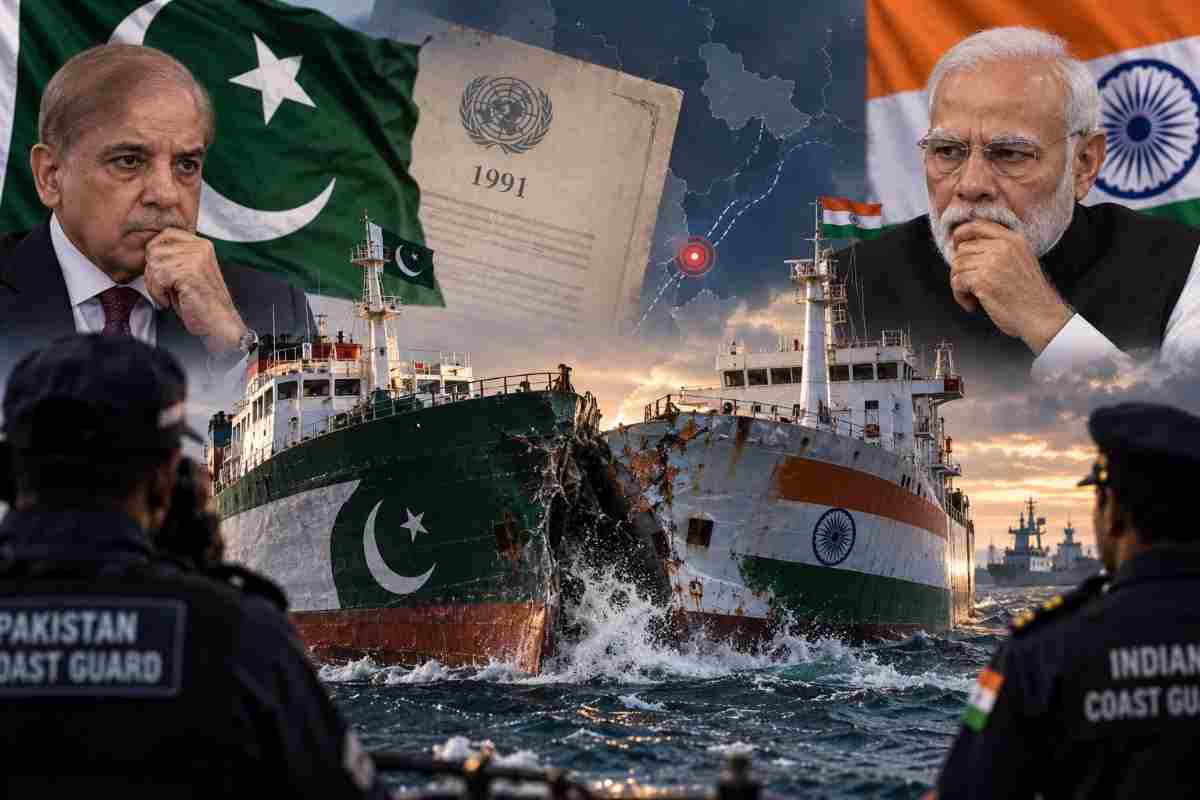
Subheading: New Delhi has summoned Pakistan’s senior diplomat after a Pakistani naval vessel collided with an Indian Navy ship in the North Arabian Sea, with India pointing to Article 10 of a 1991 bilateral agreement.
Pakistani and Indian Naval Vessels Collide
India has lodged a strong diplomatic protest with Pakistan following a collision between a Pakistani naval vessel and an Indian Navy warship in international waters in the North Arabian Sea.
The incident took place on Tuesday, September 15, and prompted the Ministry of External Affairs to summon Pakistan’s Charge d’Affaires in New Delhi. India described the conduct of the Pakistani naval units as “unacceptable and unprofessional” and said the incident did not cause any major damage.
India has also instructed its Charge d’Affaires in Islamabad to raise a similar protest with Pakistan’s Foreign Ministry.
India Cites Article 10 of the 1991 Agreement
At the centre of the dispute is the 1991 Agreement between India and Pakistan on Advance Notice on Military Exercises, Manoeuvres and Troops Movements.
The agreement was signed in New Delhi on April 6, 1991, as a confidence-building measure intended to reduce the risk of military incidents and misunderstandings between the two countries. It subsequently came into force after ratification.
India says the conduct of the Pakistani naval vessel was in direct contravention of Article 10 of the agreement.
The provision specifically states that naval ships and submarines belonging to the two countries should not come within three nautical miles of one another while operating in international waters, with the aim of preventing accidents. Three nautical miles is approximately 5.56 kilometres.
What the 1991 Pact Was Designed to Prevent
The 1991 agreement goes beyond naval safety. It established rules for advance notification of major military exercises and troop movements by both countries.
Its broader purpose was to prevent one side from misreading the military activities of the other and to reduce the possibility that an exercise or movement could trigger an unintended crisis.
The agreement covers land, naval and air activities and establishes different notification requirements depending on the scale and nature of military exercises.
For major exercises, the pact requires information such as the type and level of the exercise, its general area, expected duration and the formations involved to be communicated through diplomatic channels.
Three-Nautical-Mile Rule Explained
Article 10 is particularly relevant to the latest incident because it deals directly with the movement of naval vessels in international waters.
The provision requires ships and submarines belonging to the two countries to maintain a minimum distance of three nautical miles from one another.
The rule was designed as a practical safety measure, rather than simply a mechanism for advance notification. Maintaining separation between military vessels reduces the possibility of collisions or dangerous encounters during operations at sea.
Indian officials have therefore linked the latest collision to the bilateral confidence-building framework.
India Calls for Greater Caution at Sea
Following the diplomatic protest, the Pakistani Charge d’Affaires was advised to convey to the relevant authorities the need for military units to exercise due care and comply with existing agreements between the two countries.
India said adherence to these arrangements was necessary to prevent similar incidents from occurring again.
The Indian government has not publicly identified the vessels involved or provided extensive operational details about the collision. Pakistan had not immediately issued a public response to India’s protest in the reports available on Wednesday.
Incident Adds to Existing India-Pakistan Tensions
The collision comes against a backdrop of strained relations between the two nuclear-armed neighbours.
India and Pakistan have a history of military confrontations, and maritime incidents involving their naval forces have previously prompted diplomatic exchanges.
The 1991 agreement has itself been referenced in an earlier naval incident. In 2011, India raised concerns with Pakistan over what it described as risky manoeuvres involving a Pakistani naval vessel near an Indian warship.
The latest episode therefore places renewed attention on the importance of military-to-military safety arrangements between the two countries.
Why the 1991 Agreement Matters Today
The agreement remains significant because India and Pakistan operate military forces in close geographic proximity across land, air and maritime environments.
Its provisions are designed to create predictable rules even when political relations are strained. The naval separation requirement is particularly relevant in international waters, where both countries’ vessels may conduct surveillance, patrol and other military activities.
The current dispute also demonstrates why confidence-building measures can remain important decades after they were negotiated.
Conclusion
The collision between Pakistani and Indian naval vessels in the North Arabian Sea has triggered a diplomatic protest from New Delhi and brought renewed attention to the 1991 India-Pakistan military confidence-building agreement.
India has specifically cited Article 10, which requires the two countries’ naval ships and submarines to remain at least three nautical miles apart while operating in international waters.
Although no major damage was reported, the incident has highlighted the importance of established maritime safety rules between the two countries. Both sides now face the task of addressing the incident through diplomatic channels while ensuring that future naval operations do not produce similar encounters.