

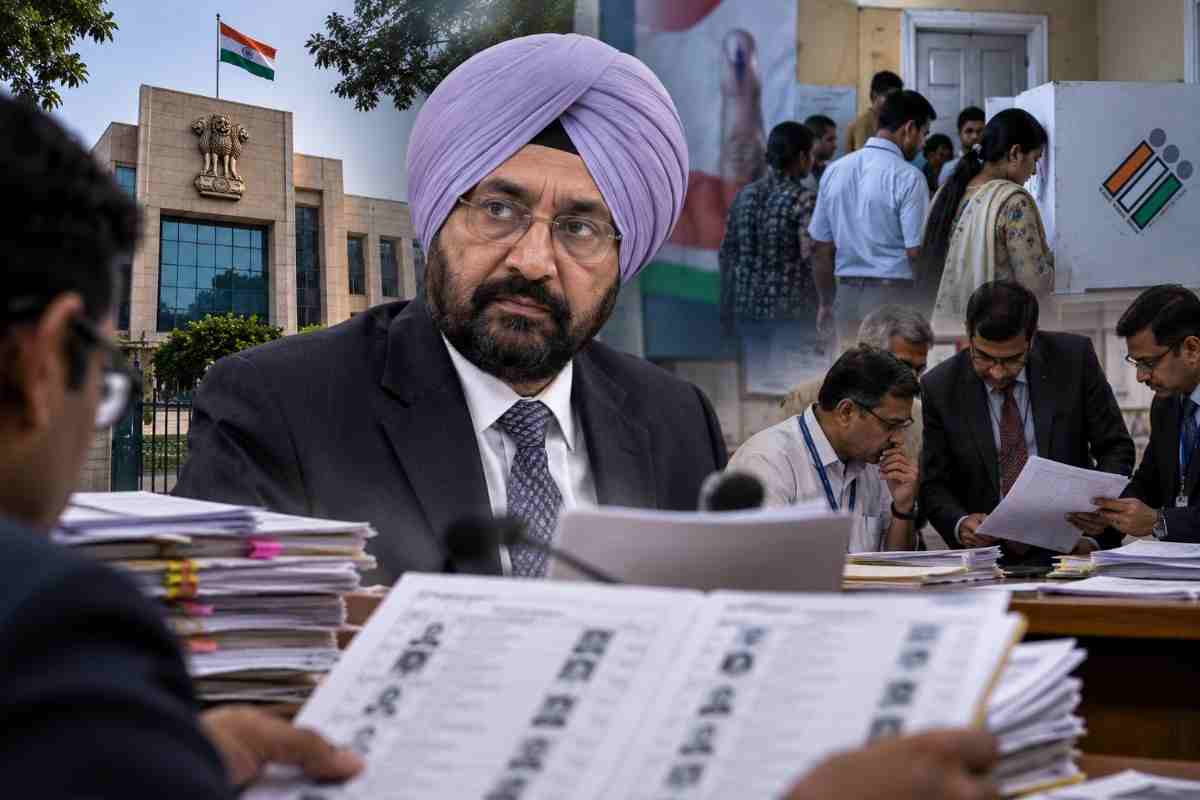
Subheading: Election Commissioner S S Sandhu and several senior political and government figures have received notices during Delhi’s Special Intensive Revision of electoral rolls over discrepancies in voter records.
SIR Notices Issued to Several High-Profile Voters
Election Commissioner S S Sandhu is among several prominent names to have received notices as part of the Election Commission of India’s ongoing Special Intensive Revision (SIR) of electoral rolls in Delhi.
The notice list also includes External Affairs Minister S Jaishankar, former deputy prime minister L K Advani, Congress leader and Rajya Sabha MP Kapil Sibal, Congress leader Abhishek Manu Singhvi, Foreign Secretary Vikram Misri and former Delhi Chief Minister Arvind Kejriwal, according to reports based on the notice list.
The notices relate to discrepancies identified during the electoral-roll verification exercise. The reasons differ from person to person and include spelling mismatches and difficulties mapping current records with those from the previous revision.
Why S S Sandhu Received the Notice
In Sandhu’s case, the notice reportedly concerns a mismatch in the spelling of his name in electoral records.
Reports said his family members also appear in the verification process for different reasons. His son, for example, has reportedly received a notice concerning a discrepancy involving his father’s name, while Sandhu’s wife cleared the relevant verification.
The notices are part of the administrative process of checking and reconciling electoral-roll records. A notice allows the concerned voter to respond to the discrepancy and provide clarification or supporting information where required.
Jaishankar and Other Officials Also on the List
External Affairs Minister S Jaishankar and his wife K S Jaishankar are also among those named in the notice list.
Former Foreign Secretary Vikram Misri has reportedly received a notice because his current electoral record could not be mapped with the records from the previous SIR. Similar mapping issues have resulted in notices being issued to other voters.
The list demonstrates the range of discrepancies being identified during the verification exercise, from relatively minor spelling differences to cases where earlier electoral records cannot immediately be matched with current entries.
L K Advani and Arvind Kejriwal Among Other Names
Former deputy prime minister and BJP veteran L K Advani is also among the prominent voters who have received notices.
Reports said Advani, his daughter Pratibha Advani and daughter-in-law Geetika were flagged because their names could not be mapped with the relevant previous electoral records. His son Jayant, however, reportedly cleared the verification.
Former Delhi Chief Minister Arvind Kejriwal and members of his family have also appeared on the list of voters receiving notices.
The inclusion of prominent public figures has drawn attention to the administrative process, although the reasons cited in individual cases vary.
What Is the Special Intensive Revision?
The Special Intensive Revision, or SIR, is an Election Commission exercise aimed at reviewing electoral rolls and verifying voter records.
The process involves checking existing entries and mapping voters against earlier electoral records. Where discrepancies or gaps are identified, voters can receive notices requiring clarification or further verification.
The Election Commission has previously described the exercise as a mechanism intended to strengthen the accuracy of electoral rolls by identifying eligible voters and removing ineligible entries.
The SIR process has been conducted in phases across different states and Union Territories, with Delhi included in the current phase of the exercise.
A Notice Does Not Automatically Mean Voter Disqualification
The issuance of a notice should not be interpreted as an automatic finding that a person is not an eligible voter.
In the cases reported so far, the reasons for notices include spelling discrepancies, logical discrepancies and failure to map records with previous electoral rolls. The affected voter can respond to the notice and address the issue through the prescribed verification process.
This distinction is important because the notice is part of the verification process rather than, by itself, a final decision on an individual’s eligibility.
SIR Continues Across Delhi
The Delhi exercise comes as the Election Commission continues its broader effort to revise and verify electoral rolls across the country.
The commission has been expanding the SIR process in phases, with Booth Level Officers and other election officials involved in checking voter information and mapping records.
The exercise has also generated political debate, particularly over how discrepancies should be handled and what documentation voters may need to provide in individual cases.
Conclusion
Election Commissioner S S Sandhu, External Affairs Minister S Jaishankar, L K Advani, Kapil Sibal, Vikram Misri and several other prominent figures have appeared among those receiving notices during Delhi’s Special Intensive Revision of electoral rolls.
The reported reasons include name mismatches and difficulties mapping current voter records with previous electoral-roll data.
The notices are part of the electoral-roll verification process and do not, by themselves, establish that the individuals concerned are ineligible to vote. The affected voters can respond to the notices and clarify the discrepancies through the prescribed procedure.