

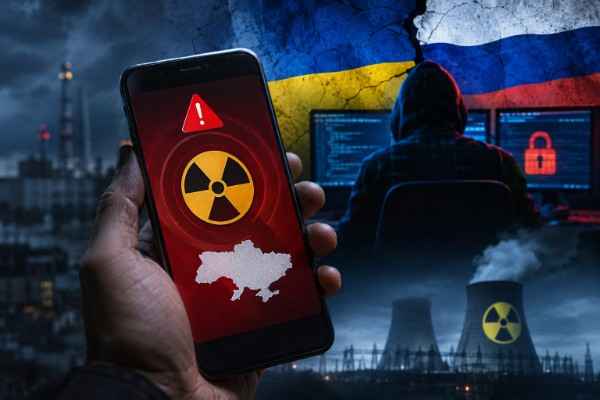
Emergency alert applications in Ukraine and Russia have been hit by cyberattacks, sending false warnings of nuclear strikes, radiation threats and chemical attacks to users in both countries. Authorities have urged residents to remain calm, confirming that no nuclear threat existed and that the incidents did not affect their wider emergency warning systems.
The cyberattacks occurred overnight between November 1 and 2, 2026, when users of emergency notification applications received alarming messages claiming that nuclear weapons had been launched or that major cities were facing radiation and chemical threats.
In Ukraine, the country’s widely used Air Alert application displayed false warnings affecting Kyiv and other regions. Some notifications claimed that Russia had launched its hypersonic Oreshnik missile, while others warned of chemical attacks and street fighting.
Hours later, Russia’s Ministry of Emergency Situations reported that its own mobile application had suffered a major cyberattack, resulting in the distribution of fabricated emergency information.
Authorities in both countries said the incidents involved false information. However, it remains unclear whether the two attacks were connected or who was responsible. <Cite refs={[“turn554364news12″,”turn554364search5″,”turn554364search3”]}/>
Ukraine’s Air Raid Alert App Sends False Nuclear Warnings
Ukraine’s Air Force confirmed on November 1 that its public air raid alert application had been compromised.
The application is widely used by civilians to receive notifications about incoming Russian missile and drone attacks. It provides warnings that help residents identify potential dangers and seek shelter.
Following the cyberattack, users received messages claiming that Kyiv and other parts of Ukraine were facing nuclear and chemical threats. One fabricated notification referred to Russia’s Oreshnik missile system.
The Ukrainian Air Force quickly issued a clarification through its official Telegram channel, stating that there was no radiation threat and asking people not to panic.
The country’s Centre for Countering Disinformation also warned that the information being circulated through the application did not reflect the actual security situation.
Ukraine’s Ministry of Digital Transformation temporarily suspended the affected application while technical teams worked to address the breach. <Cite refs={[“turn554364search1″,”turn554364search2″,”turn554364search9”]}/>
Russia Reports Separate Cyberattack on Emergency Ministry App
In a separate incident, Russia’s Ministry of Emergency Situations confirmed that its mobile application had been targeted by what it described as a massive cyberattack.
According to Russia’s state news agency TASS, hackers gained access to the application and distributed false information to users.
One fabricated notification claimed that nuclear warheads had been launched across all regions of Russia. The message also contained alarming instructions suggesting that residents should prepare for a nuclear emergency.
The ministry said it was working to restore the application and urged citizens to rely on official information channels rather than suspicious notifications.
Russian authorities stressed that the wider public warning infrastructure remained operational, including regional alert systems, text messages, television and radio broadcasts, sirens and loudspeakers. <Cite refs={[“turn554364search4″,”turn554364search5″,”turn554364search6”]}/>
No Evidence of an Actual Nuclear or Radiation Threat
Despite the alarming messages, authorities in both countries confirmed that there was no evidence of an actual nuclear attack or radiation emergency.
Ukraine’s Air Force specifically rejected claims that Russia had launched an Oreshnik missile during the incident.
The distinction was important because both countries remain involved in an ongoing war in which missile and drone attacks are regularly reported.
Emergency applications play a critical role in communicating genuine threats to civilians. False warnings can create confusion, increase public anxiety and potentially undermine confidence in official notifications.
Ukrainian officials encouraged residents to follow verified government announcements and functioning emergency warning channels while the application was being secured.
In Russia, the Emergency Ministry similarly advised users to depend on established public communication systems. <Cite refs={[“turn554364search1″,”turn554364search5″,”turn554364search7”]}/>
Who Was Behind the Cyberattacks?
The identity of those responsible for the attacks has not been independently established.
Ukrainian officials suggested that their application had been subjected to hostile interference and some Ukrainian government-linked communication channels blamed Russia.
However, no independently verified evidence has established who carried out the Ukrainian breach.
Similarly, Russian authorities confirmed the attack on their emergency application but did not publicly identify the perpetrators.
It is also unclear whether the two incidents were coordinated. Although they occurred within hours of each other, authorities have not confirmed a direct connection between them.
The incidents highlight the growing role of cyber operations in modern warfare, where digital infrastructure can become a target alongside conventional military and economic assets. <Cite refs={[“turn554364news12″,”turn554364search5″,”turn554364search3”]}/>
Cybersecurity Becomes Increasingly Important During the Ukraine War
The attacks have raised fresh concerns about the security of digital services used by civilians during wartime.
Ukraine relies heavily on mobile applications and digital communication platforms to distribute emergency information. Millions of residents depend on timely alerts to respond to incoming missiles, drones and other threats.
Russia also uses digital notification systems to communicate emergency warnings and provide information about potential security incidents.
A successful breach of such platforms can create confusion even when no physical attack is taking place.
Cybersecurity experts have repeatedly warned that attacks against public infrastructure can have consequences beyond the immediate technical disruption. Compromised communication systems can weaken public confidence and make it more difficult for authorities to ensure that genuine warnings are taken seriously.
The latest incidents demonstrate why governments need secure notification systems, independent backup channels and rapid procedures for correcting false information.
The Incidents Coincide With the End of a Local Ceasefire
The cyberattacks also occurred around the time a six-day local ceasefire in Ukraine’s Kherson region came to an end.
The temporary pause in fighting had been linked to humanitarian efforts, including the movement of civilians and the delivery of essential supplies.
The ceasefire expired around midnight at the beginning of November 2, ending a rare period of reduced fighting in the area.
Although the timing attracted attention, there is no confirmed evidence connecting the end of the ceasefire with the cyberattacks on the emergency applications. <Cite refs={[“turn554364search6″,”turn554364search8”]}/>
Conclusion
The hacking of emergency alert applications in Ukraine and Russia has exposed the risks of relying on digital communication systems during an active conflict.
False notifications about nuclear launches, radiation emergencies and chemical attacks created uncertainty among users, although authorities confirmed that no such threats existed.
Both governments are working to restore and secure the affected applications while encouraging residents to rely on verified emergency information.
The incidents also underline how cyber warfare can target civilian-facing infrastructure without a conventional military strike. As the Russia-Ukraine conflict continues, protecting digital warning systems will remain an important part of civilian safety and national security.