

Opening Summary
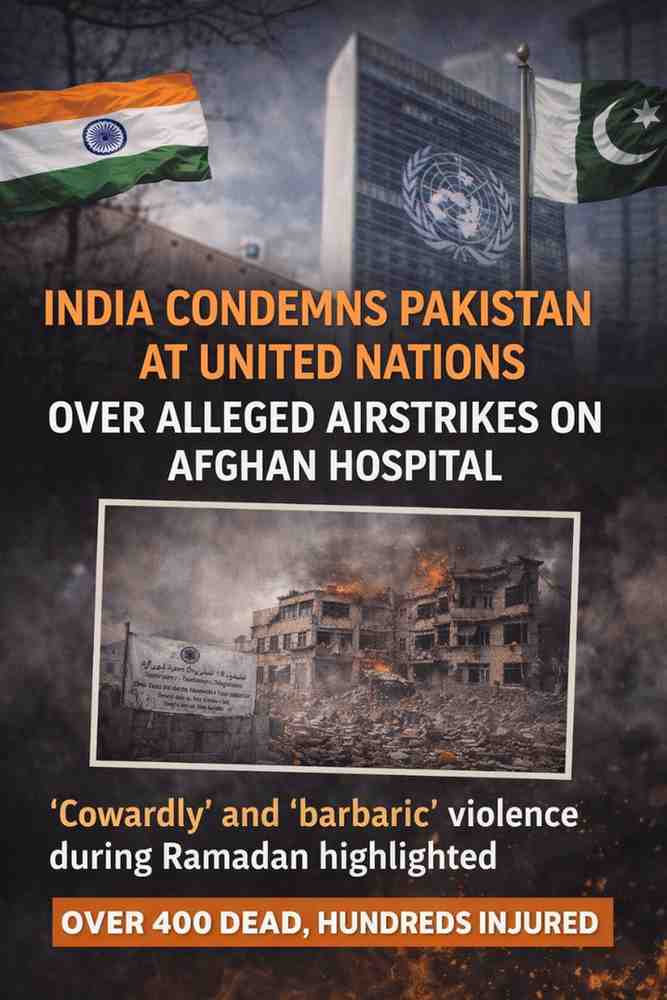
India has strongly condemned Pakistan at the United Nations over alleged airstrikes on a drug rehabilitation hospital in Kabul, Afghanistan, which reportedly killed more than 400 people and injured hundreds. Indian officials described the incident as a “cowardly” and “barbaric” act, accusing Pakistan of targeting civilians during the holy month of Ramadan. The issue matters internationally as it raises serious concerns about civilian protection, regional tensions, and accountability under international law.
Background and Context
Relations between India and Pakistan have been historically strained, with both countries frequently raising concerns against each other at international forums, including the United Nations.
Afghanistan remains a sensitive geopolitical area, with ongoing instability and security challenges since the withdrawal of international forces. Civilian infrastructure, including hospitals and humanitarian facilities, is considered protected under international humanitarian law.
Airstrikes on civilian targets are widely condemned by the international community and may constitute violations of international law if confirmed. Such incidents often lead to diplomatic disputes and calls for independent investigations.
The timing of the alleged attack during Ramadan adds further sensitivity, as the holy month is observed by Muslims worldwide as a period of reflection and peace.
Latest Developments
India’s representative at the United Nations strongly criticised Pakistan, accusing it of carrying out airstrikes on a rehabilitation hospital in Kabul.
Indian officials said the attack resulted in more than 400 deaths and hundreds of injuries, including women and children. They described the incident as an act of violence against civilians and called for international attention to the issue.
Pakistan has not publicly accepted responsibility for the alleged airstrikes and has not confirmed the details cited by India.
United Nations officials have not independently verified the casualty figures or the circumstances surrounding the incident. Calls for further investigation and clarification are expected.
The issue was raised during discussions at the UN, where member states often address allegations related to international peace and security.
Why This Matters
The allegations have significant implications for regional stability and international diplomacy. Accusations of attacks on civilian infrastructure can escalate tensions between countries and complicate diplomatic relations.
For the international community, the protection of civilians during conflict is a fundamental principle. If confirmed, such an incident could lead to calls for accountability and potential action through international mechanisms.
The situation also highlights ongoing instability in Afghanistan, where civilians remain vulnerable to violence.
For countries like Canada and other UN members, developments at the United Nations are closely watched as they may influence global responses to conflict and humanitarian issues.
What Happens Next
The United Nations may seek further information and clarification regarding the alleged incident. Calls for an independent investigation could emerge to verify the claims and establish accountability.
Diplomatic exchanges between India and Pakistan are likely to continue, with both sides presenting their positions at international forums.
Humanitarian organizations may also assess the situation on the ground to determine the scale of the damage and the needs of affected civilians.
Global attention will remain focused on whether the allegations are substantiated and how the international community responds.
Conclusion
India’s strong condemnation of Pakistan at the United Nations over alleged airstrikes in Kabul has brought renewed attention to civilian safety and regional tensions. While details of the incident remain unverified, the scale of the reported casualties has raised serious concerns.
As international discussions continue, the focus will be on establishing facts, ensuring accountability, and preventing further harm to civilians in conflict-affected areas.