

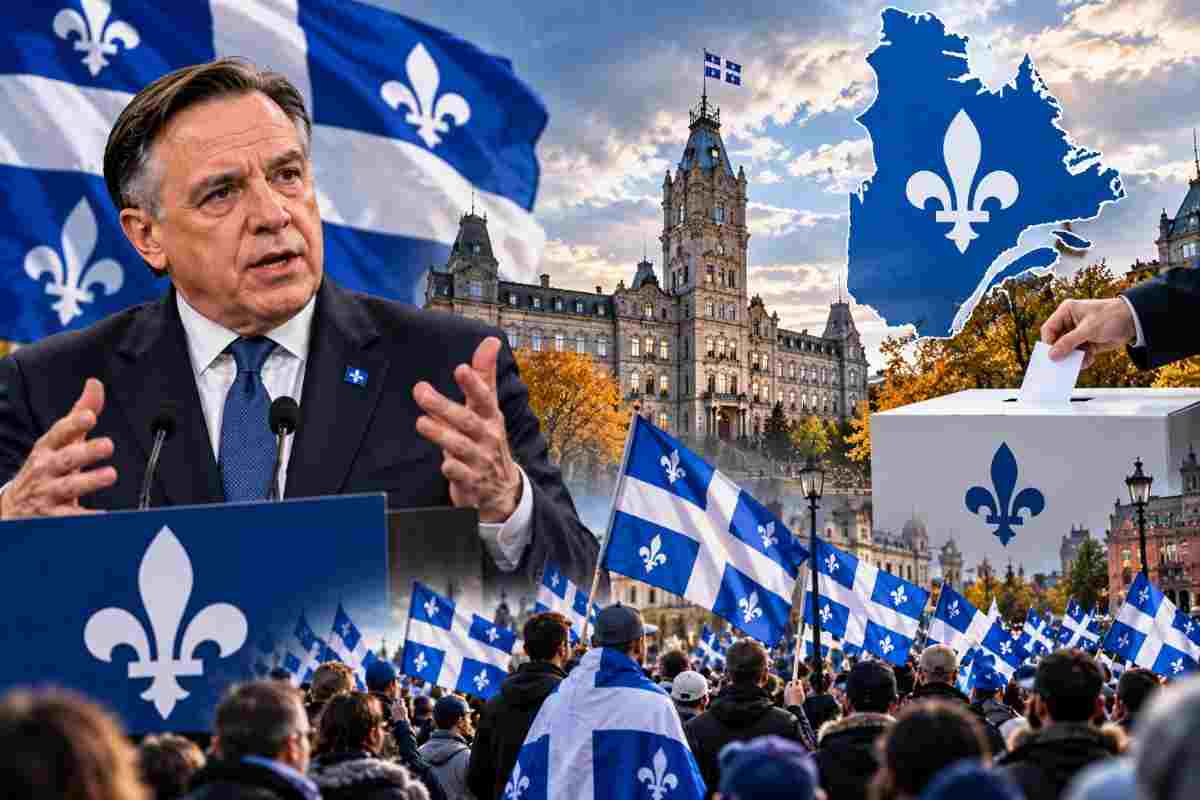
The Parti Québécois has made a dramatic comeback, forming a minority government while Quebec’s Liberals and Conservatives emerge as powerful opposition forces.
Quebec voters have delivered a major political shake-up, electing the Parti Québécois (PQ) to government for the first time in more than a decade. Led by Paul St-Pierre Plamondon, the sovereigntist party won 59 of the 127 seats in the National Assembly, falling five seats short of the 64 required for a majority.
The result ends eight years of Coalition Avenir Québec government and creates a fragmented legislature in which the PQ will need support from opposition parties to pass legislation. The election also strengthened both the Quebec Liberals and the provincial Conservatives, while the CAQ suffered a historic collapse.
Here are five key takeaways from the result.
1. The PQ Has Returned From the Brink
The election represents a remarkable turnaround for the Parti Québécois.
In the 2022 election, the party was reduced to just three seats. Four years later, it has returned to government with 59 seats, despite receiving only about 28 per cent of the popular vote.
The result reflects widespread demand for political change after two terms of CAQ government. Rather than winning an outright majority, however, the PQ will have to govern in a minority parliament and negotiate with other parties.
That could make the coming years more politically unpredictable, particularly on issues where opposition parties disagree with the government’s agenda.
2. A Future Sovereignty Referendum Is Back on the Agenda
The PQ’s return to power also puts Quebec independence back at the centre of Canadian politics.
St-Pierre Plamondon has long promised to hold another referendum on Quebec sovereignty if his party formed government. However, he has said such a vote would not take place before U.S. President Donald Trump leaves office in 2029.
The PQ’s minority status could complicate that objective because it does not have enough seats to govern alone.
Québec solidaire, another sovereigntist party, won nine seats. Combined, the two parties hold a majority of seats in the legislature, although their political positions differ on a number of other issues.
Whether that translates into cooperation on a future referendum remains a major question.
3. Quebec Liberals Become a Strong Opposition
The Quebec Liberal Party also had a significant night, winning 40 seats and becoming the official Opposition.
The Liberals more than doubled their representation compared with the previous legislature. Leader Charles Milliard has positioned the party as a federalist alternative to the PQ and has opposed another sovereignty referendum.
With 40 seats, the Liberals will have considerable influence over the minority government, particularly if the PQ seeks support for legislation that Québec solidaire or the Conservatives do not support.
The result therefore gives Quebec a much stronger federalist opposition inside the National Assembly.
4. Conservatives Enter the Legislature in Force
The election also marked a historic breakthrough for the Parti conservateur du Québec.
Led by Éric Duhaime, the Conservatives won 19 seats, making them a significant parliamentary group. The party had not elected a member to Quebec’s legislature since 1935.
The Conservatives campaigned strongly against another independence referendum and could become an important force in blocking or modifying PQ initiatives.
Their emergence also demonstrates how divided the province’s political landscape has become, with the Conservatives receiving about 21 per cent of the popular vote.
5. The CAQ Collapse Shows a Fragmented Quebec
Perhaps the biggest surprise of the election was the collapse of the outgoing Coalition Avenir Québec.
The CAQ received approximately 13 per cent of the vote but won no seats in the National Assembly. Québec solidaire, meanwhile, received about 12.4 per cent and won nine seats.
The overall result demonstrates just how fragmented Quebec politics has become.
Five parties each received more than 10 per cent of the popular vote, but none crossed the 30-per-cent mark. The PQ led with 28 per cent, followed by the Liberals at about 24 per cent and the Conservatives at roughly 21 per cent.
That fragmentation means the PQ’s ability to govern effectively will depend heavily on negotiations with other parties.
What the Result Means for Canada
The Quebec election has implications beyond the province.
A sovereigntist party is once again leading the Quebec government, raising questions about Canada’s constitutional future and the federal government’s relationship with Quebec.
The development comes at a time when Canada is already dealing with economic and political pressures, including trade tensions with the United States. Prime Minister Mark Carney congratulated St-Pierre Plamondon following the result and said Ottawa would work with the new Quebec government.
However, the election result should not automatically be interpreted as a mandate for Quebec independence. Support for sovereignty remains significantly below the level needed to demonstrate majority public support, and the PQ’s share of the vote was below 30 per cent.
What Happens Next?
The immediate challenge for St-Pierre Plamondon will be governing with a minority.
The PQ will need to negotiate with opposition parties to pass legislation and maintain confidence in the National Assembly. Its approach to sovereignty, immigration, the economy and relations with Ottawa will likely face scrutiny from several political directions.
The government will also have to decide how quickly it wants to advance its referendum plans, particularly given the lack of a majority mandate.
For Canada’s federal government, maintaining a working relationship with Quebec will become increasingly important as sovereignty debates return to the national political agenda.
Conclusion
The Quebec election has dramatically changed the province’s political landscape.
The Parti Québécois has gone from three seats in 2022 to a 59-seat minority government, while the Liberals have established a strong opposition and the Conservatives have made a historic breakthrough.
The result also puts the possibility of another sovereignty referendum back into Canadian political discussions, although the PQ lacks a majority and any referendum remains a future possibility rather than an immediate event.
For now, the biggest challenge for St-Pierre Plamondon will be turning an impressive electoral comeback into a stable minority government in one of Quebec’s most fragmented legislatures in recent history.