
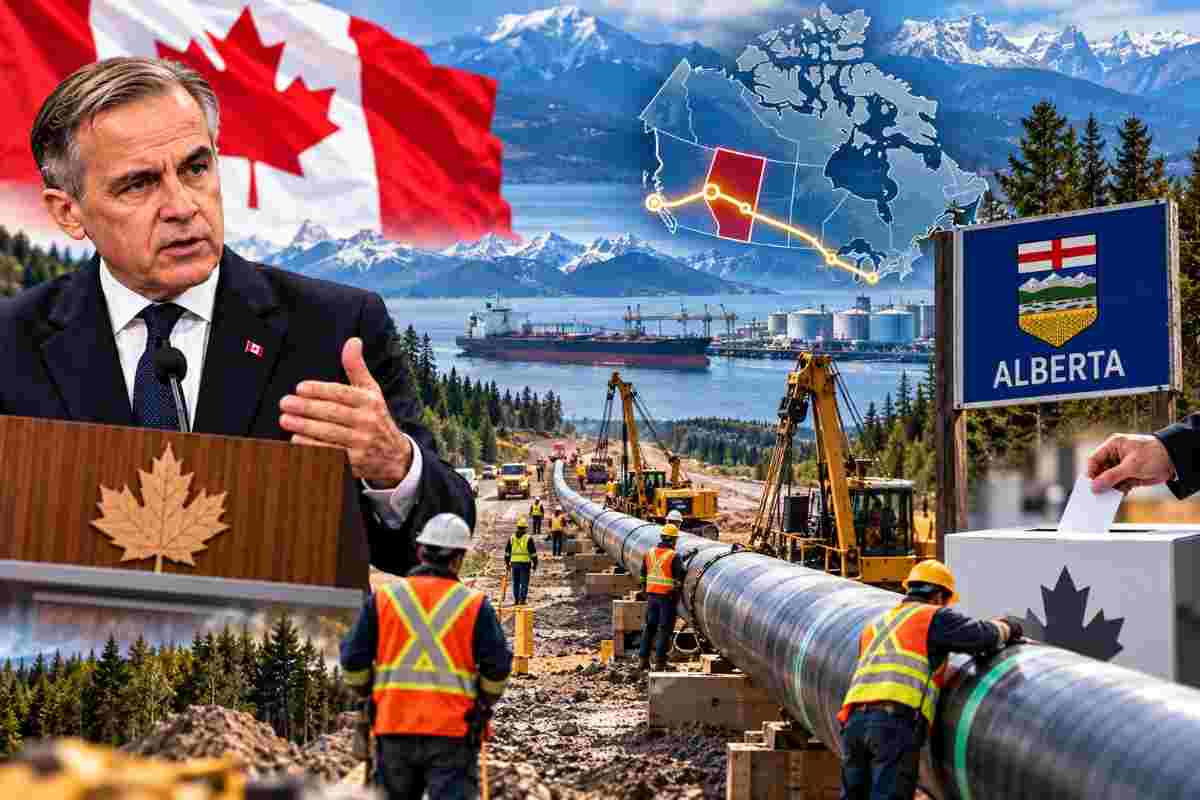
Ottawa has designated the proposed West Coast oil pipeline a project of national interest, accelerating its approval process just weeks before Alberta votes on whether to pursue a separation referendum.
Prime Minister Mark Carney has moved to fast-track the proposed Pacific Link oil pipeline, a multibillion-dollar project designed to transport Alberta crude to Canada’s Pacific coast and open greater access to Asian markets.
Carney announced the national-interest designation on October 1 alongside Alberta Premier Danielle Smith in Fort McMurray. The decision comes just over two weeks before Alberta’s October 19 vote on whether to trigger a binding referendum process on separation from Canada.
Ottawa has presented the pipeline as both an economic diversification project and an example of federal-provincial cooperation at a politically sensitive moment for Alberta.
Pacific Link Could Carry One Million Barrels a Day
The proposed pipeline would stretch approximately 1,250 kilometres, running from Bruderheim, Alberta, to a deep-water marine terminal near Delta, British Columbia.
It is designed to transport roughly one million barrels of crude oil per day to the Pacific coast, where the oil could be shipped to international customers, including markets in Asia.
The project is estimated to cost between approximately C$35 billion and C$44 billion, depending on the final design and development costs.
The federal government says the pipeline could help Canada reduce its dependence on the U.S. market and expand non-U.S. exports.
Why the Pipeline Matters to Alberta
Alberta remains heavily dependent on the United States for crude-oil exports. Carney has argued that Canada needs more routes to international markets if it wants to strengthen its economic and energy independence.
The government says Pacific Link could allow Canadian producers to reach growing Asian markets and make Canada a more significant global energy supplier.
Carney has also linked the project to his broader goal of doubling Canada’s non-U.S. exports over the next decade.
The pipeline is therefore being positioned not simply as an Alberta infrastructure project but as part of a broader strategy to diversify Canada’s trade relationships.
Fast-Track Does Not Mean Construction Is Guaranteed
Although the project has received national-interest status, Pacific Link has not received final approval to begin construction.
The designation under the Building Canada Act allows the federal government to streamline the regulatory and approval process and establish conditions for the project.
Ottawa says it is aiming to finalize those conditions by September 1, 2027. Construction could then proceed if the required approvals, financing, consultations and other conditions are completed.
The project is currently expected to begin operations around 2032 or 2033 if it moves forward.
Alberta Separation Vote Adds Political Significance
The timing of the announcement has attracted particular attention because Alberta is scheduled to vote on October 19 on whether to pursue a referendum on separation from Canada.
Premier Danielle Smith has supported keeping Alberta within Canada but has also criticized Ottawa over federal energy policies in the past.
Smith described the pipeline announcement as evidence that cooperation between Ottawa and Alberta can produce results. Carney, meanwhile, said the project demonstrated that “Canada is working” and emphasized the importance of working together across provincial and federal governments.
The pipeline has consequently become part of the wider political discussion over Alberta’s relationship with Ottawa.
Federal and Alberta Governments to Share Ownership
The project is expected to involve both federal and provincial ownership.
The federal government says Canada and Alberta will hold equal ownership in Pacific Link through Trans Mountain Corporation and the Alberta Petroleum Marketing Commission.
Indigenous communities will also be offered at least a 10% ownership interest, supported by federal and provincial Indigenous loan-guarantee programs.
Pembina Pipeline Corporation is participating as a private-sector partner and is expected to provide expertise during project development.
Indigenous Consultation Remains Important
The national-interest designation does not eliminate the requirement for consultation with Indigenous communities.
The federal government says the Major Projects Office consulted more than 130 Indigenous communities near or along potential routes during its assessment of the proposal.
Ottawa has promised further consultation as the project moves through its regulatory process.
Indigenous participation is also being presented as an important part of the project’s ownership structure, although some communities and environmental groups have raised concerns about potential impacts, including the pipeline route, marine traffic, environmental effects and treaty rights.
Trade Tensions With the US Drive Diversification
The pipeline is also being developed against the backdrop of continuing trade tensions between Canada and the United States.
Canada currently sends the overwhelming majority of its crude exports to the U.S. market. Ottawa argues that expanding access to the Pacific would give Canadian producers another major export route and reduce the risks associated with relying heavily on one trading partner.
The project could therefore become an important part of Canada’s strategy to build stronger economic relationships with countries outside North America.
Questions Remain Over Financing and Oil Supply
Despite the political backing, several practical questions remain.
The pipeline will require substantial investment, and producers will need to commit enough oil to make the project commercially viable. The government has indicated that a future open season will help determine how much capacity producers are prepared to contract.
There are also questions about whether additional oil-sands production would be required to fill a pipeline capable of carrying one million barrels per day. Reuters reported that no major new oil-sands expansion of this scale has been undertaken in more than a decade.
Environmental and Indigenous opposition could also lead to additional scrutiny or legal challenges.
What Happens Next?
The immediate focus will be on completing the regulatory conditions and continuing consultations with Indigenous communities, British Columbia and other stakeholders.
Ottawa’s target is to have the federal conditions finalized by September 1, 2027. If the necessary requirements are met, construction could begin afterward.
Meanwhile, the October 19 Alberta vote will provide a separate political test for the relationship between the province and the federal government.
Conclusion
Mark Carney’s decision to designate Pacific Link as a project of national interest represents a major step forward for a proposed pipeline that could carry one million barrels of Alberta crude per day to Canada’s Pacific coast.
The project is being promoted as a way to diversify Canada’s energy exports, reduce dependence on the U.S. market and strengthen economic ties with Asia. Its timing also gives the announcement added political significance ahead of Alberta’s October 19 separation vote.
However, the fast-track designation is not the same as final construction approval. Financing, regulatory conditions, Indigenous consultation, environmental assessments and producer commitments must still be addressed before the pipeline can proceed.