

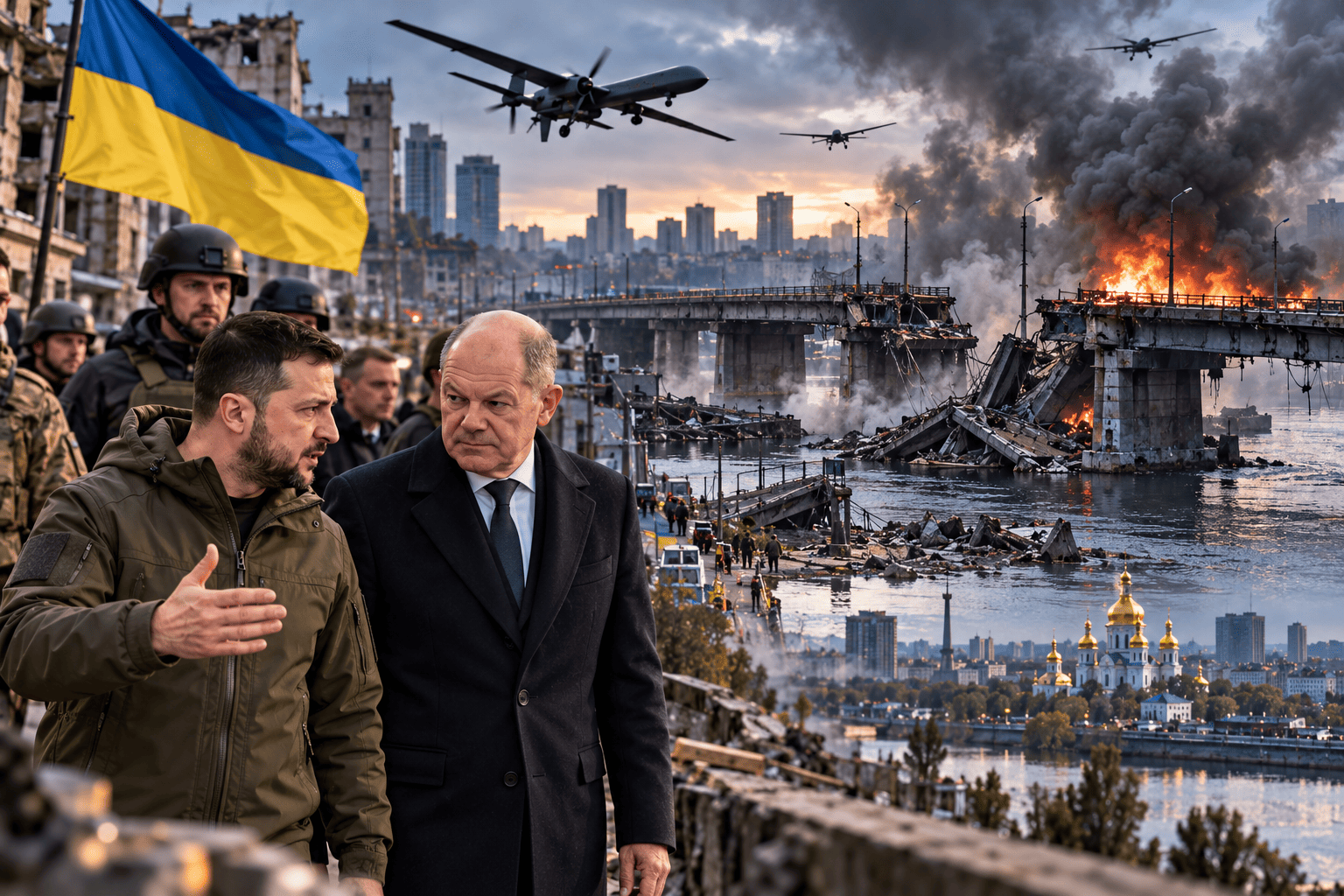
A Russian drone struck Kyiv’s Northern Bridge as German Chancellor Friedrich Merz made an unannounced visit to the Ukrainian capital, pledging fresh military and energy support.
A key bridge in Kyiv was damaged by a Russian drone attack on Sunday, October 4, as German Chancellor Friedrich Merz arrived in the Ukrainian capital for an unannounced visit to President Volodymyr Zelenskyy.
Air-raid sirens and explosions were heard across Kyiv during Merz’s visit. Kyiv Mayor Vitali Klitschko said the strike hit the roadway of the Northern Bridge over the Dnipro River and also damaged a hot-water supply system. Two people were reported injured.
The attack came amid an intensifying Russian campaign against Kyiv and other Ukrainian cities, with bridges and critical infrastructure increasingly being targeted.
Russian Drone Hits Northern Bridge
Klitschko said emergency services were sent to the Northern Bridge after the drone strike. The crossing remained standing, but the attack caused damage to the roadway and disrupted infrastructure in the surrounding area.
The Northern Bridge is an important connection between the two sides of the Dnipro River. Recent attacks on Kyiv’s bridges have created additional disruption for residents and transportation networks.
According to Reuters, Russia has targeted bridges in Kyiv since last week, with the apparent aim of disrupting connections between the capital’s eastern and western sides as well as logistical routes.
Merz Arrives as Sirens Sound Across Kyiv
The bridge strike occurred shortly after Merz arrived in Kyiv for his second visit to Ukraine since becoming German chancellor.
His arrival came under heightened security conditions after Russia had warned foreign diplomats and other foreign nationals against travelling to or remaining in Kyiv because of the risk of further attacks.
Despite the warning, Merz travelled to the capital to demonstrate continued German support for Ukraine. He said Ukraine needed Germany’s support during what he described as decisive weeks.
During his visit, Merz met Zelenskyy and visited the damaged National Academy of Sciences building, which was hit during a Russian drone attack the previous week.
Germany Announces More Than €1.3 Billion in Support
Merz used the visit to announce a new German support package worth more than €1.3 billion.
Around €1 billion is earmarked for military assistance, including long-range weapons, combat drones and satellite technology. Another €350 million will support repairs to Ukraine’s energy infrastructure ahead of winter.
Germany and Ukraine are also working to expand cooperation in defence production, including joint development and manufacturing of drones and other weapons.
The two countries signed 15 agreements worth more than €8.5 billion, covering areas including security cooperation, weapons production and procurement, according to the Associated Press.
Focus on Drone and Long-Range Weapons Production
Defence cooperation was a major part of Merz’s visit.
Germany and Ukraine are expected to advance agreements on producing drones designed to counter Russia’s increasingly fast jet-powered attack drones. The two countries are also working on cooperation involving longer-range weapons capable of reaching targets deep inside Russia.
The cooperation reflects a broader effort by European countries to strengthen Ukraine’s domestic defence-production capacity while continuing to provide weapons and financial assistance.
Zelenskyy Warns of Continued Russian Attacks
Zelenskyy told Merz that people in Kyiv were experiencing what he described as extremely difficult conditions because of the continuing Russian attacks.
The latest strikes have increasingly focused on infrastructure, including energy facilities, transport links and other strategically important sites.
Ukraine is preparing for another winter of war, with its energy system facing renewed pressure from Russian attacks. Germany’s additional funding for repairs is therefore intended to help restore damaged infrastructure before colder weather increases demand for electricity and heating.
Merz Calls for an End to the War
During his visit, Merz again called on Russian President Vladimir Putin to end the conflict.
The German chancellor said Germany was prepared to support negotiations aimed at ending the war but argued that attacks on Ukrainian civilians must stop.
His remarks came as the latest strikes demonstrated the continuing difficulty of achieving a reduction in hostilities despite repeated diplomatic efforts.
Russia, meanwhile, has said its attacks are responses to Ukrainian strikes on Russian infrastructure. Moscow has also warned that it intends to continue its campaign against targets in Ukraine.
Kyiv Faces Growing Infrastructure Pressure
The bridge attack is part of a broader series of strikes that have increased pressure on Kyiv’s infrastructure.
Several bridges across the Dnipro have been affected in recent days, while Russian attacks have also targeted energy facilities, logistics networks and other infrastructure across Ukraine.
Repeated attacks have caused temporary road closures and traffic disruptions in Kyiv, adding to the difficulties faced by residents as the city prepares for winter.
What Happens Next?
Merz’s visit is expected to strengthen military and economic cooperation between Germany and Ukraine at a time when Kyiv is seeking additional air-defence systems, ammunition and support for its energy infrastructure.
The two countries are also expected to move ahead with defence-industry agreements, particularly in drone production and longer-range weapons.
At the same time, continued Russian attacks could increase pressure on Ukraine’s power and transport infrastructure as winter approaches.
Conclusion
The strike on Kyiv’s Northern Bridge came at a highly significant moment, occurring shortly after German Chancellor Friedrich Merz arrived in the Ukrainian capital for an unannounced visit.
While the Russian drone attack damaged the bridge and injured two people, Merz used the visit to announce more than €1.3 billion in additional German support for Ukraine, including military assistance and funding for energy repairs.
The developments underline the continuing intensity of the Russia-Ukraine conflict, with Kyiv facing sustained attacks while European governments, led in part by Germany, increase their military and economic support for Ukraine.