

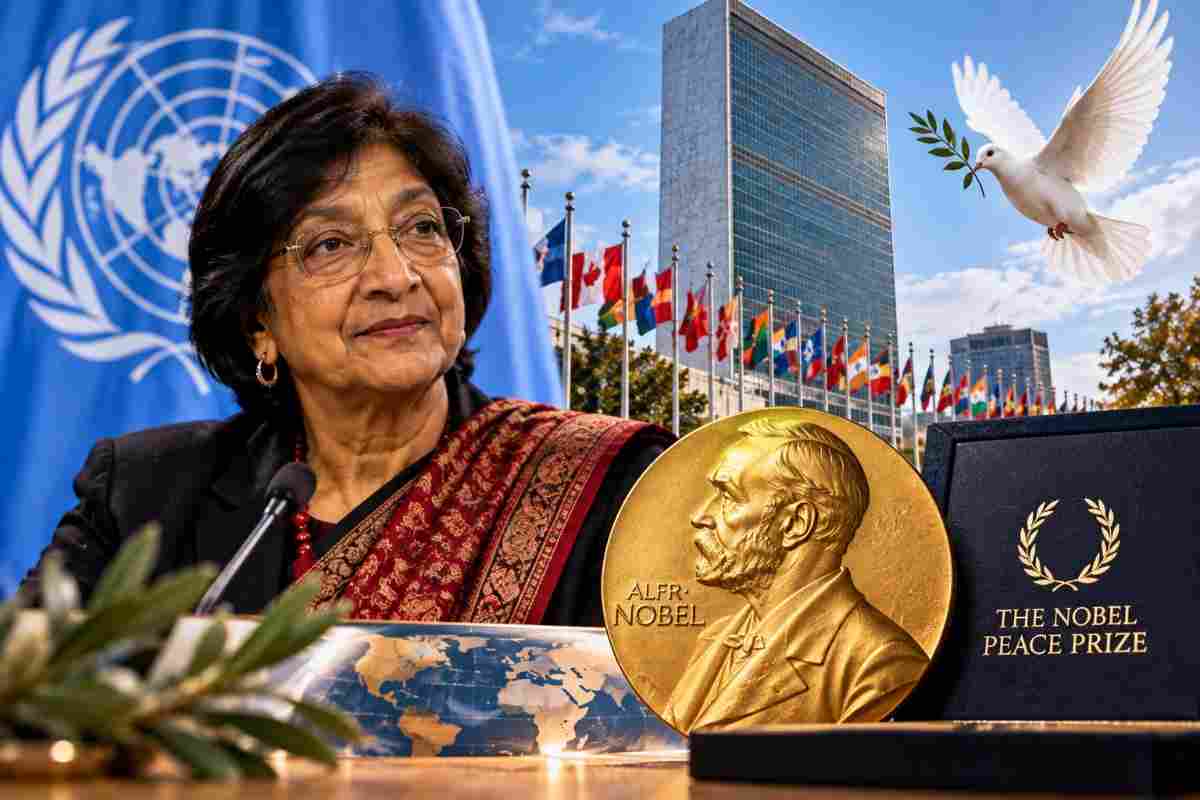
The South African jurist and former United Nations human rights chief has been honoured for her decades of work promoting justice, accountability for atrocities and respect for international law.
South African jurist Navanethem “Navi” Pillay has been awarded the 2026 Nobel Peace Prize in recognition of her efforts to promote peace and strengthen international law. The Norwegian Nobel Committee announced the decision on October 9, highlighting her longstanding work to ensure that war crimes, crimes against humanity and genocide are prosecuted. <Cite refs={[“turn832887search0″,”turn832887search4”]}/>
Pillay, 85, has spent decades working in human rights and international justice. Her career spans the struggle against apartheid in South Africa, judicial service at international criminal tribunals and leadership at the United Nations. The award also comes at a time when international legal institutions face growing political pressure and questions about their ability to hold powerful individuals and governments accountable. <Cite refs={[“turn832887news23″,”turn832887search3”]}/>
Nobel Committee Recognises Her Commitment to International Justice
The Norwegian Nobel Committee said Pillay had helped advance a more comprehensive international legal order through her work in courts and human rights institutions. The committee emphasised that international law plays a crucial role in preventing violence and creating conditions for peaceful conflict resolution. <Cite refs={[“turn832887search0″,”turn832887search12”]}/>
The prize recognises more than one position or investigation. It reflects Pillay’s broader contribution to establishing legal standards for prosecuting serious crimes and reinforcing the principle that individuals responsible for atrocities should be held accountable.
The committee also highlighted her commitment to universal legal principles, describing her career as an example of the importance of defending human dignity and the rule of law.
From Apartheid-Era South Africa to International Courts
Born in Durban, South Africa, in 1941 to a family of Indian Tamil origin, Pillay grew up under apartheid, a system of racial segregation and discrimination. She became a lawyer and defended people who challenged the apartheid government, including political activists. Her legal career helped establish her reputation as a prominent advocate for equality and justice. <Cite refs={[“turn832887search8″,”turn832887search9”]}/>
In 1995, she became the first non-white woman appointed to South Africa’s High Court. Her subsequent work took her beyond the country’s borders and into international judicial institutions dealing with some of the most serious crimes committed during armed conflicts.
Her career illustrates how legal advocacy at the national level can develop into broader efforts to strengthen international accountability.
Rwanda Tribunal Work Helped Shape International Law
One of Pillay’s most significant contributions came through her service at the International Criminal Tribunal for Rwanda, where she later became president of the tribunal.
The tribunal investigated and prosecuted crimes committed during the 1994 Rwandan genocide. Pillay played an important role in landmark legal developments concerning sexual violence, genocide and the use of propaganda to incite mass atrocities. <Cite refs={[“turn832887search0″,”turn832887search8”]}/>
These developments helped establish that rape and other forms of sexual violence can constitute crimes against humanity and, under the relevant circumstances, acts of genocide.
Pillay later served as a judge at the International Criminal Court and became United Nations High Commissioner for Human Rights, a position she held from 2008 to 2014. Across these roles, she worked on issues involving civilian protection, discrimination, accountability and the application of international law. <Cite refs={[“turn832887search4″,”turn832887search9”]}/>
Her Work on Gaza Draws International Attention
Pillay’s recent work has also placed her at the centre of international debate over the conflict in Gaza. She headed the United Nations Independent International Commission of Inquiry on the Occupied Palestinian Territory, including East Jerusalem, and Israel. In 2025, the commission concluded that Israel had committed genocide in Gaza. Israel has strongly rejected that conclusion and criticised the commission’s findings. <Cite refs={[“turn832887news23″,”turn832887search5”]}/>
The findings have become part of a wider international dispute over the conduct of the war, civilian casualties and the application of international humanitarian law.
Pillay’s Nobel award has therefore drawn both praise from human rights advocates and criticism from Israeli officials. Supporters have described the recognition as an endorsement of accountability and the protection of victims, while critics have questioned the impartiality of her work on Israel. These competing reactions underline the political sensitivity surrounding international investigations into alleged atrocities. <Cite refs={[“turn832887news24″,”turn832887search9”]}/>
A Nobel Prize Amid Pressure on International Institutions
The award comes as international courts and human rights bodies face scrutiny over their investigations and decisions. The Nobel Committee’s emphasis on international law highlights concerns about whether established institutions can continue to investigate alleged crimes and apply legal standards consistently, regardless of the political influence of those involved.
The Peace Prize does not itself settle disputed legal questions or replace judicial proceedings. Instead, it recognises Pillay’s contribution to promoting international justice and the institutions responsible for addressing serious violations.
Her career has been closely associated with the principle that allegations of war crimes, crimes against humanity and genocide should be investigated through established legal processes rather than decided solely through political pressure.
Conclusion
Navi Pillay’s selection for the 2026 Nobel Peace Prize recognises a career dedicated to human rights, international justice and the rule of law. From defending activists under apartheid to serving at international tribunals and leading the UN human rights office, she has helped shape efforts to hold perpetrators of serious crimes accountable.
The award also sends a wider message about the role of international law in a world facing armed conflicts and disputes over human rights. While reactions to some of Pillay’s work remain sharply divided, the Nobel Committee has placed renewed attention on the importance of legal institutions, accountability and human dignity in the pursuit of peace. <Cite refs={[“turn832887search0″,”turn832887search11”]}/>