

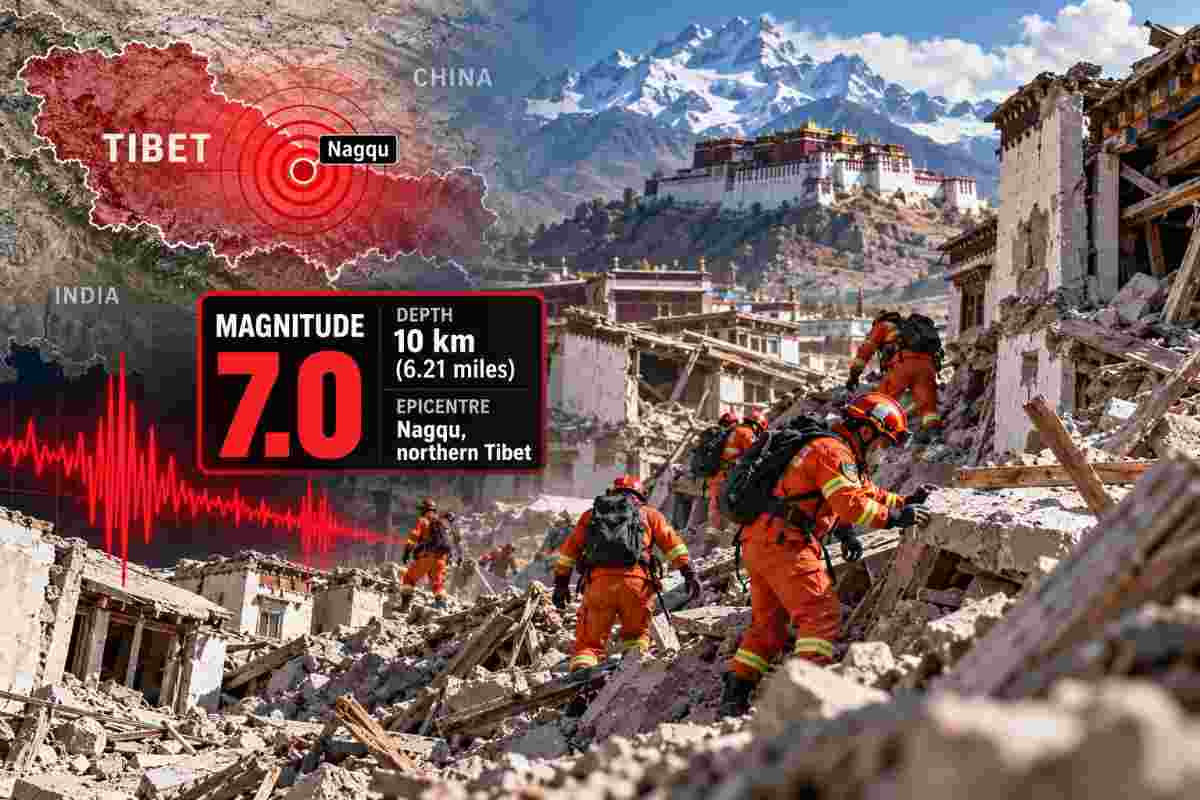
A powerful earthquake measuring magnitude 7 has struck a high-altitude area of northern Tibet, with the epicentre located in Nagqu at a depth of approximately 10 kilometres, raising concerns about potential damage and aftershocks.
A powerful earthquake of magnitude 7 has struck the Tibet Autonomous Region in western China, according to preliminary seismic information. The epicentre was reported in a high-altitude county in Nagqu, northern Tibet, at a depth of approximately 10 kilometres (6.21 miles).
The relatively shallow depth of the earthquake has raised concerns about the possibility of strong ground shaking near the epicentre. However, the extent of the damage, the number of people affected and the possibility of casualties require confirmation from local authorities and emergency services.
Tibet is located in a seismically active region where the Indian and Eurasian tectonic plates interact. Earthquakes in the area can affect remote mountain communities, where difficult terrain and long travel distances may complicate emergency response operations.
Earthquake Strikes High-Altitude Area of Nagqu
The earthquake was reported in Nagqu, a large administrative area in northern Tibet characterised by high-altitude grasslands, mountainous terrain and sparsely populated settlements.
The region lies on the Tibetan Plateau, one of the world’s highest and most geologically active areas. Communities in the region often face challenging weather conditions and limited transport access, factors that can make it difficult for emergency teams to reach affected locations quickly.
The reported epicentre was located in a high-altitude county within Nagqu. Seismic monitoring agencies generally issue preliminary magnitude and location estimates shortly after an earthquake, and those figures can be revised as additional data become available.
Authorities will need to assess whether buildings, roads, bridges and other infrastructure sustained damage, particularly in settlements closest to the epicentre.
Shallow Depth Raises Concerns About Ground Shaking
The earthquake’s reported depth of approximately 10 kilometres makes it a relatively shallow seismic event.
Shallow earthquakes can produce intense shaking near their epicentres because seismic energy travels a shorter distance before reaching the surface. However, the actual impact depends on several factors, including the earthquake’s magnitude, the local geology, building construction and the distance of populated areas from the epicentre.
A magnitude 7 earthquake is considered a major seismic event capable of causing significant damage, particularly where buildings are not designed to withstand strong ground movement.
Nevertheless, magnitude alone does not determine the final impact. The number of people affected and the scale of destruction depend heavily on the location of the earthquake and the vulnerability of nearby communities.
Officials and emergency services will need to inspect the affected area before the consequences can be fully assessed.
Tibet Located in a Major Earthquake Zone
Tibet is situated in one of the world’s most seismically active regions because of the ongoing collision between the Indian and Eurasian tectonic plates.
The Indian Plate is moving northward and pushing against the Eurasian Plate, contributing to the uplift of the Himalayas and the Tibetan Plateau. The immense geological pressure generated by this movement is released periodically through earthquakes.
The region has experienced numerous significant earthquakes over the years, affecting communities across Tibet, Nepal and neighbouring parts of western China.
The geological conditions mean that strong earthquakes can occur across the broader Himalayan region. However, the precise location, timing and magnitude of future earthquakes cannot be reliably predicted.
Emergency Assessments and Aftershock Monitoring
Following a major earthquake, authorities typically monitor the affected region for aftershocks and assess potential damage to infrastructure.
Aftershocks are smaller earthquakes that occur as the Earth’s crust adjusts following the main seismic event. Some can still be strong enough to damage weakened buildings or create additional hazards.
Emergency teams may inspect residential buildings, public facilities, roads and communication networks to determine whether evacuations or temporary safety measures are necessary.
In remote high-altitude areas, rescue operations can be complicated by difficult terrain, changing weather and limited access to some communities. Maintaining communications and reaching potentially isolated settlements can therefore become important priorities.
At the time of writing, the available information did not establish the full extent of the damage or confirm a final casualty figure. Updates from local authorities and recognised seismic monitoring agencies will be needed to clarify the situation.
Possible Implications for Nearby Regions
Although the reported epicentre is in northern Tibet, a major earthquake can be felt across a wider area depending on its depth, magnitude and the characteristics of the surrounding terrain.
The effects may extend beyond the immediate epicentral zone, particularly in communities connected by mountain roads or located near active geological structures.
However, the earthquake’s location alone does not establish that significant damage has occurred in neighbouring countries or regions. Such effects would need to be confirmed through seismic observations and reports from local authorities.
For residents in earthquake-prone areas, standard safety advice includes moving away from windows during shaking, taking cover beneath sturdy furniture where possible and avoiding damaged buildings after the shaking stops.
People should also follow official emergency instructions and remain alert to warnings about aftershocks or local hazards.
Conclusion
The reported magnitude 7 earthquake in Tibet’s Nagqu region highlights the seismic risks facing communities across the Tibetan Plateau.
With the epicentre located at a relatively shallow depth of approximately 10 kilometres, strong shaking may have occurred close to the affected area. However, the scale of the damage, the number of casualties and the condition of local infrastructure require confirmation.
The immediate priorities are to assess affected communities, identify any urgent rescue needs and monitor the region for aftershocks.
Further information from Chinese authorities and seismic monitoring agencies will be essential to establish the earthquake’s full impact and determine whether additional emergency measures are required.