

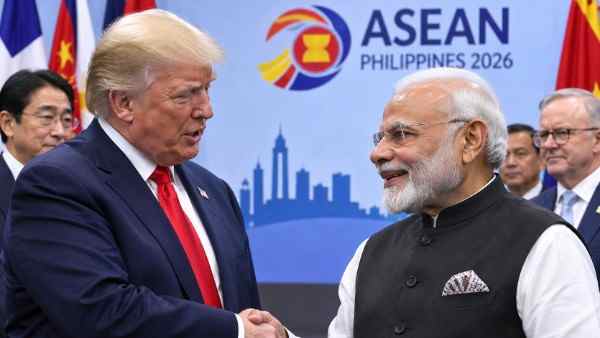
US President Donald Trump met Indian Prime Minister Narendra Modi, along with the leaders of Japan and Australia, in Manila on November 17 as he began a high-profile Asian tour focused on regional security, trade, artificial intelligence and strategic cooperation.
US President Donald Trump arrived in the Philippines on Tuesday for the first leg of his three-day Asian visit, holding discussions with key regional leaders as Washington seeks to strengthen its partnerships across the Indo-Pacific.
One of the most important engagements of the visit was a meeting with Prime Minister Narendra Modi, Japanese Prime Minister Sanae Takaichi and Australian Prime Minister Anthony Albanese under the Quad framework.
The meeting marked the first gathering of Quad leaders since Trump returned to the White House in January 2025 and came at a time of growing competition between the United States and China over trade, technology and regional influence.
Trump’s visit to Manila is part of a wider diplomatic programme that will also take him to China for discussions with Chinese President Xi Jinping and Russian President Vladimir Putin.
Trump Meets Modi at Quad Leaders’ Gathering
Trump met Modi alongside the leaders of Japan and Australia during the Quad meeting in Manila.
The four countries form the Quadrilateral Security Dialogue, commonly known as the Quad, a strategic partnership focused on maintaining a free, open and stable Indo-Pacific region.
Speaking ahead of the discussions, Trump described the leaders as friends and emphasised the importance of cooperation between their countries.
The US president also praised Modi, describing him as a tough leader and expressing confidence in the relationship between Washington and New Delhi.
For India, the meeting provides an opportunity to strengthen its strategic partnership with the United States while continuing cooperation with Japan and Australia on regional security and economic issues.
The discussions covered maritime security, technology development, critical supply chains and broader cooperation across the Indo-Pacific.
Quad Announces Maritime Security and AI Initiatives
One of the key announcements from the meeting was a plan to conduct a joint exercise involving maritime patrol aircraft.
The initiative is intended to strengthen coordination between the four countries and improve their ability to monitor important maritime areas.
The leaders also backed closer cooperation in artificial intelligence through a proposed accelerator initiative aimed at speeding up technological development.
Artificial intelligence has become an increasingly important area of international competition, particularly as governments seek to secure access to advanced computing capabilities, semiconductors and other critical technologies.
The Quad countries are also concerned about vulnerabilities in supply chains, particularly those involving rare earth minerals and other materials essential for modern industries.
The meeting reflected a shared interest in expanding cooperation without limiting the partnership to traditional military and security matters.
China Remains a Major Factor in Indo-Pacific Discussions
The Quad meeting took place against the backdrop of increasing strategic competition between Washington and Beijing.
China has expanded its economic and military influence across the Asia-Pacific region, while the United States has strengthened partnerships with countries including India, Japan, Australia and the Philippines.
Maritime security remains a particularly sensitive issue because of territorial disputes in the South China Sea.
China claims sovereignty over much of the waterway, while several Southeast Asian countries, including the Philippines, contest parts of those claims.
The United States has repeatedly stated that it supports freedom of navigation and international maritime law.
The Philippines, a longstanding US defence ally, has also sought stronger security cooperation with Washington amid continuing disputes with Beijing.
For India, the Indo-Pacific remains central to its foreign policy, particularly through its Act East Policy and partnerships with regional countries.
Trump Begins Visit Amid Trade and Economic Discussions
Apart from security cooperation, trade is another major priority of Trump’s Asian tour.
During his stay in Manila, Trump met Thai Prime Minister Anutin Charnvirakul and announced a trade agreement that he said would eliminate tariffs on US exports and reduce non-tariff barriers.
Trump also said Thailand would purchase an additional $2.6 billion in American agricultural products.
The Thai government described the development as progress in negotiations, with further details of the formal agreement expected to be finalised in the coming weeks.
The United States is Thailand’s largest export market, making the negotiations particularly important for Bangkok.
Trump is also expected to discuss commercial opportunities in defence, aviation, energy and technology during his regional visit.
Protests Take Place During Trump’s Arrival
Trump’s visit to Manila has also attracted criticism from sections of the Philippine public.
Demonstrations took place in the capital ahead of his arrival, with protesters raising concerns about American military influence, the conflict in the Middle East and the economic policies of the Trump administration.
Some demonstrators called for a reduction in US military involvement in the region, while others criticised Washington’s international security initiatives.
The protests highlight the political sensitivities surrounding the US presence in Southeast Asia, even as regional governments continue to pursue closer economic and security relations with Washington.
China Visit to Include Talks With Xi Jinping and Putin
After completing his engagements in the Philippines, Trump is scheduled to travel to Shenzhen, China, for the next stage of his Asian tour.
The visit is expected to include a high-profile meeting involving Trump, Xi Jinping and Russian President Vladimir Putin.
The proposed trilateral discussions are expected to address nuclear security and wider international strategic issues.
Trump’s planned engagement with Xi comes at a particularly sensitive moment for US-China relations.
Both countries have been attempting to maintain a fragile trade understanding while continuing to disagree over technology restrictions, critical minerals and economic competition.
The presence of Putin adds another dimension to the diplomatic discussions, particularly given the continuing international tensions surrounding Russia.
Trump has also suggested that North Korean leader Kim Jong Un could be interested in meeting him during the wider Asia-Pacific gathering, although no confirmed meeting has been announced.
What the Manila Meeting Means for India
For India, Trump’s meeting with Modi and the other Quad leaders represents an important opportunity to reinforce its role in Indo-Pacific cooperation.
New Delhi has consistently supported a regional framework based on freedom of navigation, peaceful resolution of disputes and stronger economic partnerships.
Cooperation with the United States, Japan and Australia also provides opportunities in maritime security, advanced technology, infrastructure and supply-chain diversification.
However, India continues to maintain its independent foreign policy and has relationships with several countries that hold competing strategic interests.
The challenge for New Delhi will be to deepen cooperation with its Quad partners while protecting its own economic and diplomatic priorities.
A High-Stakes Week for Asian Diplomacy
Trump’s arrival in the Philippines has opened a significant week of diplomatic activity across Asia.
From Quad security cooperation and trade negotiations in Manila to planned discussions with Chinese and Russian leaders, the visit brings together several major issues shaping international relations.
For Modi, the meeting offers another opportunity to engage directly with Washington and strengthen India’s partnerships with Japan and Australia.
For Trump, the tour is an opportunity to reinforce American engagement in the Indo-Pacific while pursuing economic agreements and strategic discussions with major world powers.
The outcome of these meetings could influence regional security, trade relationships and the balance of diplomatic influence across Asia in the months ahead.
Source: Reuters, Associated Press, ABC News, ABC News Australia and Government of India Press Information Bureau.