

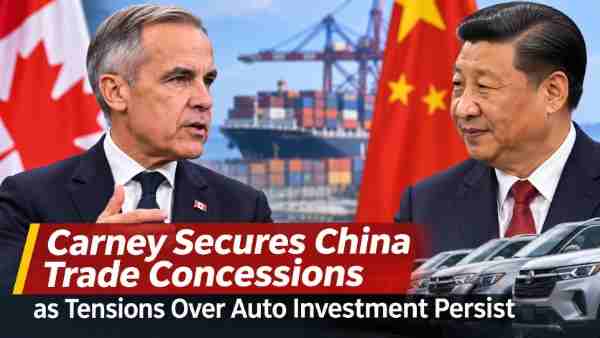
Canadian Prime Minister Mark Carney has secured additional Chinese tariff reductions covering approximately C$400 million in Canadian exports following talks with President Xi Jinping. However, disagreements over Chinese investment in Canada’s automotive industry and the future of North American manufacturing remain unresolved.
Canadian Prime Minister Mark Carney has announced a new trade arrangement with China after meeting Chinese President Xi Jinping in Shenzhen on Tuesday, November 17, 2026.
The agreement expands existing trade concessions and is expected to improve access for Canadian agricultural producers, pork exporters and seafood businesses in the Chinese market.
The announcement represents another step in Carney’s strategy to diversify Canada’s international trade relationships and reduce its heavy dependence on the United States.
However, the improving relationship between Ottawa and Beijing comes with considerable challenges. Canada’s automotive industry has become a major point of discussion, particularly as Carney considers whether Chinese manufacturers could play a larger role in Canadian vehicle production.
The issue is especially sensitive because Canada is simultaneously trying to preserve its integrated automotive manufacturing relationship with the United States.
China Agrees to Reduce Tariffs on Canadian Exports
One of the most significant outcomes of the Carney-Xi meeting was an agreement to expand the existing trade arrangement between the two countries.
Under the new measures, China will provide additional tariff relief for approximately C$400 million worth of Canadian exports annually.
The products covered include:
- Frozen Canadian pork cuts worth approximately C$116 million.
- Fish and seafood products worth approximately C$285 million.
- Certain frozen cold-water shrimp and prawns.
- Selected molluscs, including geoduck.
- Sea cucumbers and Greenland halibut.
The agreement is expected to improve the competitiveness of Canadian agricultural and seafood products in China, one of the world’s largest consumer markets.
For Canadian farmers, seafood harvesters and exporters, the reduced tariffs could create new commercial opportunities and help expand sales beyond traditional markets.
The latest arrangement builds on earlier tariff reductions negotiated during Carney’s January 2026 visit to Beijing.
Canada Makes Trade Concessions in Return
The agreement is not a one-sided arrangement.
In exchange for additional Chinese market access, Canada has agreed to extend existing tariff remission measures for certain Chinese steel and aluminium products by two years.
Ottawa will also expand the exemptions to cover 32 additional tariff items, including 23 steel products and nine aluminium products.
These exemptions apply to goods for which Canadian domestic supply is insufficient or unavailable.
The measures are designed to maintain access to industrial materials while reducing trade friction between the two countries.
Both governments have described the arrangement as part of a broader effort to establish more predictable economic relations.
Carney’s Strategy to Reduce Dependence on the United States
The agreement comes as Canada faces continuing trade uncertainty with its largest trading partner, the United States.
The Trump administration’s tariff policies have created pressure on Canadian manufacturers, agricultural exporters and businesses operating across the North American supply chain.
Carney has increasingly emphasised the importance of expanding Canada’s international trade relationships rather than relying too heavily on a single market.
China is particularly important to this strategy because of its large consumer base, industrial capacity and demand for agricultural commodities, energy and natural resources.
According to the Canadian government, bilateral merchandise trade between Canada and China reached C$125.6 billion in 2025, an increase of 5.6 per cent compared with the previous year.
Canada’s merchandise exports to China were valued at C$35.1 billion during that period.
The government says restoring market access for more than 90 per cent of Canadian exports previously affected by Chinese tariff measures represents nearly C$7.5 billion in trade.
Carney has also stated that Canada is ahead of schedule in its objective of increasing exports to China by 50 per cent by 2030.
Chinese Automotive Investment Remains a Major Disagreement
While the latest agreement improves agricultural and seafood trade, the future of China’s involvement in Canada’s automotive industry remains uncertain.
Carney has indicated that Canada could consider working more closely with Chinese automakers if negotiations with the United States fail to preserve an integrated North American automotive industry.
The Canadian prime minister has made it clear that maintaining access to the US market remains his preferred option.
However, he has also argued that Canada’s automotive workers, manufacturing facilities and industrial capabilities should not remain underutilised if North American trade arrangements become less favourable.
Chinese companies such as BYD and Geely have been expanding their international operations, while Canada has already taken steps to allow a limited number of Chinese electric vehicles into its market.
Under the January 2026 agreement, Canada reduced its 100 per cent tariff on Chinese electric vehicles to 6.1 per cent, initially allowing imports of up to 49,000 vehicles annually. The import limit is expected to increase over time.
China, in return, reduced tariffs on several Canadian agricultural products, including canola.
The latest discussions suggest that both countries are interested in expanding this relationship beyond vehicle imports towards potential manufacturing investment.
Carney Insists on Conditions for Chinese Investment
Despite expressing interest in Chinese automotive investment, Carney has emphasised that any future arrangement must protect Canadian workers and domestic manufacturing capabilities.
He has said that Chinese companies interested in establishing operations in Canada must provide quality employment opportunities rather than simply assembling vehicles using components manufactured elsewhere.
The Canadian government wants investment that strengthens the domestic supply chain, supports skilled employment and contributes to the country’s electric vehicle industry.
Carney has also stressed that negotiations with Washington will influence how far Canada opens its automotive sector to Chinese manufacturers.
This position reflects the difficult balance facing Ottawa.
Canada wants to attract international investment and diversify its economy, but closer cooperation with Chinese automakers could create additional tensions with the United States.
US Officials Raise Concerns Over Canada’s China Strategy
Carney’s comments about potentially working with Chinese automakers have already attracted criticism from officials close to the Trump administration.
US trade adviser Peter Navarro criticised the Canadian prime minister’s remarks, questioning whether Ottawa was attempting to use China as leverage in negotiations with Washington.
The criticism highlights the diplomatic sensitivity surrounding Canada’s expanding economic relationship with Beijing.
The United States and Canada have historically maintained deeply integrated automotive supply chains, with vehicles and components regularly crossing their shared border during production.
Any major shift towards Chinese manufacturing investment could complicate that relationship, particularly as Washington continues to scrutinise Chinese companies operating in strategic industries.
Canadian officials must therefore consider both the potential economic benefits of Chinese investment and the possible consequences for trade relations with the United States.
New Opportunities in Aviation, Education and Business
The Carney-Xi meeting also produced several agreements beyond tariffs and automotive manufacturing.
Air Canada plans to introduce new direct flights between Vancouver and Guangzhou beginning in May 2027. Chinese airlines are also expected to increase flight services between the two countries.
Canada has announced a major trade mission to China in 2027 to connect Canadian businesses with Chinese industry leaders.
The two countries will also organise a Canada-China Year of e-Commerce in 2027, aimed at helping Canadian small and medium-sized businesses access Chinese online marketplaces.
In education, Canada announced C$850,000 in scholarships to support 850 Canadian students studying at Chinese universities.
The two governments also welcomed agreements involving Canadian businesses, cultural organisations and universities.
These initiatives indicate that the relationship is expanding beyond traditional merchandise trade into education, technology, aviation and financial cooperation.
What the Agreement Means for Canada
The latest agreement provides Canadian exporters with additional access to one of the world’s largest markets.
For agricultural producers and seafood businesses, lower tariffs could improve competitiveness and create opportunities for higher sales.
For the Canadian government, the agreement is another step towards reducing dependence on the United States and building a more diversified international trade network.
However, the automotive issue remains unresolved.
Carney must balance the economic opportunities offered by Chinese investment against the importance of Canada’s manufacturing relationship with the United States.
The government will also need to establish clear conditions covering employment, domestic production, supply chains and industrial standards before any major expansion of Chinese automotive manufacturing takes place.
A New Phase in Canada-China Economic Relations
The meeting between Carney and Xi marks another important development in the gradual improvement of relations between the two countries.
Additional tariff reductions, expanded business cooperation and new investment opportunities suggest that both governments are interested in maintaining a more stable economic relationship.
However, closer trade ties do not automatically resolve wider disagreements involving national security, industrial policy and international diplomacy.
For Canada, the challenge is to secure new markets without damaging existing economic partnerships.
The latest agreement offers Canadian exporters additional opportunities, but the future of Chinese investment in the country’s automotive industry could become the next major test of Carney’s strategy.
Source: Reuters, The Canadian Press, Associated Press, Global News and Prime Minister of Canada’s official announcement, November 17, 2026.